
Managing Complex Event Schedules with PAC Management Software
Performing arts centers juggle more scheduling variables than any other venue type, yet most still rely on methods that guarantee chaos.
- The average PAC transforms a single space multiple times daily, from morning rehearsals to evening performances.
- Modern PAC software reduces double-booking incidents to near zero through automated conflict detection.
- Cloud-based platforms enable real-time schedule visibility across programming, production, and front-of-house teams.
- Venues using purpose-built scheduling tools report reductions in administrative time and scheduling errors.
If your calendar system can’t distinguish between a hard hold and a tentative inquiry, it’s costing you shows.
A touring Broadway production needs three days of load-in and technical rehearsals. Your resident theater company expects its usual Wednesday afternoon block. A local youth orchestra has a rental agreement for Saturday morning. And the marketing team just asked if they can host a donor reception in the lobby on Friday evening while the main stage is being set for the weekend run.
Welcome to live venue booking in the performing arts world, where scheduling isn’t just about blocking dates on a calendar. Performing arts center management is an intricate dance of competing priorities, technical requirements, and stakeholder expectations that would make your average corporate event planner weep.
The global event management software market reached $8.4 billion in 2024 and is projected to hit $17.33 billion by 2030, growing at a CAGR of 13.2%. That growth is fueled by venues recognizing that spreadsheets and sticky notes can’t handle the complexity of modern PAC operations. Performing arts center software is the solution for venues drowning in scheduling conflicts and communication breakdowns.
Why Do Performing Arts Centers Face Unique Scheduling Challenges?
The dream of having dedicated spaces for each performance or group rarely matches reality. Performing arts center management requires transforming a single space multiple times daily, accommodating everything from morning rehearsals to evening performances. This constant metamorphosis requires precision timing that generic event tools can’t provide.
Consider a typical day at a mid-sized PAC. Your daily schedule needs to account for load-in windows, technical setup periods, cleaning breaks, sound checks, and rehearsal blocks. Each element must be carefully timed to ensure smooth transitions between events. Success lies in the details of coordinating multiple users within the same space.
The morning might find you juggling a local theater company’s technical rehearsal while the education department runs a student workshop in Studio B. By afternoon, a youth orchestra has taken over the main hall for practice, and a touring production’s advance team arrives to assess the space for their evening performance. Each transition requires careful planning and clear communication among all parties involved.
Unlike corporate conference centers or hotel ballrooms, PACs deal with artistic temperaments, union regulations, technical riders that vary from one production to the next, and audience expectations that demand perfection. A double-booking at a corporate event is embarrassing. A double-booking at a performing arts center can torpedo relationships with touring companies, damage your reputation with ticket holders, and cost tens of thousands in lost revenue and potential legal complications.
What Problems Does Performing Arts Center Software Solve?
Performing arts center software addresses the disconnect between how PACs actually operate and how generic scheduling tools assume they work. When a booking comes in, basic software updates a calendar. Advanced PAC software simultaneously checks artist performance history, calculates projected revenue versus costs, updates financial projections, triggers automated follow-up sequences, alerts relevant team members, and begins generating the documentation needed for successful show execution.
A Gartner survey found that 47% of digital workers struggle to find the information needed to perform their jobs due to the proliferation of disconnected applications. Comprehensive venue management platforms consolidate these workflows into unified systems that communicate with each other.
Smart PAC software understands concepts that generic solutions don’t accommodate. It knows the difference between a first hold and a challenge. It tracks radius clause restrictions that could prevent you from booking certain artists within specific timeframes of other performances. It manages the complex web of co-promotion deals and rental agreements that define how most performing arts centers generate revenue.
How Does Conflict Detection Prevent Scheduling Disasters?
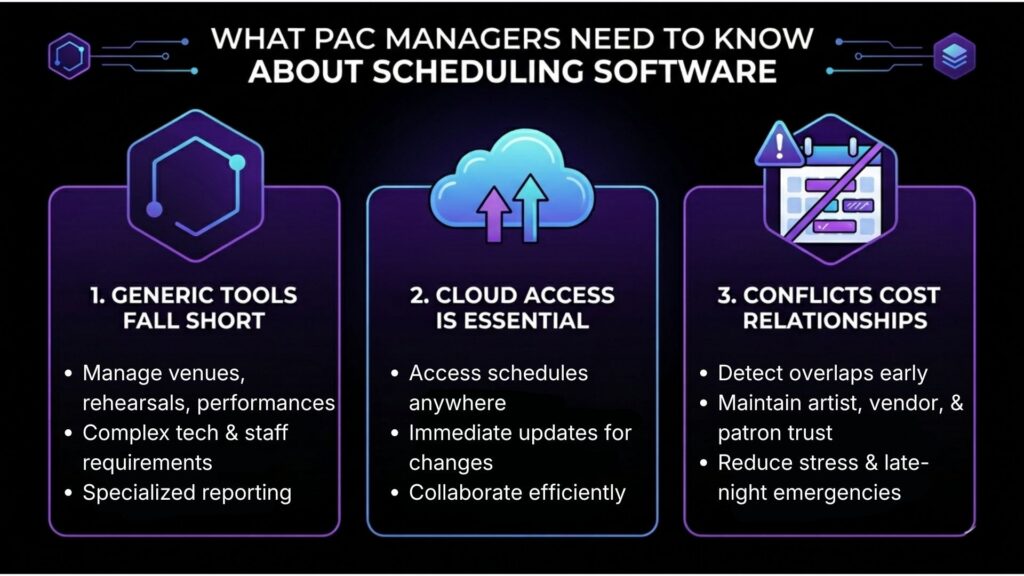
Traditional scheduling methods rely on human memory and vigilance. PAC management software uses systematic checks that never get tired, distracted, or overwhelmed during busy seasons.
Real-time conflict detection operates across multiple dimensions simultaneously. It’s not just checking whether the main theater is available. It’s verifying that the required technical crew isn’t already committed elsewhere, that the loading dock access doesn’t conflict with another production’s load-out, and that your required equipment isn’t already allocated to a different event.
The system flags potential issues before you’ve committed to anything, protecting both your relationships and your revenue. Instead of discovering a conflict when an angry production manager shows up to find another company already on stage, you catch the problem during the booking phase when it can still be elegantly resolved.
What Features Should PAC Software Include?
Not all performing arts center software delivers equal value. The difference between platforms built for serious venue operations and glorified digital calendars comes down to several critical capabilities.
Essential features for PAC scheduling success:
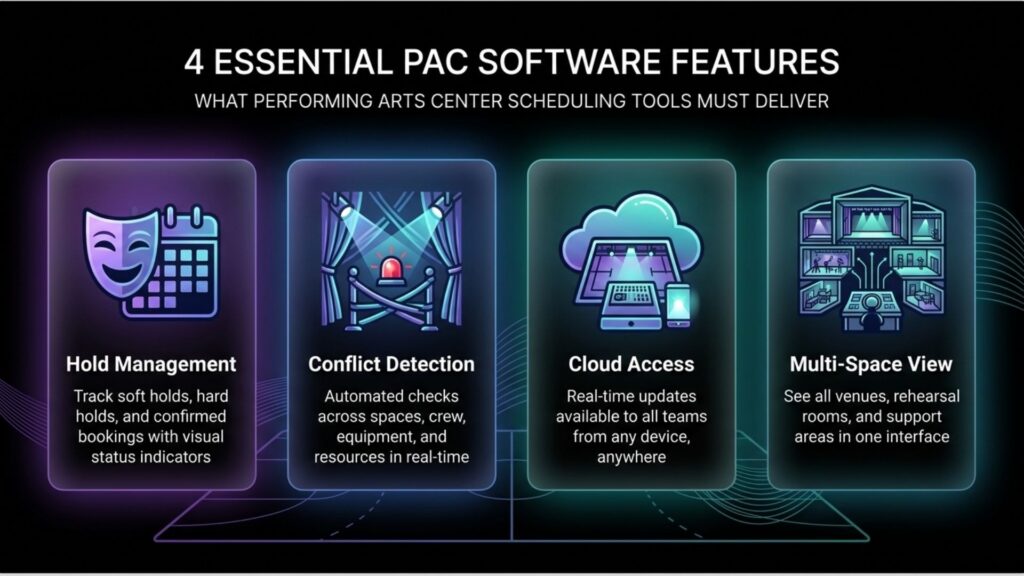
- Hold management with graduated status levels: Distinguish between soft holds, hard holds, and confirmed bookings with visual indicators that prevent premature confirmations.
- Multi-space simultaneous viewing: See availability across theaters, rehearsal spaces, lobbies, and support areas in a single interface.
- Resource allocation tracking: Monitor equipment, crew, and facility resources alongside space bookings.
- Automated conflict detection: Flag scheduling conflicts, resource overlaps, and radius clause violations before commitments are made.
- Integration with ticketing systems: Pull real-time sales data directly into your scheduling view for informed decision-making.
Modern PAC software also incorporates AI-driven scheduling assistance that can analyze historical booking patterns, suggest optimal scheduling windows based on past performance data, and predict which tentative holds are most likely to convert to confirmed bookings.
How Does Cloud-Based Access Transform PAC Operations?
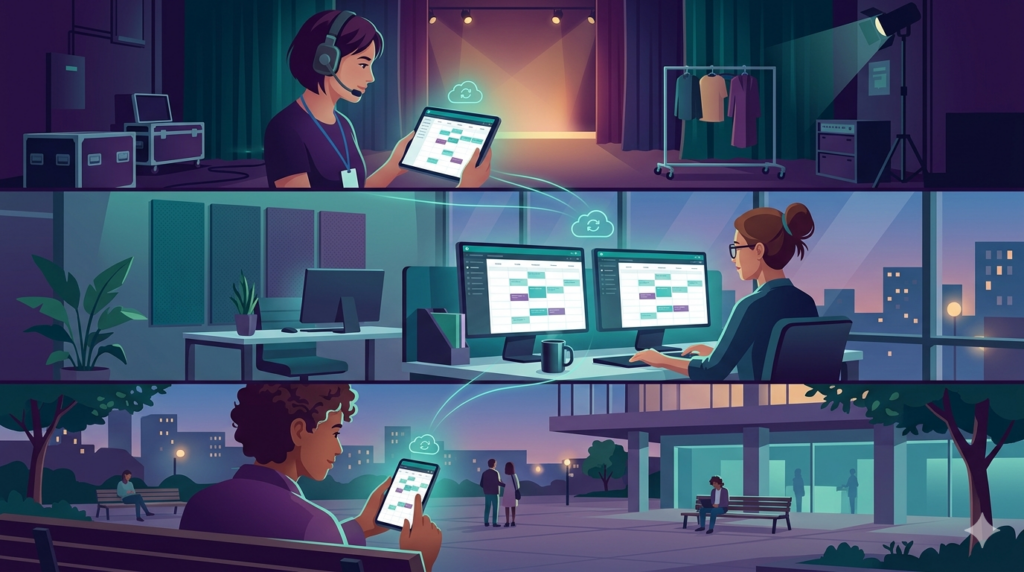
Your technical director needs to know about last-minute program changes just as much as your box office staff does. Your marketing team needs updates about upcoming events just as much as your production team does. This is where cloud-based venue scheduling becomes invaluable.
Today’s performing arts centers operate in both physical and digital spaces. Your team needs access to important information, whether they’re in the booth, at home, or on the road. Cloud-based PAC management software allows staff to access show information, technical riders, scheduling updates, and other crucial details from any device, at any time.
For example, a touring company sends updated technical requirements for next week’s show. Instead of this information sitting in one person’s email inbox, it can be immediately available to your entire technical team. Your front-of-house manager updates the running time of tonight’s performance, and this information instantly reaches your box office staff, parking attendants, and backstage crew. While boosting efficiency, this seamless communication helps prevent the kind of miscommunications that can derail an otherwise perfect event.
The cloud-based segment held the largest market share of over 63% in the event management software market in 2024, and that dominance is expected to continue. PACs can’t afford to have scheduling information trapped on a single desktop computer when decisions need to happen in real time across multiple locations and team members.
What’s the Real Cost of Poor Scheduling Systems?
Every minute spent reconciling information across disconnected systems is time not spent on relationship-building with artists, promoters, and community partners.
Consider the ripple effects of a single scheduling error. A double-booked rehearsal space doesn’t just inconvenience one group. It damages your reputation with both parties, potentially affects their performance quality, strains your staff who must manage the crisis, and consumes administrative time that should have been spent on revenue-generating activities.
Poor scheduling systems also create opportunity costs that never show up on a balance sheet. When your booking calendar can’t quickly show available dates alongside historical performance data, you’re making decisions with incomplete information. You might pass on a touring show that would have sold out or accept a booking that historically underperforms in your market.
The venues that thrive have eliminated the repetitive, time-consuming tasks that bog down traditional operations. PAC software creates space for the strategic thinking and relationship building that actually grow your business.
How Do You Choose the Right PAC Software Solution?
When looking for performing arts center software, prioritize industry-specific functionality over generic feature lists. A platform built for wedding venues or corporate conference centers will misunderstand how your PAC operates.
Look for solutions developed by teams with actual performing arts experience. They’ll understand why your hold system needs multiple status levels, why settlement processes must integrate with booking data, and why technical advancement documents require specific formatting that touring companies expect.
Integration capabilities matter. Your PAC software should communicate with your ticketing platform, accounting system, and marketing tools. The goal is a unified information ecosystem where data entered once flows appropriately to all relevant systems without manual re-entry.
Scalability considerations should match your venue’s trajectory. A community theater’s needs differ from a multi-venue performing arts complex, but growth potential matters. The platform you choose should accommodate expanded operations without requiring a complete system replacement.
Finally, evaluate support and training resources. The most powerful software becomes useless if your team can’t effectively implement it. Look for vendors who understand the performing arts world and can provide onboarding that addresses your specific operational workflows.
FAQ
What is performing arts center software? Performing arts center software is specialized venue management technology designed to handle the unique scheduling, financial, and operational requirements of theaters, concert halls, and multi-use cultural facilities. Unlike generic event management tools, PAC software understands industry-specific concepts like hold management, technical riders, settlement procedures, and the complex stakeholder relationships that define performing arts operations.
How does PAC software prevent double-bookings? Modern PAC software uses real-time conflict detection that simultaneously checks availability across multiple dimensions, including space, equipment, crew, and loading dock access. The system flags potential conflicts during the booking process rather than after commitments have been made, protecting relationships and preventing costly scheduling disasters.
Can PAC management software handle multiple venues? Yes, robust PAC software is designed to manage complex operations across multiple spaces, including main theaters, rehearsal halls, lobbies, studios, and outdoor areas. Multi-space viewing allows administrators to see availability and conflicts across all venues simultaneously while maintaining separate booking protocols for each space.
What’s the difference between PAC software and generic event management tools? Generic event management platforms treat all events similarly and lack understanding of performing arts-specific workflows like graduated hold systems, co-promotion deals, technical advancement processes, and settlement procedures. PAC software is built specifically for venues that present live performances and understands the unique operational requirements of that environment.
Schedule Your Next Season with Confidence
The performing arts world moves fast, and the venues that succeed match operational excellence with artistic vision. Modern PAC management software transforms the chaos of complex scheduling into a streamlined system that protects your relationships, maximizes your facility utilization, and frees your team to focus on creating unforgettable experiences for your audiences.
Prism provides performing arts centers with comprehensive venue management solutions built by live entertainment professionals who understand the unique demands of cultural venues. Get started with Prism today to eliminate scheduling headaches and run your PAC with confidence.

Matt Ford is the founder and CEO of Prism.fm, a platform built to help the live music industry operate with more clarity and confidence. After 15+ years running venues, producing festivals, and promoting shows, Matt saw firsthand how much of the business relied on fragmented tools and guesswork. He founded Prism in 2018 to change that.
Today, Prism powers more than 3,000 venues and 330 organizations nationwide, serving as an all-in-one platform designed to streamline operations by replacing cumbersome spreadsheets with integrated tools for booking, financial tracking, and contract management. Matt has also led the development of Insights, Prism’s demand prediction platform, which uses real, verified ticketing data to help teams better understand artist performance and make smarter decisions before committing to a show.
Related Post
Choosing the Right Live Music Management Software for Your Venue
The U.S. live music market is projected to exceed $19 billion in 2026, yet many venues still manage operations with spreadsheets and disconnected systems that cost them time, money, and sanity. If your current process…
Maximizing Live Event Marketing Software for Concert Promotion
Specialized live event marketing software separates packed houses from empty rooms by giving concert promoters the data, automation, and integration they need to run smarter campaigns. If your promotional workflow still relies on disconnected platforms…
How Event Management Software Simplifies Calendar and Roster Management
The operational chaos killing live music businesses isn’t a talent problem; it’s a systems problem. If you’re still running your operation on spreadsheets and scattered calendars, you’re leaving money on the table. The U.S. live…