
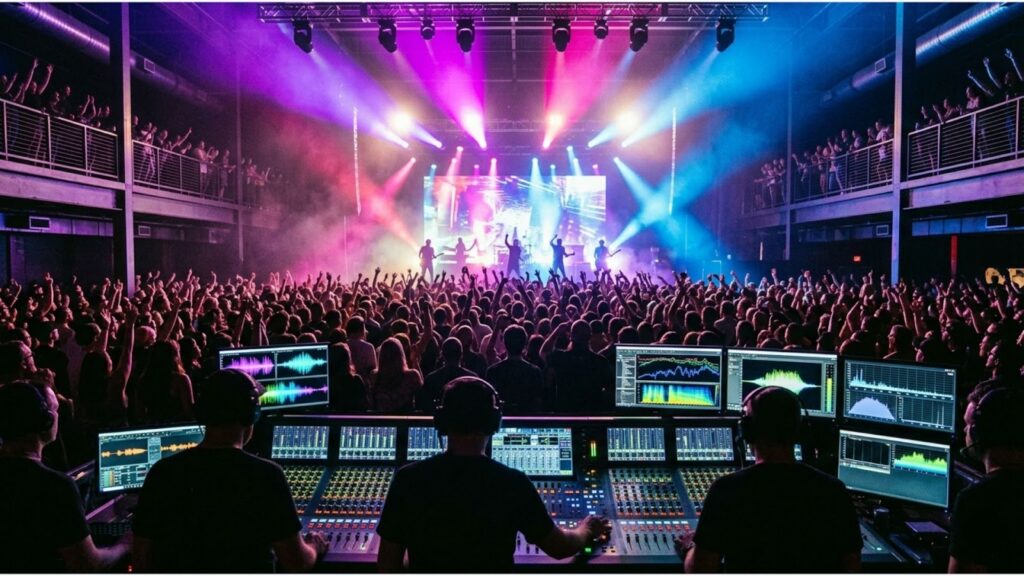
Maximizing Live Event Marketing Software for Concert Promotion
Specialized live event marketing software separates packed houses from empty rooms by giving concert promoters the data, automation, and integration they need to run smarter campaigns.
- The U.S. live music market reached $18.51 billion in revenue in 2025, with projections climbing toward $19.7 billion in 2026.
- Generic marketing platforms lack the industry-specific features that connect ticket sales, audience behavior, and campaign performance in real time.
- Promoters using integrated event promotion tools save time and achieve higher ROI on marketing spend.
If your promotional workflow still relies on disconnected platforms and manual tracking, you’re leaving money on the table and burning hours you don’t have.
Concert promoters operate in a world where timing is everything and margins are unforgiving. Live music professionals are facing a market that demands precision, speed, and the ability to pivot on a dime. With the U.S. live music industry achieving 6.45% growth, the opportunity is massive, but so is the competition. The promoters consistently filling rooms aren’t necessarily the ones with the biggest budgets. They’re the ones leveraging live event marketing software to work smarter, target better, and execute campaigns that convert to ticket sales.
Marketing a concert isn’t like a product launch or a corporate conference. The timeline is compressed, the stakes are immediate, and your audience’s decision to buy happens in a split second. Generic marketing platforms don’t understand holds versus confirms, radius clauses, or why a Tuesday announcement might tank your Thursday on-sale. The right event promotion tools change the game by connecting every piece of your promotion into a single, actionable system.
Why Does Concert Promotion Require Live Event Marketing Software?
The live music industry operates on logic that doesn’t translate to other sectors. Concert promotion lives in the gray area between confirmed and hopeful. You might be marketing a show that’s still technically on a soft hold, building anticipation for an artist whose routing could change next week, or trying to move tickets for a mid-week date that historically underperforms. Standard marketing automation tools treat every campaign like a static target. Live event marketing software understands that your target is constantly moving.
The complexity multiplies when you factor in the relationships that make live music work. Promoters are maintaining credibility with agents, coordinating with venues, managing sponsor expectations, and sometimes splitting responsibilities with co-promoters. Each of these relationships generates data that should inform your marketing decisions, but only if your tools can actually connect that information.
The Data Gap Most Promoters Don’t Know They Have
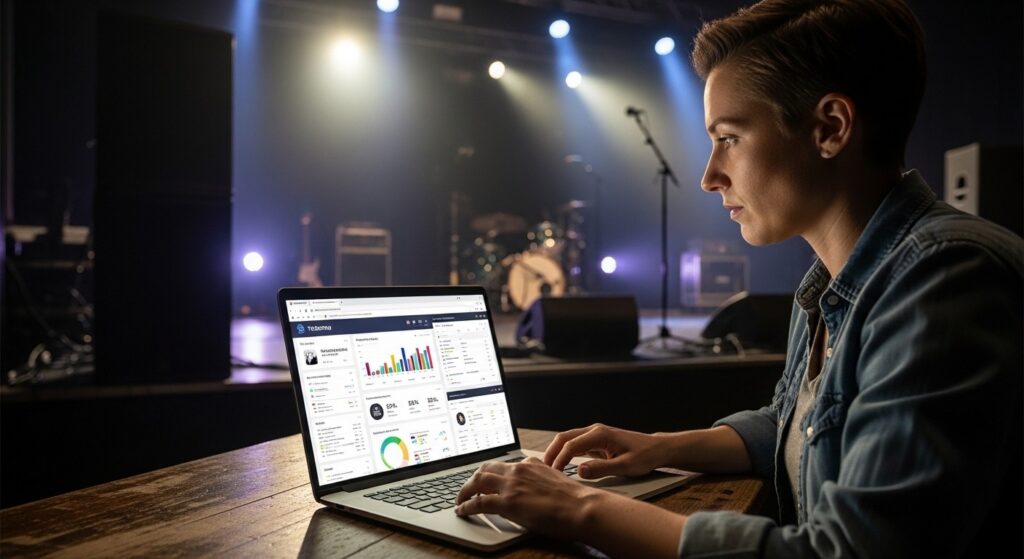
Without integrated promoter marketing tools, you run a campaign, watch the engagement metrics, and feel pretty good about the reach. Meanwhile, your ticketing platform shows slow sales, but you can’t directly connect which campaigns drove which purchases. You’re flying partially blind, making decisions based on incomplete information, and hoping your gut is right.
The promoters pulling ahead use software that connects campaign performance to actual ticket sales in real time. When they see a spike in conversions, they know exactly which creative, platform, and audience segment delivered. When something isn’t working, they catch it early enough to pivot instead of finding out after the show that their ad spend was wasted.
What Features Define Effective Live Music Marketing Software?
Effective event management software for concert promotion functions as a command center that connects every aspect of your operation to your promotional strategy.
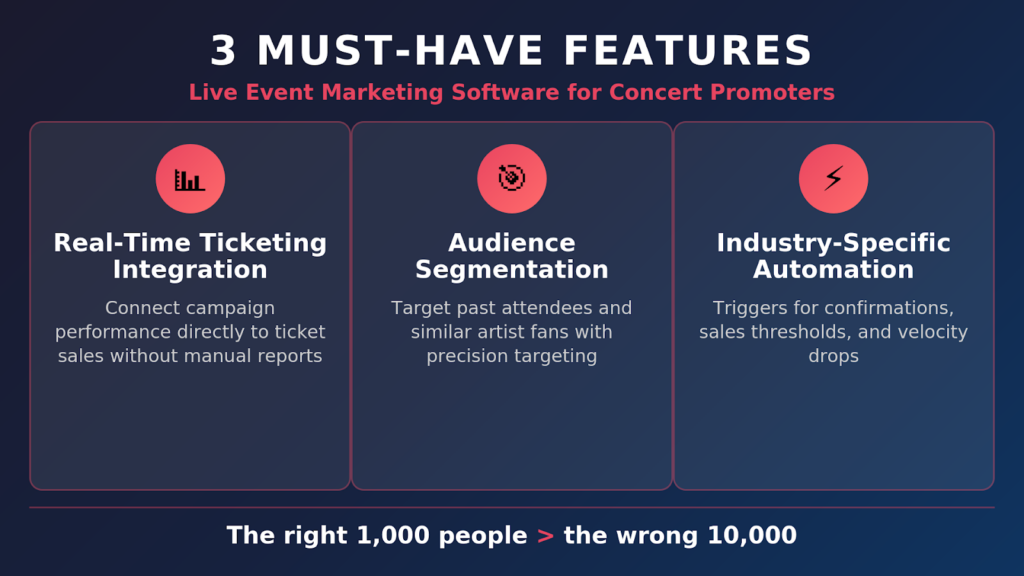
Real-time ticketing integration sits at the core. Your marketing platform should automatically pull live sales data, allowing you to see exactly how campaigns impact purchases without switching between systems or waiting for manual reports.
Audience segmentation capabilities let you target past attendees, fans of similar artists, or people who engaged with previous events but didn’t convert. The more granular your targeting, the less money you waste showing ads to people who were never going to buy. Modern event promotion strategies prioritize reaching the right 1,000 people over blasting the wrong 10,000.
Automation That Fits Your Workflow
Marketing automation sounds great until you realize most platforms automate the wrong things for live music. You don’t need a drip campaign designed for e-commerce. You need automated triggers tied to industry-specific events: the moment a show is confirmed, when tickets hit a certain threshold, when an artist posts about the tour, or when sales velocity drops below expectations.
The automation features that matter for concert promoters include:
- Announcement sequences that fire across all channels the moment a show moves from hold to confirmed
- Dynamic pricing alerts that adjust promotional messaging based on ticket availability
- Countdown campaigns that escalate urgency as show dates approach
- Post-purchase follow-ups that build your database for future events
- Re-engagement triggers for fans who browsed but didn’t buy
Each of these automations should connect directly to your booking and event management system. If you’re manually initiating campaigns every time a show gets confirmed, you’re losing precious hours and potentially missing the optimal announcement window.
How Do You Build a Marketing Stack That Delivers Results?
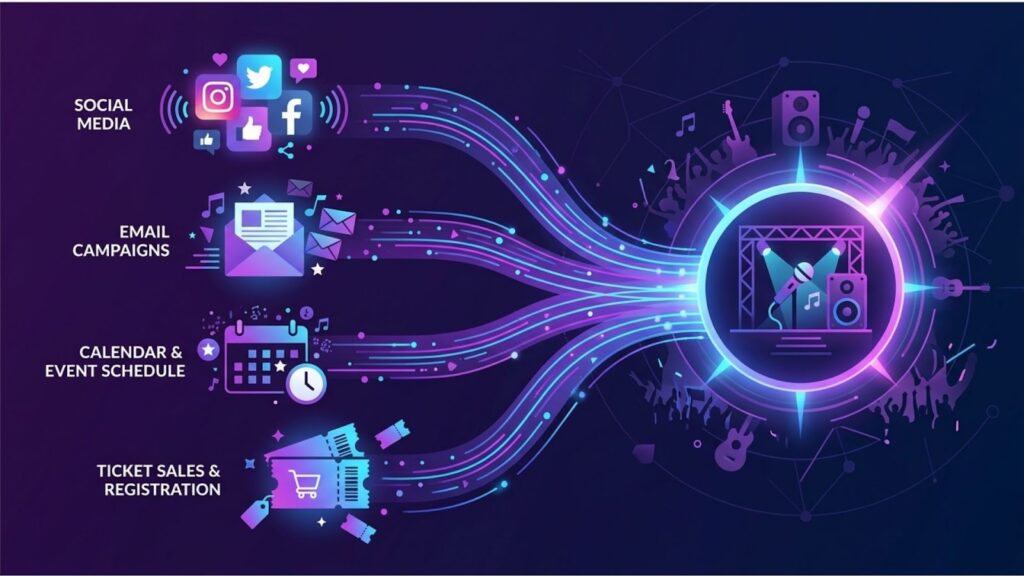
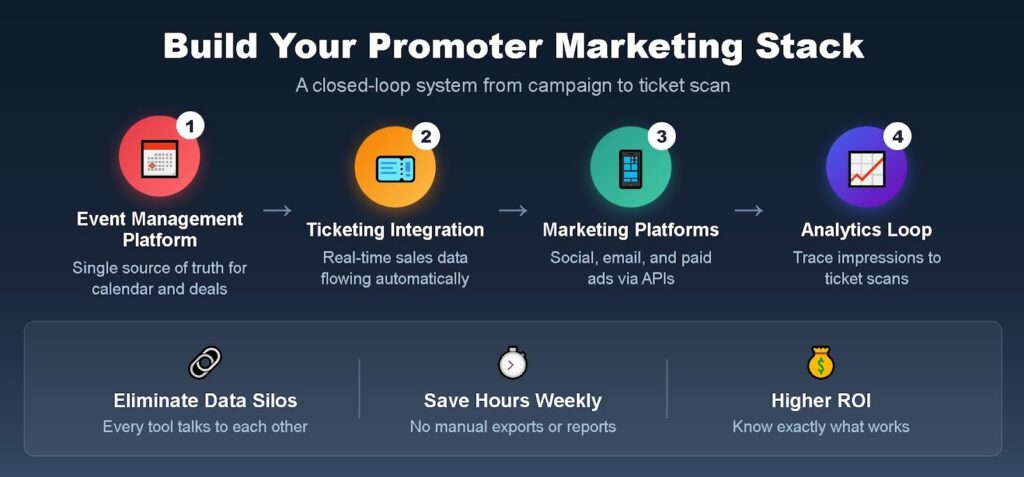
Successful promoters choose platforms that actually talk to each other and eliminate the gaps where data gets lost.
Start with your core event management platform. This software should be the single source of truth for your calendar, deals, financial projections, and settlement data. Every marketing tool you add should integrate with this core system. If integration isn’t possible, you’re creating data silos that will eventually cost you money and clarity.
Your ticketing platform comes next, and the integration with your event management system is non-negotiable. Real-time ticket data needs to flow automatically into your operational dashboard and marketing analytics. Manual exports and delayed reports create blind spots that smart competitors will exploit. The best promoter marketing tools handle this connection seamlessly.
Social media management, email marketing, and paid advertising platforms round out the stack. These should connect to your central system through APIs or native integrations. The goal is to create a closed loop where every campaign can be traced from initial impression to final ticket scan.
Avoiding the Tool Overload Trap
Promoters sometimes accumulate platforms over time, adding a new tool for every problem without considering how they’ll work together. Teams end up spending more time switching between apps than executing campaigns.
Audit your current stack with a simple question: Does each tool connect to your core event and ticketing systems? If not, evaluate whether the tool’s benefits outweigh the manual work required to bridge the gap. Often, a slightly less feature-rich tool with strong integration delivers better results than a powerful platform that operates in isolation.
What Mistakes Derail Concert Marketing Campaigns?
Even with solid technology, concert promotion campaigns fail for predictable reasons. Recognizing these patterns helps you avoid the same traps that sink competitors.
Starting too late is the most common error. Concert promotion isn’t like launching a product where you can extend timelines. Your show date is fixed, and every day of delayed marketing is a lost opportunity. Effective promoters begin building anticipation the moment a show is realistic, not the moment it’s confirmed. Social media marketing works best with longer runways that create genuine buzz rather than frantic last-minute pushes.
Ignoring your existing audience costs more than you realize. Acquiring new customers always costs more than retaining existing ones, and this principle hits harder in live music. Your past ticket buyers already know your venue, trust your curation, and are predisposed to attend again. Yet many promoters spend the bulk of their budgets on cold acquisition while neglecting the warm audience sitting in their database.
The Analytics Avoidance Problem
Some promoters treat marketing analytics as optional reading material, glancing at dashboards without making decisions based on the data. This tactic wastes the primary advantage that live event marketing software provides.
Every campaign generates information that should influence your next move. If Instagram Stories outperform feed posts for a particular demographic, shift your creative resources accordingly. If email open rates spike on Thursday mornings, schedule your announcements to hit inboxes then. If paid social drives traffic but not conversions, the problem might be your landing page rather than your targeting.
The promoters seeing the best results treat their software as a feedback mechanism, not just a broadcast tool. They test, measure, adjust, and iterate, treating each campaign as an experiment that informs the next one.
What Does the Future Hold for Event Promotion Technology?
AI-driven tools now predict demand patterns, suggest optimal pricing, and generate creative variations for testing. Advanced market research tools help promoters anticipate audience preferences based on historical behavior and comparable events.
Virtual and hybrid event components are becoming standard features. Promoters using software that supports livestream ticketing, virtual meet-and-greets, and hybrid attendance models can tap additional revenue streams while expanding their geographic reach.
Privacy regulations and platform changes will continue reshaping digital advertising. First-party data, the information you collect directly from your audience, becomes more valuable as third-party tracking becomes less reliable. Your event management software should make it easy to build, segment, and activate your owned audience data.
The promoters who thrive will be those who treat technology as a competitive advantage rather than a necessary evil. They’ll invest in platforms that grow with their operations, integrate cleanly with their existing workflows, and provide the real-time visibility needed to make smart decisions under pressure.
Frequently Asked Questions
What’s the difference between live event marketing software and general marketing platforms?
Live event marketing software is built for the specific workflows and timelines of concert promotion. It understands concepts like holds, on-sale dates, and radius clauses that generic platforms ignore. More importantly, it integrates with ticketing systems and event management platforms to provide real-time data that general marketing tools can’t access. This integration lets you connect campaign performance directly to ticket sales rather than guessing which efforts drove results.
How much should independent promoters budget for marketing software?
Budget varies based on operation size, but the right question is ROI rather than absolute cost. Software that saves you 10 hours per week on manual tasks and increases campaign effectiveness by even a modest percentage typically pays for itself quickly. Many platforms offer tiered pricing that scales with your event volume, making enterprise-level tools accessible to smaller operations. Focus on platforms that integrate with your existing ticketing and event management systems to avoid paying for features you can’t fully utilize.
Can marketing software help with co-promoted shows?
Yes, and this is an area where live music-specific platforms excel. Effective event promotion tools allow you to track shared campaigns, allocate expenses appropriately, and maintain clear records for settlement. When multiple parties share promotional responsibilities, having a single system that tracks each contribution prevents disputes and ensures everyone can see the same performance data.
Take Control of Your Concert Marketing
The gap between struggling promoters and thriving ones comes down to operational infrastructure. Venues and promoters still running on disconnected systems are working harder while achieving less, spending hours on manual tasks that integrated software handles automatically.
Prism gives live music professionals the all-in-one platform designed for the complexity of concert promotion and event management. From booking through settlement, every piece connects, creating the foundation that effective marketing requires. Get started with Prism and see what integrated event management can do for your bottom line.

Matt Ford is the founder and CEO of Prism.fm, a platform built to help the live music industry operate with more clarity and confidence. After 15+ years running venues, producing festivals, and promoting shows, Matt saw firsthand how much of the business relied on fragmented tools and guesswork. He founded Prism in 2018 to change that.
Today, Prism powers more than 3,000 venues and 330 organizations nationwide, serving as an all-in-one platform designed to streamline operations by replacing cumbersome spreadsheets with integrated tools for booking, financial tracking, and contract management. Matt has also led the development of Insights, Prism’s demand prediction platform, which uses real, verified ticketing data to help teams better understand artist performance and make smarter decisions before committing to a show.
Related Post
Live Music Management Software: How to Replace Spreadsheets for Booking & Scheduling
Getting off spreadsheets isn’t a decision problem anymore. It’s an execution problem, and many teams botch the execution. Pick your cutover date before you pick your platform, and work backward from it. Your calendar lives…
Managing Complex Event Schedules with PAC Management Software
Performing arts centers juggle more scheduling variables than any other venue type, yet most still rely on methods that guarantee chaos. If your calendar system can’t distinguish between a hard hold and a tentative inquiry,…
Choosing the Right Live Music Management Software for Your Venue
The U.S. live music market is projected to exceed $19 billion in 2026, yet many venues still manage operations with spreadsheets and disconnected systems that cost them time, money, and sanity. If your current process…