

How Event Management Software Simplifies Calendar and Roster Management
The operational chaos killing live music businesses isn’t a talent problem; it’s a systems problem.
- Modern event management software eliminates double-bookings, manual data entry, and communication breakdowns that cost venues thousands annually.
- Centralized platforms give teams real-time visibility across rosters, calendars, and financial data from any device.
- Automation handles the grunt work, so your team can focus on booking better shows and building relationships.
If you’re still running your operation on spreadsheets and scattered calendars, you’re leaving money on the table.
The U.S. live music market reached $18.51 billion in 2025, and the competition for quality dates, artists, and venues has never been fiercer. Yet many booking agents, venue managers, and promoters still rely on fragmented systems that weren’t built for live music.
Generic calendar apps and project management tools miss the nuances that define this industry. They don’t understand holds versus confirms. They can’t calculate settlement sheets. They have no concept of radius clauses or co-promotion splits. Talented professionals waste hours on administrative tasks that purpose-built software handles automatically.
Event management software designed for live music centralizes every moving piece of your operation. From initial holds through final settlement, the right platform creates a single source of truth that keeps your entire team aligned and your business running efficiently.
How Does Event Management Software Transform Calendar Operations?
Calendar management in live music involves far more than blocking dates. You’re juggling multiple rooms, tracking hold priorities, coordinating with agents across time zones, and ensuring that one confirmed show doesn’t create conflicts with radius clauses affecting three other potential bookings.
Advanced event scheduling tools provide real-time visibility across your entire operation. When an agent calls about a date, you can immediately see availability, check for conflicts, and place a hold without fumbling through multiple systems or waiting for team members to respond to emails.
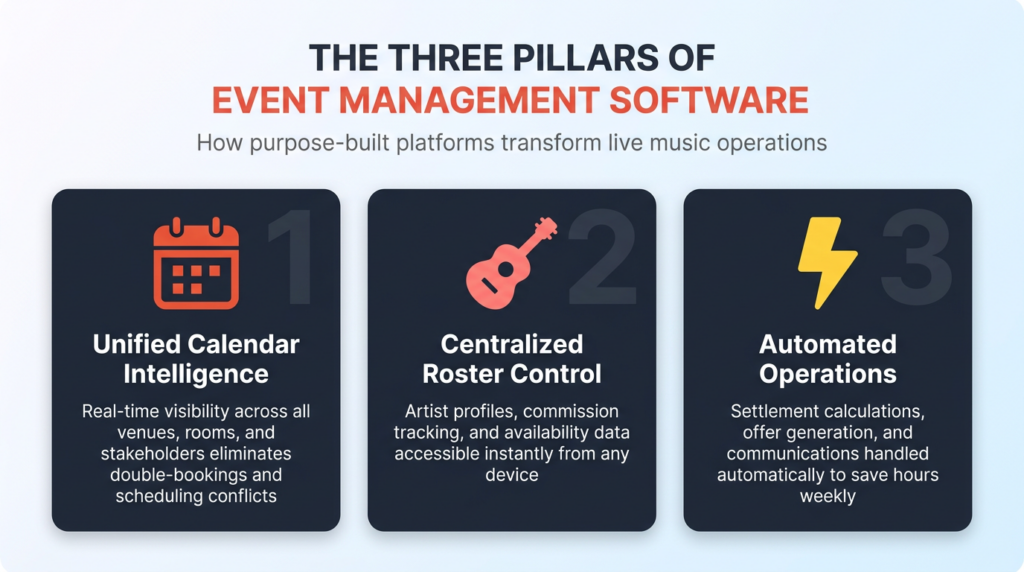
Real-Time Availability and Conflict Detection
The best platforms sync calendars in real time across all stakeholders. When someone places a hold on Stage A for March 15th, everyone with access sees that change immediately. No more calling the office to check availability. No more accidentally double-booking because someone forgot to update the shared spreadsheet.
Automated conflict detection flags potential issues like radius clause violations, production conflicts between rooms, and scheduling overlaps that manual processes inevitably miss. This level of calendar intelligence prevents costly mistakes before they happen.
Multi-Venue and Multi-Room Coordination
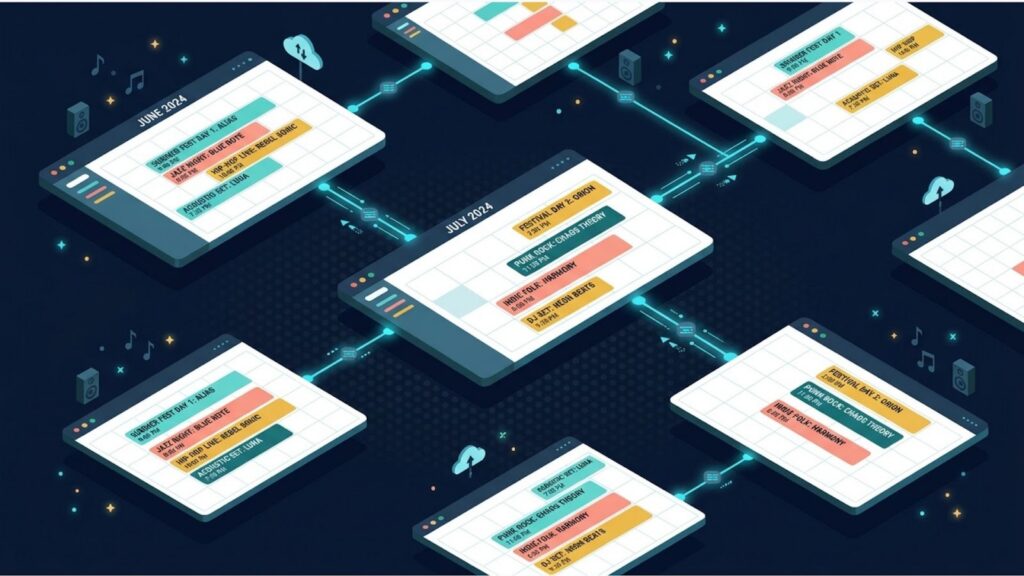
Operators managing multiple venues or rooms face exponentially more complexity. Event management software provides a bird’s-eye view of availability across all locations, making it easy to identify open dates, coordinate schedules, and optimize routing for touring artists.
Filtering capabilities let you drill down to specific venues, stages, or time periods as needed. Want to see only confirmed shows at your main room for Q3? Two clicks. Need to review all holds placed in the last week across three venues? Done. This flexibility transforms how teams approach scheduling decisions.
What Makes Roster Management Software Essential for Agencies?
Booking agents live and die by their ability to manage multiple artists without dropping balls. Each artist on your roster has their own calendar, availability constraints, touring preferences, and financial arrangements. Multiply that complexity across dozens of artists, and you understand why roster management software isn’t optional anymore.
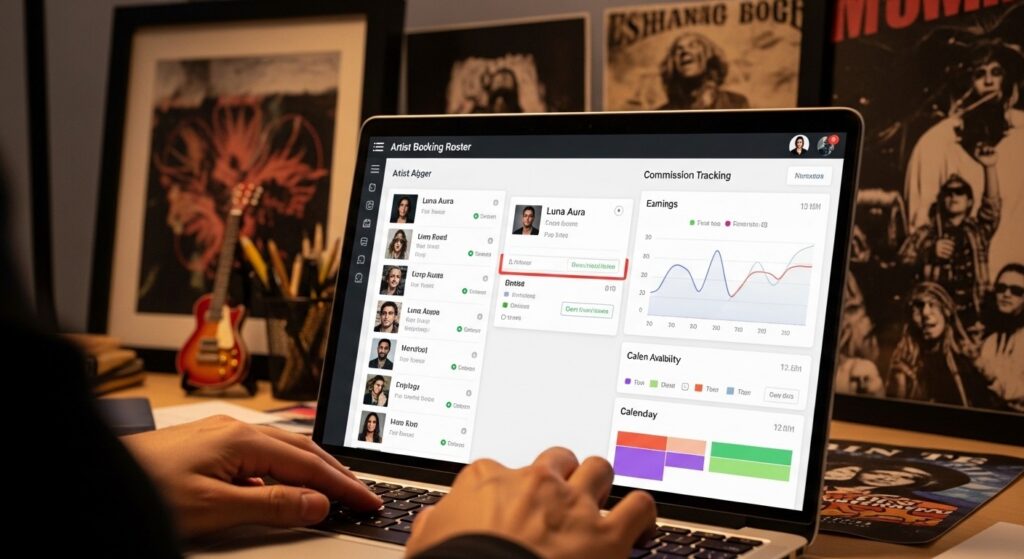
Industry-specific platforms consolidate everything about your roster into one accessible system. Artist profiles house contact information, commission structures, rider requirements, and performance history. When an opportunity comes in, you can quickly assess which artists are available, appropriate for the venue, and interested in the market.
Centralized Artist Profiles and Data
Roster management software eliminates scattered information. Instead of hunting through emails for an artist’s tech rider or digging through files for their preferred guarantee structure, everything lives in one place. Team members can access what they need instantly from any device without interrupting colleagues.
Commission tracking becomes automatic rather than a monthly headache. As shows confirm and settle, the software calculates agency and agent commissions based on predetermined structures. This accuracy and transparency strengthen relationships with artists and simplify year-end accounting.
Filtering and Visibility Controls
Managing a roster requires seeing both the big picture and granular details. Good platforms let you filter calendars by individual artist, showing only their confirmed dates, pending offers, and availability windows. This focused view makes it easier to identify gaps in touring schedules where additional shows could fit.
Privacy controls matter too. You want team members to see relevant information while keeping sensitive financial details appropriately restricted. Customizable permissions ensure the right people access the right data without overexposing confidential arrangements.
5 Essential Features in Event Scheduling Tools
When evaluating event management software, certain capabilities separate professional-grade platforms from glorified digital calendars. Here’s what actually matters for live music operations:
- Integrated Hold Management – The platform should automatically track hold levels, expiration dates, and priorities. When a first hold expires or converts to a confirm, the system should notify relevant parties and update availability accordingly.
- Ticketing Platform Integration – Real-time ticket sales data flowing into your calendar events provides context for decision-making. Seeing that a show is pacing ahead of projections or struggling against a nearby competing event changes how you approach future bookings.
- Mobile Accessibility – The live music industry doesn’t pause for business hours. Event scheduling tools that work fully on mobile devices let you manage operations from festival grounds, airport lounges, or artist green rooms without sacrificing functionality.
- Financial Dashboard Integration – The best platforms connect scheduled events directly to budgets, actual expenses, and revenue tracking, giving you a complete picture of each show’s financial health.
- Shared Calendar Publishing – Selectively sharing availability with agents, promoters, or partner venues speeds up the booking process. They can see what dates are open and place holds directly, eliminating back-and-forth communication delays.
How Does Automation Reduce Administrative Burden?
Manual processes don’t scale. As your operation grows, the administrative tasks that seemed manageable with ten shows a month become overwhelming at fifty. Event management software automates the repetitive work that consumes valuable time.
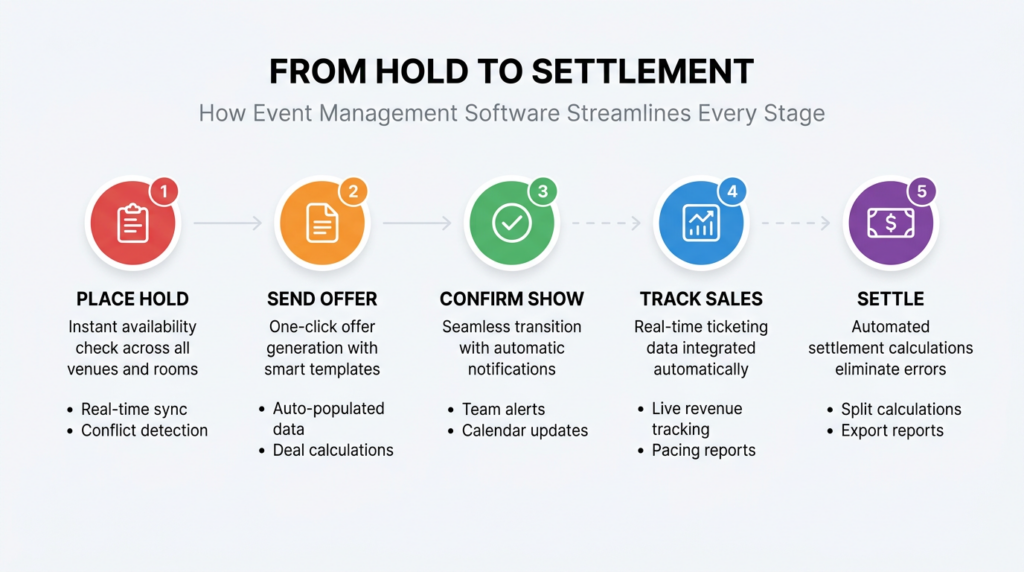
Offer generation is a prime example. Rather than building each offer from scratch, the right platform lets you create templates that populate automatically with venue-specific details, artist information, and calculated projections. One-click offer creation turns a 30-minute task into a 30-second one.
Automated Communications and Notifications
Following up on holds, sending reminders about pending contracts, and notifying team members about schedule changes shouldn’t require manual effort. Automation handles these communications, ensuring nothing falls through the cracks during busy periods.
Smart notification systems alert the right people at the right times. When a deposit comes due, the relevant team member gets a reminder. When a show confirms, everyone who needs to know receives an update. Consistent communication improves coordination without adding to anyone’s workload.
Settlement and Financial Automation
Settlement calculations are where errors become expensive. Complex deal structures involving guarantees, percentages, co-promotion splits, and various deductions create ample opportunity for mistakes. Automated settlement features eliminate these risks by handling the math accurately every time.
The software pulls in actual ticket sales, recorded expenses, and deal terms to automatically generate settlement sheets. No more staying up late reconciling numbers or discovering errors after checks have been cut. Accuracy improves relationships with artists and agents while protecting your bottom line.
What Should You Look for When Choosing Event Management Software?
Venue managers have different needs than booking agents, and festival producers face challenges that club operators never encounter. Evaluating options against your specific requirements prevents expensive mistakes.
Start with the core functionality. Does the system handle holds and confirms the way your business operates? Can it manage the deal structures you actually use, whether flat guarantees, door deals, or complex hybrid arrangements? If the platform can’t support your workflows, fancy additional features won’t matter.
Industry-Specific vs. Generic Solutions
Generic project management tools and calendar apps lack the music industry context that makes specialized software valuable. They don’t understand settlement sheets, radius clauses, or why you need to track both estimated and actual ticket counts. Every workaround you create to compensate for missing functionality adds friction to your operations.
Platforms built by live music professionals eliminate these gaps. The terminology matches how you actually talk about bookings. The workflows align with industry-standard processes. The reports provide metrics that matter for your business decisions.
Integration Capabilities
Your event management software needs to connect with the other tools your business relies on. Ticketing platforms, accounting systems, and communication tools should integrate to prevent duplicate data entry and ensure information stays synchronized.
Evaluate both available integrations and the quality of those connections. A platform that technically connects to your ticketing system but requires manual syncing or provides limited data transfer creates more problems than it solves. Look for deep integrations that actually automate workflows.
How to Maximize Revenue Through Better Scheduling Intelligence
Data is a strategic asset that informs better booking decisions and revenue optimization.
Historical performance data reveals patterns that intuition might miss. Which nights of the week generate the highest per-caps at your venue? What genres consistently exceed projections? How do shows perform when scheduled against competing events in your market? Answers to these questions help you book smarter and price more accurately.
Reporting capabilities vary between platforms. The best tools provide customizable dashboards that track the metrics most relevant to your operation, whether that’s show profitability, agent performance, or seasonal trends. Data-driven decisions compound over time, creating sustainable competitive advantages.
FAQ
What is event management software for live music? Event management software is a specialized platform that helps venues, promoters, and booking agents manage calendars, artist rosters, contracts, settlements, and financial tracking in one centralized system. Unlike generic calendar or project management tools, these platforms understand industry-specific workflows like hold management, co-promotion deals, and settlement calculations.
How does roster management software help booking agents? Roster management software consolidates all artist information (calendars, commission structures, contact details, and performance history) into one accessible platform. Agents can quickly view availability across their entire roster, filter by individual artists, and manage bookings without juggling multiple spreadsheets or disconnected systems.
What features should I prioritize in event scheduling tools? Prioritize real-time calendar sync, automated conflict detection, integrated hold management, mobile accessibility, and ticketing platform integration. These features address the most common pain points in live music scheduling while providing the visibility needed for informed decision-making.
Can event management software integrate with my ticketing platform? Most professional event management platforms offer integrations with major ticketing providers. These connections automatically import ticket sales data, eliminating manual entry and providing real-time revenue tracking. Verify that your preferred platform supports the specific ticketing systems you use before committing.
How quickly can teams implement new event management software? Implementation timelines vary based on operation complexity and data migration needs. Most teams can begin using core calendar and booking features within days, with full adoption including historical data and integrations, typically taking two to four weeks. Quality platforms provide onboarding support to accelerate the transition.
Build Your Tech Stack for Long-Term Success
The global event management software market is projected to reach $17.33 billion by 2030, reflecting the industry’s recognition that technology investments drive real business results. Two-thirds of venue operators invested in technology upgrades in 2025, and that trend shows no signs of slowing.
Choosing the right platform positions your operation for growth. As you add venues, artists, or shows, the system should scale with you rather than becoming a bottleneck. Cloud-based solutions ensure your team can access critical information regardless of location, supporting the distributed nature of live music.
Prism delivers the comprehensive event management software that live music professionals need to eliminate chaos and operate at their best. From calendar management to settlement automation, we provide one platform for your entire operation. Get started with Prism and see the difference purpose-built software makes.

Matt Ford is the founder and CEO of Prism.fm, a platform built to help the live music industry operate with more clarity and confidence. After 15+ years running venues, producing festivals, and promoting shows, Matt saw firsthand how much of the business relied on fragmented tools and guesswork. He founded Prism in 2018 to change that.
Today, Prism powers more than 3,000 venues and 330 organizations nationwide, serving as an all-in-one platform designed to streamline operations by replacing cumbersome spreadsheets with integrated tools for booking, financial tracking, and contract management. Matt has also led the development of Insights, Prism’s demand prediction platform, which uses real, verified ticketing data to help teams better understand artist performance and make smarter decisions before committing to a show.
Related Post
Managing Complex Event Schedules with PAC Management Software
Performing arts centers juggle more scheduling variables than any other venue type, yet most still rely on methods that guarantee chaos. If your calendar system can’t distinguish between a hard hold and a tentative inquiry,…
Choosing the Right Live Music Management Software for Your Venue
The U.S. live music market is projected to exceed $19 billion in 2026, yet many venues still manage operations with spreadsheets and disconnected systems that cost them time, money, and sanity. If your current process…
Maximizing Live Event Marketing Software for Concert Promotion
Specialized live event marketing software separates packed houses from empty rooms by giving concert promoters the data, automation, and integration they need to run smarter campaigns. If your promotional workflow still relies on disconnected platforms…