
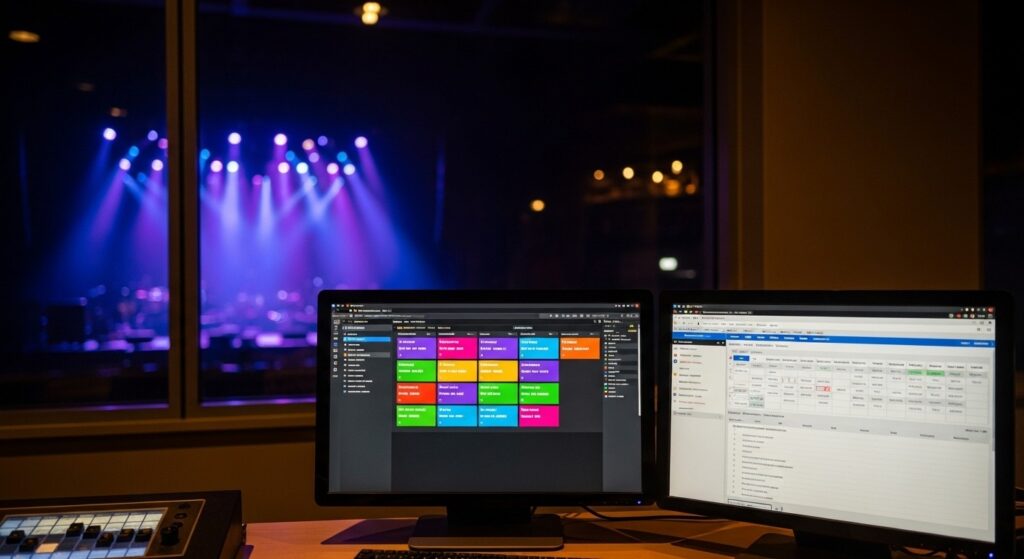
Choosing the Right Live Music Management Software for Your Venue
The U.S. live music market is projected to exceed $19 billion in 2026, yet many venues still manage operations with spreadsheets and disconnected systems that cost them time, money, and sanity.
- Purpose-built live music management software outperforms generic event platforms for venue-specific workflows like settlement calculations, hold tracking, and co-promotion management.
- The right platform centralizes booking, finances, and team communication into a single system accessible from anywhere.
- Venues that modernize their tech stack spend less time on administrative tasks and more time booking shows that drive revenue.
If your current process involves toggling between five different apps and hoping nothing falls through the cracks, it’s time to evaluate specialized software.
The U.S. live music market reached $18.51 billion in 2025 and is projected to climb to nearly $27 billion by 2031. Venues that capitalize on this growth aren’t the ones with the biggest stages or the flashiest light rigs. They’re the ones with systems that actually work behind the scenes.
Live music management software has evolved beyond calendar apps and contact databases. Modern platforms handle everything from initial artist outreach to final settlement, automating the grunt work that used to eat up entire days. The challenge is finding software that understands the unique chaos of live music rather than forcing you to adapt your workflows to generic business tools designed for corporate conferences and wedding planners.
This guide breaks down what live event management software actually does, which features matter most for venue operations, and how to evaluate platforms without getting lost in marketing jargon.
What Is Live Music Management Software?
Live music management software is a specialized platform designed to handle the operational complexities of booking, promoting, and settling live music events. Unlike generic event management tools that treat a rock concert the same as a corporate retreat, these systems understand the specific workflows of live music.
Venues juggle relationships with booking agents, promoters, tour managers, production crews, and internal staff. Each show involves negotiations, contracts, holds, confirms, advances, and settlements. Managing all of this across email threads, spreadsheets, and sticky notes creates exactly the kind of environment where expensive mistakes happen.
Purpose-built platforms follow the workflows that generic tools ignore. Co-promotion deals require complex split calculations. Hold management needs to track multiple dates for the same artist while maintaining clear communication with agents about priorities. Settlement processes demand accurate calculations of guarantees, percentage splits, and deductions that can make or break venue-promoter relationships.
The distinction between venue management software and generic event platforms comes down to specificity. Generic tools offer calendars and contact management. Industry-specific platforms offer those features, plus talent deal tracking, real-time financial projections, co-promoter settlement tools, and integrations with ticketing platforms that automatically update revenue data.
What Features Should Your Venue Prioritize?
Not every feature marketed by software vendors matters for daily operations. The best concert management software focuses on eliminating the tasks that waste your time and the errors that cost you money.
Calendar and Hold Management
Effective music booking software tracks holds across multiple rooms and stages, manages hold priorities for competing offers, and provides clear visibility into which dates are tentative and which are locked down.
The hold-to-confirm workflow is where many venues lose opportunities. When an agent reaches out about a date that’s already on soft hold for another artist, you need instant visibility into the status of both negotiations. Specialized platforms automate hold expiration notifications and help you track routing opportunities when tours announce dates in your region. Without this visibility, venues end up either double-booking by accident or leaving money on the table by moving too slowly on promising opportunities.
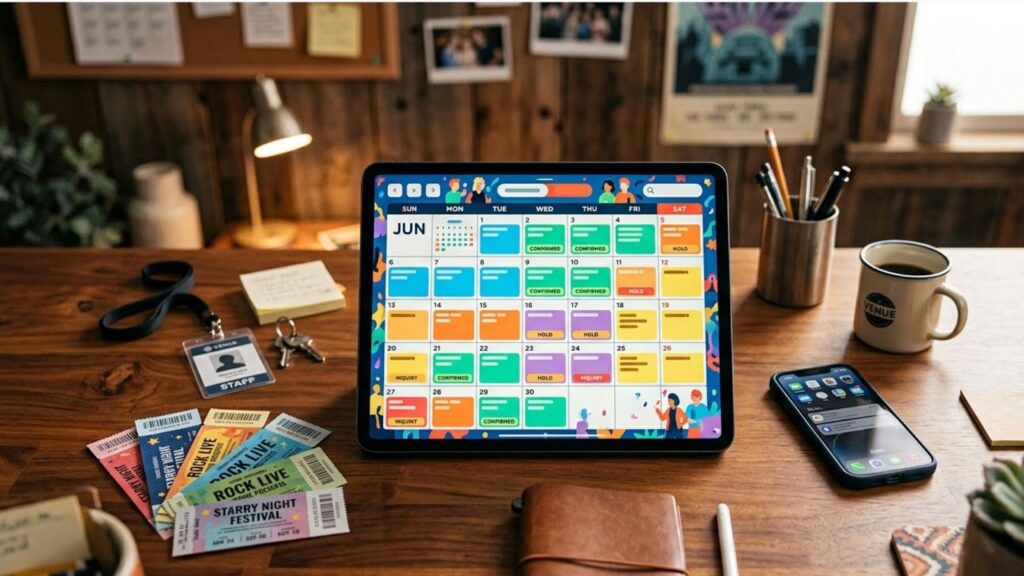
Integration with external calendars keeps everyone synchronized. Your production manager needs to see confirmed dates without accessing the full booking system. Your marketing team needs advance notice to plan campaigns. Role-based access controls let you share relevant information with the right people without exposing sensitive deal terms to everyone.
Financial Tools and Settlement Automation
Finances are where talent buying software proves its value. Your system needs to handle the full spectrum of deal structures common in live music: flat guarantees, percentage splits, versus deals, door deals, and hybrid arrangements.
Settlement automation eliminates hours of manual calculation and reduces the errors that damage relationships. When ticket sales data feeds directly from your ticketing platform into your management software, you can generate accurate settlements without transcribing numbers from one system to another. The math that used to require a calculator and three spreadsheet tabs happens automatically.
Co-promotion tracking deserves special attention. When you’re splitting costs and revenues with a co-promoter, the financial complexity multiplies. Which revenue streams are part of the split? What expenses get deducted before calculating shares? The right software handles these calculations transparently, generating documentation both parties can trust.

Real-time financial projections help you make better decisions throughout the booking process. Before you confirm a show, you should understand the break-even point, projected profit margins, and how different ticket pricing scenarios affect your bottom line. Waiting until settlement to discover that a show lost money is a problem that proper software prevents.
Mobile Access and Team Collaboration
Venue managers don’t spend their days at desks. During load-in, sound check, and the show itself, you’re on the floor solving problems in real time. Mobile-optimized platforms keep information accessible whether you’re in the green room, at the box office, or managing crowd flow in the lobby.
Team collaboration tools eliminate the communication gaps that lead to mistakes. When everyone accesses the same centralized system, there’s no confusion about which version of a contract is current or whether a particular expense has been approved. Document sharing, task assignment, and progress tracking happen within the same platform where you manage bookings.

Communication logs create accountability and institutional memory. When a booking agent calls about a date you discussed six months ago, you need instant access to the history of that conversation. Software that logs every interaction prevents the “I thought you said…” conflicts that waste time and damage relationships.
How Does Specialized Concert Management Software Compare to Generic Platforms?
The market for event management software is crowded with options designed for every type of gathering imaginable. The global event management software market stands at $15.2 billion in 2026 and is projected to hit $24.17 billion by 2031. That growth shows demand, but it also means venues face an overwhelming number of options that weren’t designed for their specific needs.
Understanding why live music venues need specialized tools helps you avoid the frustration of adapting your operations to software that doesn’t speak your language.
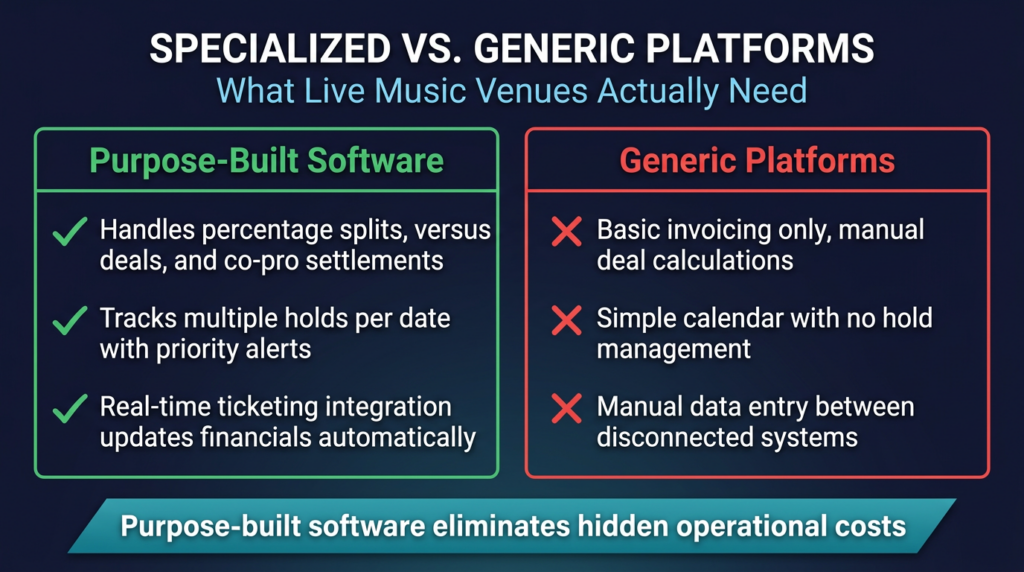
Key differences between specialized and generic platforms:
- Deal structure support: Generic platforms handle basic invoicing. Music-specific platforms understand percentage splits, versus deals, and tiered payment structures that change based on ticket sales thresholds.
- Hold management: Generic calendars show booked dates. Purpose-built systems track multiple holds per date, hold priorities, and automated notifications when holds expire or need advancement.
- Settlement automation: Generic tools might generate invoices. Industry-specific platforms calculate gross potential, apply deductions, split revenues according to contract terms, and generate settlement documents formatted the way agents and promoters expect.
- Integration depth: Generic platforms integrate with standard business tools. Specialized platforms connect with ticketing systems, providing real-time sales data that automatically updates financial projections.
- Industry terminology: Using software that understands holds, confirms, advances, and settlements means your team doesn’t need to translate their workflow into generic business concepts.
Every time you manually calculate a settlement, export data from one system to import into another, or search through email threads for a contract you know exists somewhere, you’re paying an invisible tax on operations. Purpose-built software eliminates these friction points.
Which Music Booking Software Platforms Lead the Market?
Several platforms compete for attention in the live music management space, each with different strengths and target audiences. Rather than recommending one solution over another, consider what questions to ask when evaluating any platform.
Evaluation criteria that actually matter:
- Industry focus: Was the platform built specifically for live music, or is it a generic events tool being marketed to venues? Software built by people who understand the industry tends to solve problems you didn’t even know you needed help with.
- Feature depth vs. feature breadth: Some platforms do many things adequately. Others do specific things exceptionally well. Identify which capabilities are most critical for your operation and evaluate platforms on those dimensions.
- Scalability: If you manage multiple venues or plan to expand, you need software that grows with your operation without requiring separate instances or manual data synchronization.
- Integration ecosystem: Your venue already uses ticketing platforms, accounting software, and communication tools. Evaluate how well potential solutions connect with your existing tech stack.
- Support quality: The complexity of live music means you’ll need help at some point. Responsive support from people who understand the industry is worth more than fancy features you can’t figure out how to use.
Vendors will happily tell you their platform does everything. Your job is to cut through the marketing and determine which solutions actually solve the problems keeping you up at night. Request demonstrations focused on your specific workflows rather than generic feature tours.
What Should You Consider When Evaluating an Event Management System?
Several factors determine whether software will improve your operations or just add another system to manage.
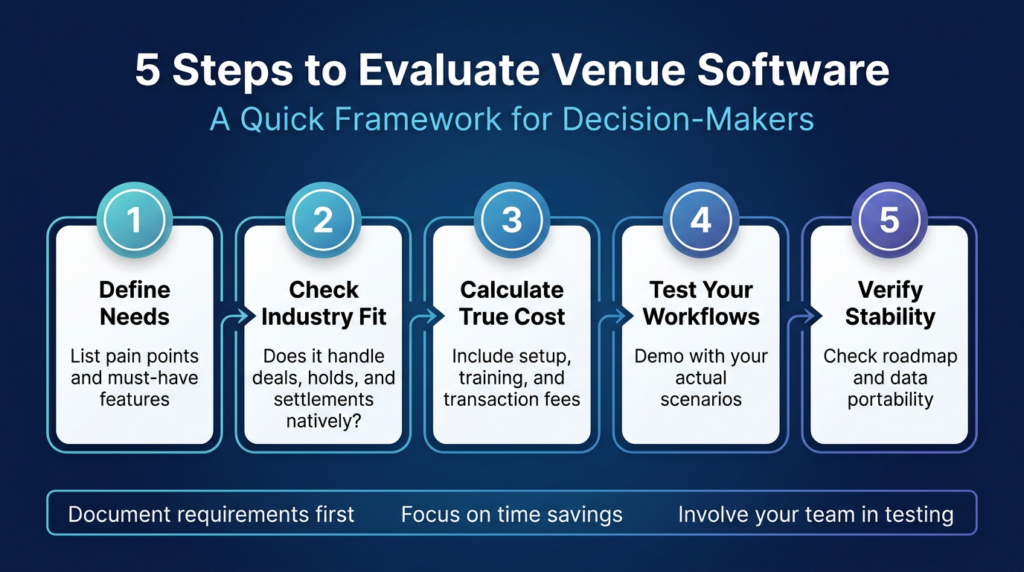
Implementation and onboarding determine whether you’ll actually use the software you’re paying for. Ask potential vendors about typical implementation timelines, data migration processes, and training resources. Some platforms require weeks of setup and configuration. Others get you operational within days. Consider how much time your team can realistically dedicate to learning a new system.
Total cost of ownership includes more than subscription fees. Factor in implementation costs, training time, potential productivity losses during the transition period, and any per-transaction fees for integrations. A platform that appears cheaper on the surface might cost more when you account for all the additional tasks required to make it work.
Vendor stability and roadmap matter for long-term planning. You don’t want to invest in a platform that might disappear or stagnate in two years. Ask vendors about their development roadmap, recent feature releases, and the size of their customer base. Active development and a growing user base indicate a vendor investing in the product’s future.
User experience determines adoption. The most feature-rich platform in the world doesn’t help if your team refuses to use it because the interface is confusing. During demonstrations, pay attention to how many clicks common tasks require and whether the workflow feels intuitive or forced.
Data ownership and portability protect your business. Before committing to any platform, understand what happens to your data if you decide to switch systems. Can you export your booking history, contact database, and financial records in usable formats? Vendors that make it difficult to leave are betting you’ll stay out of convenience rather than satisfaction.
Frequently Asked Questions
What’s the difference between venue management software and booking software? Venue management software handles the full spectrum of operations, including booking, financial tracking, settlement, team collaboration, and reporting. Booking software typically focuses specifically on calendar management and deal tracking. The most comprehensive platforms combine both capabilities, eliminating the need for multiple disconnected systems.
How long does it take to implement live music management software? Implementation timelines vary depending on the platform and the complexity of your operations. Some solutions offer quick onboarding that gets basic functionality running within days. Full implementation, including data migration, custom configuration, and team training, typically takes several weeks. Ask vendors for realistic timelines based on venues similar to yours.
Can live music management software integrate with my existing ticketing platform? Most purpose-built music industry platforms offer integrations with major ticketing systems, allowing real-time sales data to feed directly into your financial tracking and settlement calculations. During evaluation, confirm that your specific ticketing platform is supported and understand whether the integration requires additional fees or technical setup.
Is specialized live music software worth the cost for smaller independent venues? Independent venues often benefit the most from purpose-built software because they have fewer staff members to absorb administrative overhead. The time saved on manual tasks, combined with reduced errors in settlements and contracts, typically delivers positive ROI even for venues running a few dozen shows annually. The key is selecting software scaled to your operation rather than overpaying for enterprise features you don’t need.
Time to Modernize Your Venue Operations
The gap between thriving and struggling venues often comes down to operational efficiency. While some venues chase the next big booking, the most successful operators focus on systems that make every booking more profitable and less painful to execute.
Live music management software isn’t a luxury for large venues anymore. Independent operators handling dozens of shows per year save enough time and prevent enough errors to justify the investment multiple times over.
Prism delivers the all-in-one platform that transforms booking chaos into streamlined operations, giving venues, promoters, and agencies the tools they need to do more in less time. Get started with Prism and experience what happens when your software actually understands the live music industry.

Matt Ford is the founder and CEO of Prism.fm, a platform built to help the live music industry operate with more clarity and confidence. After 15+ years running venues, producing festivals, and promoting shows, Matt saw firsthand how much of the business relied on fragmented tools and guesswork. He founded Prism in 2018 to change that.
Today, Prism powers more than 3,000 venues and 330 organizations nationwide, serving as an all-in-one platform designed to streamline operations by replacing cumbersome spreadsheets with integrated tools for booking, financial tracking, and contract management. Matt has also led the development of Insights, Prism’s demand prediction platform, which uses real, verified ticketing data to help teams better understand artist performance and make smarter decisions before committing to a show.
Related Post

What Is Speculative Ticketing? How It Works and Why the Live Music Industry Is Fighting It
Buying a concert ticket should be fairly straightforward: a ticket exists, someone sells it, and a fan buys it. But in the secondary ticket market, that isn’t always what happens. In some cases, resellers advertise…
Managing Complex Event Schedules with PAC Management Software
Performing arts centers juggle more scheduling variables than any other venue type, yet most still rely on methods that guarantee chaos. If your calendar system can’t distinguish between a hard hold and a tentative inquiry,…

Music Festival Marketing in 2026: A Promoter’s Playbook for Selling Out
Music festival marketing in 2026 is a multi-channel, data-driven campaign that lives or dies by attribution. If your marketing system can’t tie ad spend to ticket revenue per channel, you’re not marketing a festival. You’re…