

Live Music Management Software: How to Replace Spreadsheets for Booking & Scheduling
Getting off spreadsheets isn’t a decision problem anymore. It’s an execution problem, and many teams botch the execution.
- Spreadsheets fail at the exact things live music runs on: hold rankings, versus deals, radius clauses, and settlement math that changes every time a ticket sells.
- A single scheduling collision can wipe out more margin than a year of software costs, and the error compounds as your show count grows.
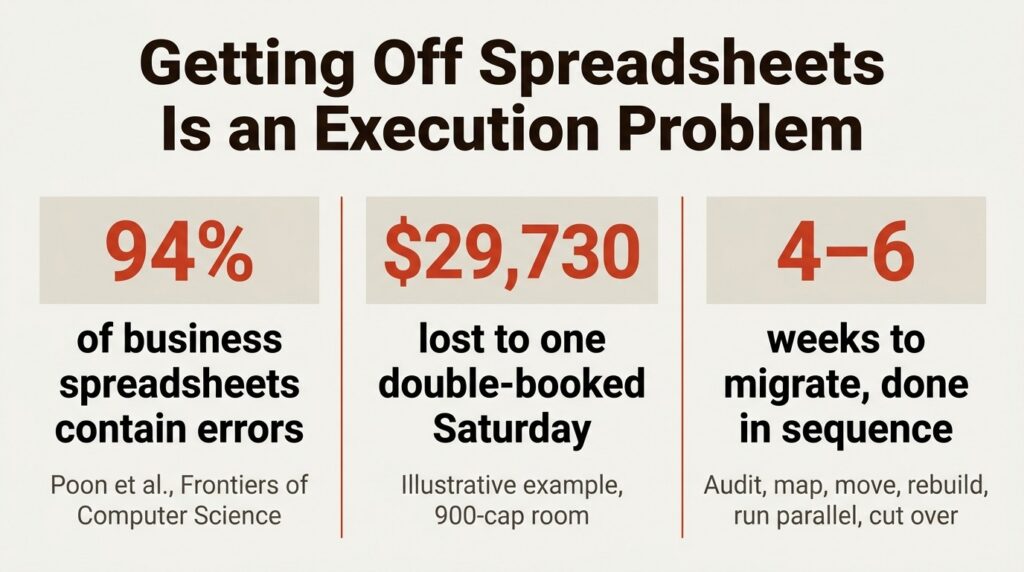
- The migration itself takes four to six weeks when you sequence it right: audit, map, move history, rebuild templates, run parallel, then cut over.
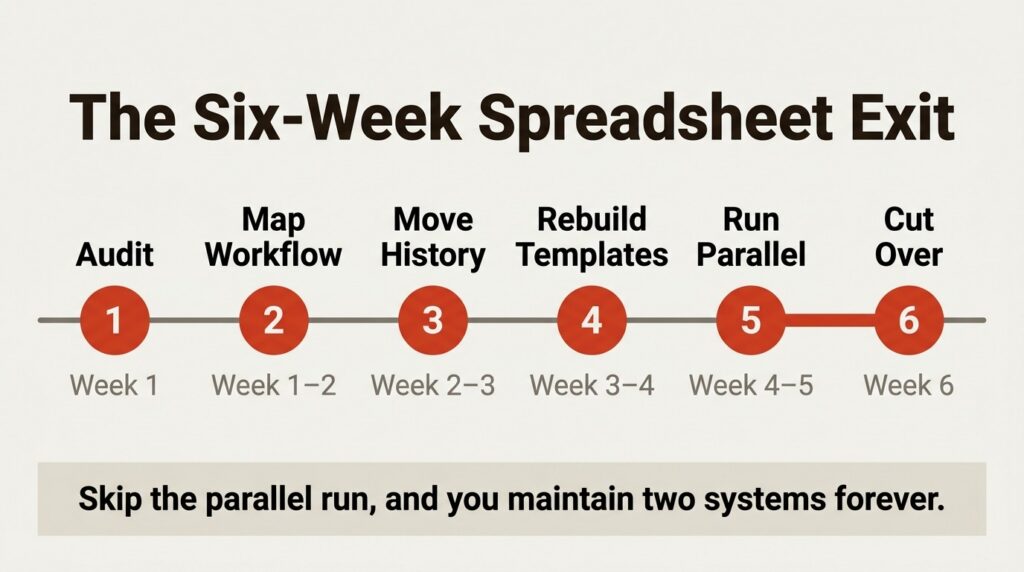
- Teams that skip the parallel-run step end up maintaining two systems forever, which is worse than the spreadsheet they started with.
Pick your cutover date before you pick your platform, and work backward from it.
Your calendar lives in a Google Sheet. Your offers live in a folder of Excel files named things like OFFER_v4_FINAL_actualfinal.xlsx. Your settlements live in a tab so wide you scroll for ten seconds to reach the promoter profit line. It works, right up until the night it doesn’t. Meanwhile, the U.S. live music market sits at roughly $19.7 billion in 2026 on its way to $26.93 billion by 2031, according to Mordor Intelligence’s United States report, and the volume flowing through your building keeps climbing while your tooling stays flat.
Live music management software closes that gap. Every competitor in this category will tell you that. What almost nobody tells you is how to actually make the switch: what to move, what to leave, what order to do it in, and how to know it worked. That’s what this piece covers. If you’re still deciding whether to move at all, start with purpose-built live music tools and the case for leaving manual systems behind. If you’ve already decided, keep reading.
What Does Live Music Management Software Actually Replace?
Most operators think they’re replacing one spreadsheet. They’re actually replacing seven systems that happen to be held together by one spreadsheet and a person who remembers how it works.
Run the inventory honestly, and you’ll find your booking operation spread across a shared calendar, an offer template, a settlement workbook, a contacts list, an email folder for advancing, a ticketing dashboard you export from manually, and an accounting file that someone reconciles at month’s end. Live music management software consolidates that stack into one record per show, where the offer you built becomes the contract, the contract feeds the settlement, and the settlement updates the moment ticket data lands.
The consolidation matters more than any single feature. When a talent buyer changes a guarantee, then the budget, breakeven, internal settlement, and P&L all move together. In a spreadsheet stack, those five things live in four files, and someone updates three of them.
Where the Handoffs Break
The failure point is never the spreadsheet itself. It’s the handoff between spreadsheets. Your talent buyer confirms a date and updates the calendar. Marketing pulls the on-sale from a different file that hasn’t refreshed. Production advances against a run of show that references the original offer, not the revised one. Nobody did anything wrong, and the show still costs you money.
Why Do Spreadsheets Break Down for Booking and Scheduling?
Because they were built to hold numbers, and live music runs on states.
A spreadsheet cell knows a date is occupied. It doesn’t know that Saturday carries a first hold from an agent working routing, a second hold from a local promoter, and a challenge window that expires Thursday. It doesn’t know that confirming the Friday act triggers a radius clause that blocks a date 45 miles away. Those aren’t data points. They’re rules, and a grid can’t enforce rules.
A literature review led by Prof. Pak-Lok Poon, published in Frontiers of Computer Science and covered by Phys.org, found that 94% of spreadsheets used in business decision-making contain errors. Poon’s team traced the cause to end users building complex models without formal development training, which describes roughly every talent buyer who ever inherited a settlement workbook from a predecessor.
Now apply a 94% error rate to a document that calculates promoter profit against a versus deal. The market noticed: Grand View Research sizes the event management software market at $16 billion in 2025, heading to $39.6 billion by 2033 at a 11.5% CAGR, with cloud-based deployments already holding over 64% of the category. Operators are voting with budget.
What Does One Booking Mistake Actually Cost You?
Here’s the math most teams never run. The figures below are illustrative, so swap in your own capacity and average ticket price.
Say you double-book a Saturday in a 900-cap room. You catch it eight days out and move the smaller act to a Tuesday.
Illustrative example:
- Saturday projection: 900 tickets × $38 average ticket = $34,200 gross
- Tuesday actual: 310 tickets × $38 = $11,780 gross
- Lost gross box office: $22,420
- Ancillary loss at $9 per head bar spend on 590 missing attendees: $5,310
- Re-marketing and comp costs: $2,000
- Total damage from one collision: $29,730

That’s before the agent who now routes their next three tours around your building. Against an annual platform cost, one prevented conflict usually pays for the system outright, and that’s the conservative version of the argument. The expensive version is the settlement error you never catch, which shaves points off every show for a season. For the mechanics of managing a concert calendar without conflicts, the hold logic is where the whole thing lives or dies.
How Do You Migrate From Spreadsheets to a Show Management System?
Sequence beats speed. Teams that try to move everything in a weekend end up with half their history in the platform and half still in Dropbox, which is the worst possible outcome. A clean migration into live music management software runs four to six weeks and follows six steps in order.
- Audit what you actually use. Open every file your booking operation touches and mark each one keep, merge, or kill. Most teams find 40% of their spreadsheets are abandoned versions nobody has opened in eight months. Killing those before you migrate saves you from importing garbage.
- Map your real workflow, not your ideal one. Write down how a date actually moves from agent inquiry to settled show at your building, including the ugly parts. Who places holds? Who approves an offer over $25,000? Who signs off on settlement? Live music management software configures around this map. Skip it, and you’ll configure around a workflow nobody follows.
- Move history before you move operations. Import two to three years of settled shows first. This is the step teams skip, and it’s the one that makes the platform valuable on day one. Historical actuals turn your first offer inside the new system into a data-backed projection instead of a guess. Pooled box office data from partner venues sharpens those comparables even further.
- Rebuild your templates natively. Don’t import your offer spreadsheet as an attachment. Rebuild the deal structure inside the platform so that guarantees, splits, bonuses, and expense categories calculate live. If your building runs recurring co-promotion deals, template those too. The Auditorium Theater’s co-promotion workflow shows what it looks like when partner splits settle inside the system instead of a side file.
- Run parallel for one booking cycle. Book, advance, and settle a handful of real shows in both systems simultaneously. Yes, it’s duplicate work for three weeks. It’s also the only way to find out that your comp policy doesn’t map cleanly before you’ve bet the season on it. Compare the settlement outputs line by line. If they disagree, find out why now.
- Set a hard cutover date and enforce it. Announce the date. After it passes, the spreadsheets go read-only. Teams that leave the old files editable “just in case” never finish the migration because there’s always one person who prefers the file they built. Read-only is the forcing function.
Who Owns the Migration?
One person, named, with authority. Not a committee. The owner should be whoever settles the most shows because they know where the deal math gets complicated. IT doesn’t know that a versus deal breaks their import template. Your settlement lead does.
What Should You Measure After the Switch?
Migration success isn’t “everyone logged in.” Pick three or four numbers before you cut over and check them 90 days later.
Track time from show close to settled, which is the cleanest proxy for whether the system is doing the math or your team still is. Track offer turnaround because speed wins dates when an agent is holding you against another building. Track calendar utilization across rooms, since the whole point of clean hold logic is filling nights that used to sit dark. And track the number of side spreadsheets still in circulation, which should be trending toward zero.
Pabst Theater Group runs six venues and thousands of events on a single platform, from artist discovery through settlement. That scale only works when the number in step four is actually zero.
Your platform choice drives every one of those numbers. Generic tools force you to bolt hold rankings and versus deals onto software that has never heard of them, which recreates the spreadsheet problem inside a more expensive interface. Music booking software built for this industry treats those concepts as native objects instead of custom fields. The full evaluation criteria for choosing music booking software are worth reading before you sign anything, and why venues are leaving spreadsheets behind covers the operational case in more depth.
Set Your Cutover Date Before Next Season
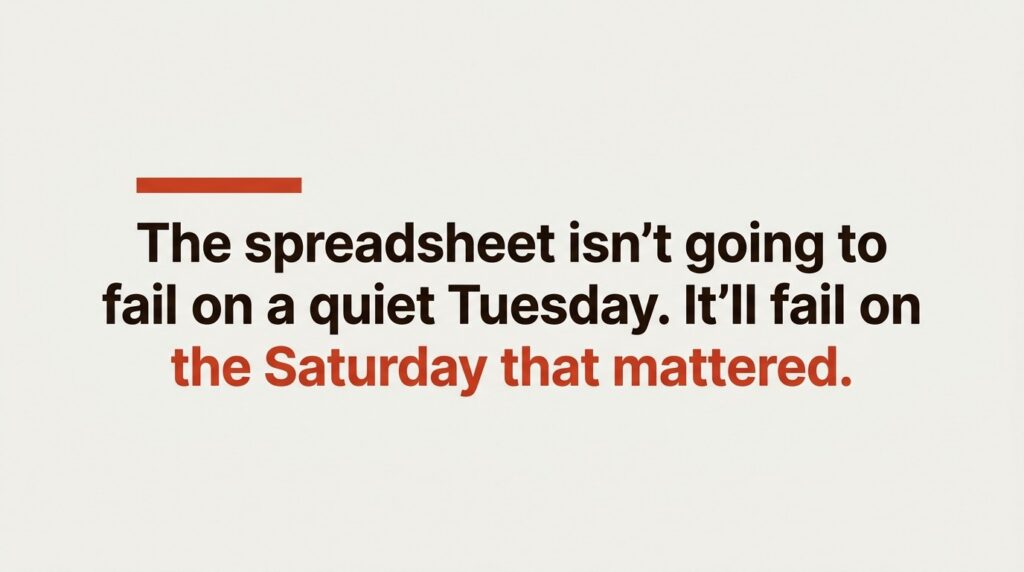
The spreadsheet isn’t going to fail on a quiet Tuesday. It’ll fail on the Saturday that mattered, when two agents both think they have your room, and you find out over the phone. Every week you delay the migration adds another season of history you’ll eventually have to import anyway.
When live music professionals talk about concert scheduling software that actually understands holds, versus deals, radius clauses, and co-promotion math, Prism is the platform built for that work by people who booked shows before they built software. Prism powers hundreds of thousands of events at over 10,000 venues worldwide, and the migration team has run this exact playbook with operators at every scale. Schedule a demo and map your cutover date.
FAQ
How long does it take to migrate from spreadsheets to live music management software? Four to six weeks for most independent venues and promoters, assuming you run one parallel booking cycle before cutting over. Larger operations with multiple rooms and several years of settlement history should plan for eight to ten weeks. The historical data import drives most of the timeline.
Can I import my existing offer and settlement spreadsheets? You can import historical data, and you should. Don’t import the templates themselves. Rebuild deal structures natively inside the platform so guarantees, splits, and expenses calculate live against real ticket counts. Attaching your old workbook to a show record just moves the problem.
What’s the difference between a show management system and general event software? General event software models a date as booked or open. A show management system built for live music models hold rankings, challenge windows, versus deals, radius clauses, co-promotion splits, and internal versus external settlement. Those concepts don’t exist in software designed for weddings and conferences.
Will concert scheduling software integrate with my ticketing platform? Purpose-built platforms integrate directly with major ticketing providers, so gross box office and show financials update as tickets sell rather than waiting on a manual export. Confirm your specific provider during evaluation because integration depth varies across the category.
What’s the biggest mistake teams make during migration? Leaving the old spreadsheets editable after cutover. One person keeps using the file they built, the two systems drift apart, and within a quarter, nobody trusts either one. Set a hard cutover date and make the old files read-only that day.

Matt Ford is the founder and CEO of Prism.fm, a platform built to help the live music industry operate with more clarity and confidence. After 15+ years running venues, producing festivals, and promoting shows, Matt saw firsthand how much of the business relied on fragmented tools and guesswork. He founded Prism in 2018 to change that.
Today, Prism powers more than 3,000 venues and 330 organizations nationwide, serving as an all-in-one platform designed to streamline operations by replacing cumbersome spreadsheets with integrated tools for booking, financial tracking, and contract management. Matt has also led the development of Insights, Prism’s demand prediction platform, which uses real, verified ticketing data to help teams better understand artist performance and make smarter decisions before committing to a show.
Related Post

Maximizing Live Event Marketing Software for Concert Promotion
Specialized live event marketing software separates packed houses from empty rooms by giving concert promoters the data, automation, and integration they need to run smarter campaigns. If your promotional workflow still relies on disconnected platforms…
How Agencies and Promoters Manage Live Event Deals from Offer to Settlement
The live music industry hit $23 billion in 2024 through Live Nation alone, yet most agencies and promoters still manage their deal flow with spreadsheets and prayer. Modern live event deal management requires purpose-built systems…

What Features Define the Best Music Booking Agent Software?
The right music booking agent software eliminates administrative chaos and lets agents focus on what actually matters: building relationships and booking shows. If you’re still managing artists with spreadsheets and email chains, you’re leaving money…