
How Agencies and Promoters Manage Live Event Deals from Offer to Settlement
The live music industry hit $23 billion in 2024 through Live Nation alone, yet most agencies and promoters still manage their deal flow with spreadsheets and prayer.
- The offer-to-settlement workflow involves multiple stakeholders, complex deal structures, and financial calculations that compound in complexity as shows scale.
- Talent agencies juggle dozens of simultaneous negotiations across their roster while promoters balance risk, ticket projections, and artist expectations.
- Settlement accuracy directly impacts relationships, cash flow, and whether you get the next booking.
Modern live event deal management requires purpose-built systems that understand music industry workflows rather than generic event tools.
The live music industry continues breaking records, with Live Nation reporting $23 billion in total revenue for 2024 and concert attendance up 4% year-over-year. Behind every sold-out show sits a deal that traveled from initial offer through contract negotiation to final settlement. That journey is the operational backbone of every talent agency and promotion company in the business.
Live event deal management encompasses everything that happens between “we’re interested” and “here’s your check.” For agencies representing artists, it means tracking offers across venues and festivals, negotiating terms that protect their clients, and ensuring accurate payouts hit bank accounts on time. For promoters, it involves assessing risk, structuring deals that work for both sides, and managing the financial reality of putting bodies in rooms.
The pros who excel share one thing in common: they’ve built systems that eliminate friction at every stage. Whether you’re running a boutique agency with five artists or promoting shows across multiple venues, understanding the complete deal lifecycle determines whether you’re scaling your business or drowning in administrative chaos.
What Does Live Event Deal Management Actually Involve?
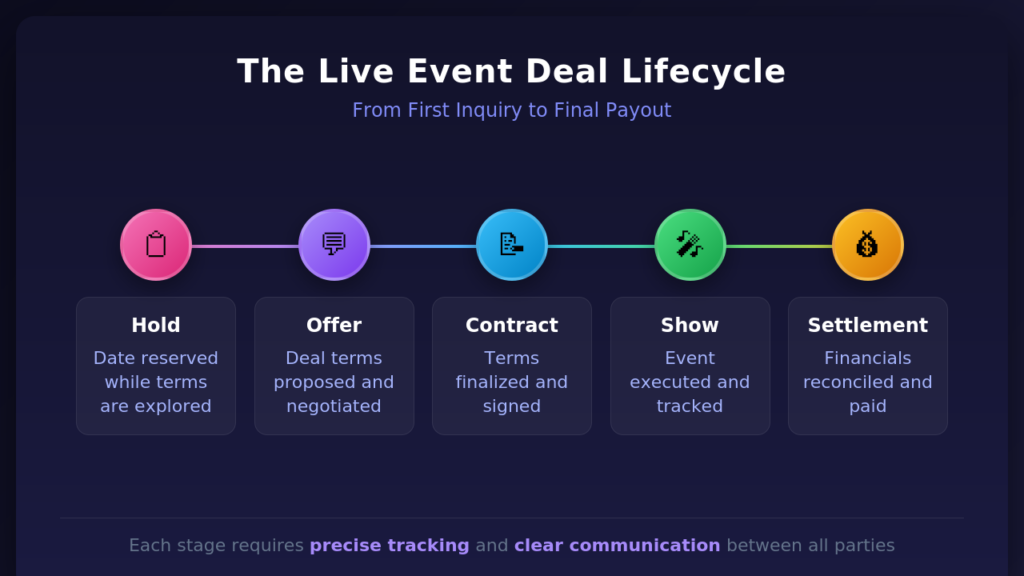
Every deal follows a predictable arc, though the complexity varies based on artist profile, venue type, and deal structure. Understanding each phase helps you identify where your current process breaks down and where automation can reclaim hours of your week.
The Offer Phase
Deals begin with holds and inquiries. A promoter identifies a date and artist that could work, then reaches out to the booking agent with initial interest. This triggers a hold request, which temporarily reserves the date while both parties explore terms. Managing holds across multiple potential shows requires meticulous tracking since agents may have the same artist holding dates in competing markets.
The formal offer follows, outlining proposed compensation, production requirements, marketing commitments, and deal structure. Common structures include flat guarantees, versus deals (guarantee versus percentage of net box office, whichever is greater), and door deals based on ticket revenue after expenses. Each structure carries different risk profiles for both parties.
Negotiations happen through email, phone, and shared platforms where both sides can view and comment on offer terms. The back-and-forth typically involves adjustments to guarantee amounts, expense caps, merchandise splits, and ticketing arrangements. Speed matters here since popular artists have limited routing windows, and delays can cost you the show entirely.

Contract and Confirmation
Once terms align, the deal converts from offer to confirmed booking. This transition triggers contract generation with all negotiated terms formalized into legally binding documents. Understanding venue promoter agreements is vital since these contracts govern everything from load-in times to liability allocation.
Contract execution through e-signature has become standard, but tracking signed documents across dozens of active deals creates its own administrative burden. The confirmation also kicks off advancing processes: production requirements get communicated to venue staff, hospitality arrangements get finalized, and marketing campaigns begin their countdown.
Deposit schedules typically activate at contract signing, with promoters required to submit initial payments to secure the booking. Tracking these deposits, along with their due dates and payment status, is another critical element of agency deal tracking that can easily slip through cracks when managed manually.
How Do Agencies Track Deals Across Multiple Artists?
Talent agency management software evolved because generic tools couldn’t handle the complexity of managing simultaneous negotiations across a roster of artists. When you’re booking shows for 15 acts with varying career stages, deal structures, and routing requirements, you need systems designed for this exact use case.
Effective agency deal tracking breaks down into five core components:
- Pipeline Visibility – Seeing every active inquiry, hold, offer, and confirmed booking across your entire roster from one view. This prevents double-booking, identifies routing conflicts, and highlights opportunities where dates remain unfilled.
- Deal Documentation – Storing every version of every offer alongside communication history so nothing gets lost when deals span weeks or months. When an agent revisits a negotiation six months later, the complete context should be immediately accessible.
- Financial Projections – Calculating estimated artist earnings based on deal terms, ticket price projections, and expense assumptions. This helps agents advise artists on which offers actually make financial sense versus which look attractive on paper but won’t deliver.
- Commission Tracking – Automatically computing agency commissions based on deal structures and ensuring accurate payouts once shows settle. Manual commission calculations invite errors that damage trust with artists.
- Communication Logs – Maintaining records of every conversation with promoters, venue buyers, and artist management so anyone on the team can pick up a deal without starting from scratch.
The agencies pulling ahead treat their deal data as a competitive weapon. Historical performance data across venues, markets, and deal types informs future negotiations. Knowing that a particular venue consistently underperforms on merchandise sales, for example, strengthens your position when negotiating merchandise splits.
What Makes Promoter Management Operations Different?
While agents represent artist interests, promoters must balance risk across their calendar while maintaining relationships with both artists and venues. Promoter management operations require visibility into financial exposure, ticket sales velocity, and expense management across every active show.
Co-Promotion Complexity
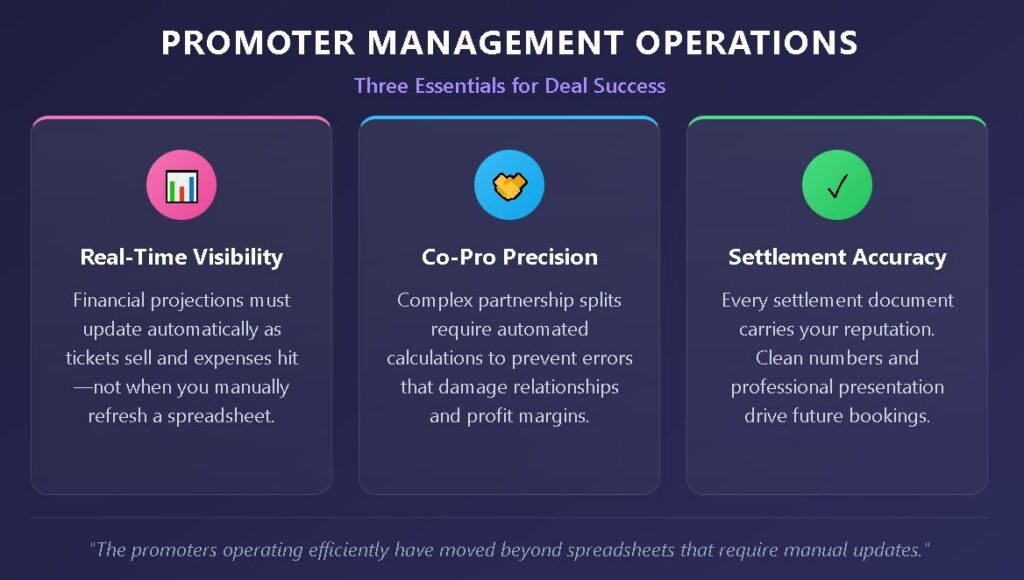
Many shows involve multiple promoters sharing costs and revenues. These co-promotion arrangements require precise tracking of which party incurred which expenses, how revenue splits apply to different income streams, and what the final settlement looks like for each partner. Comprehensive venue booking platforms automatically handle co-promoter splits, calculating complex percentage arrangements and generating accurate settlement documents.
Let’s say two promoters split a show 60/40, but only certain revenue streams (ticket sales and sponsorship) apply to the split, while others (bar revenue) stay with the venue. Add a per-ticket bonus structure on top of the percentage split, and you’ve got calculations that become error-prone when handled manually. The cash reconciliation at settlement determines whether your partnership strengthens or fractures.
Real-Time Financial Visibility
Promoters rely on their ability to see financial reality as shows approach. Estimated versus actual ticket sales, expense creep, and marketing spend all impact whether a show hits projections. Building accurate concert budget templates establishes the foundation, but real-time updates as tickets sell and invoices arrive keep you from flying blind.
The promoters operating efficiently have moved beyond spreadsheets that require manual updates every time ticket counts change. Integration with ticketing platforms means revenue projections adjust automatically, settlement calculations stay current, and financial surprises become rare rather than routine.
Why Settlement Is Where Deals Live or Die
Settlement is the moment of truth for every deal. All the promises made during negotiation get reconciled against actual performance. Concert venue settlement best practices emphasize accuracy, transparency, and professionalism since this final interaction shapes whether you’ll work together again.
Deal Types and Their Settlement Implications
Different deal structures create different settlement dynamics. A flat guarantee simplifies the math since the artist receives their agreed amount regardless of ticket sales. But versus deals require calculating the actual net box office, comparing it against the guarantee, and paying whichever is greater. Door deals involve expense verification before calculating the artist’s share of remaining revenue.
The top 100 worldwide tours grossed $9.5 billion in 2024. Behind that number sit thousands of individual settlements, each requiring accurate expense tracking, ticket reconciliation, and payout calculations. Even small percentage errors compound quickly at scale.
The settlement meeting reviews every financial element: gross box office receipts, taxes and facility fees, artist costs, promoter costs, additional revenue streams, and final payout calculations. When numbers don’t match expectations, relationships strain. When they match perfectly and documentation is clean, you’ve built trust that leads to future business.

How Can Software Transform Your Deal Workflow?
Music promoter software has become essential for scaling live music operations. Generic event management platforms handle basic scheduling but fail when you need to calculate a tiered guarantee with an 85/15 split after expenses. They don’t understand holds versus confirms, radius clauses, or the complex financial structures that define live entertainment.
Purpose-built solutions for live event deal management offer distinct advantages:
- Automated settlement calculations that eliminate manual spreadsheet work and reduce errors
- Hold management with expiration alerts that prevent double-bookings and missed opportunities
- Real-time ticketing integration that keeps financial projections current
- Document generation for contracts, offer sheets, and settlement reports
- Payment tracking with automated reminders for deposits and balances
- Historical analytics that inform future booking decisions
Choosing the right venue booking software requires evaluating whether the platform understands music industry workflows or forces you to adapt your processes to generic capabilities. The hours saved on administrative work translate directly into capacity for booking more shows and building stronger relationships.
Frequently Asked Questions
What’s the difference between a versus deal and a door deal? A versus deal offers artists a guaranteed minimum payment versus a percentage of net box office receipts, with the artist receiving whichever amount is greater. A door deal provides the artist a straight percentage of ticket revenue after the promoter covers specified expenses, with no guaranteed minimum. Versus deals reduce artist risk while door deals offer higher upside potential when shows exceed expectations.
How long does the typical offer-to-settlement cycle take? Timelines vary based on artist profile and venue type. Club shows may move from initial inquiry to settlement within weeks, while arena tours and festival appearances often involve negotiations spanning months. The settlement itself typically occurs within days of the performance, though payment processing may extend the final payout timeline.
What expenses typically come off the top before calculating artist payouts? Common deductions include facility fees, ticket taxes, sound and lighting production costs, security, hospitality, marketing expenses agreed upon in the contract, and the venue’s house nut covering fixed operational costs. Specific expense categories and caps should be clearly defined in the contract before the show.
Can agencies and promoters use the same deal management platform? Yes, and increasingly they do. Platforms designed for the live music industry serve both sides of the transaction since efficient deal management benefits everyone involved. When agencies and promoters use compatible systems, offer data can transfer seamlessly, reducing double-entry and ensuring both parties work from identical information.
Take Control of Your Deal Flow
Live event deal management separates thriving operations from those constantly fighting fires. The agencies and promoters dominating their markets have systematized every stage from offer to settlement, eliminating the friction that costs time, money, and relationships.
Prism gives agencies and promoters the complete toolkit for managing deals the way the industry actually works. From hold tracking through settlement automation, every feature reflects real workflows refined by music industry veterans. Get started with Prism and discover why over 1,500 venues and promoters trust us to power their operations.

Matt Ford is the founder and CEO of Prism.fm, a platform built to help the live music industry operate with more clarity and confidence. After 15+ years running venues, producing festivals, and promoting shows, Matt saw firsthand how much of the business relied on fragmented tools and guesswork. He founded Prism in 2018 to change that.
Today, Prism powers more than 3,000 venues and 330 organizations nationwide, serving as an all-in-one platform designed to streamline operations by replacing cumbersome spreadsheets with integrated tools for booking, financial tracking, and contract management. Matt has also led the development of Insights, Prism’s demand prediction platform, which uses real, verified ticketing data to help teams better understand artist performance and make smarter decisions before committing to a show.
Related Post

Live Music Management Software: How to Replace Spreadsheets for Booking & Scheduling
Getting off spreadsheets isn’t a decision problem anymore. It’s an execution problem, and many teams botch the execution. Pick your cutover date before you pick your platform, and work backward from it. Your calendar lives…
Managing Complex Event Schedules with PAC Management Software
Performing arts centers juggle more scheduling variables than any other venue type, yet most still rely on methods that guarantee chaos. If your calendar system can’t distinguish between a hard hold and a tentative inquiry,…
Choosing the Right Live Music Management Software for Your Venue
The U.S. live music market is projected to exceed $19 billion in 2026, yet many venues still manage operations with spreadsheets and disconnected systems that cost them time, money, and sanity. If your current process…