
Theatre Management Software vs. Performing Arts Center Software: What PACs Actually Need
The label on the software matters far less than whether the tool models how a performing arts center actually runs a week.
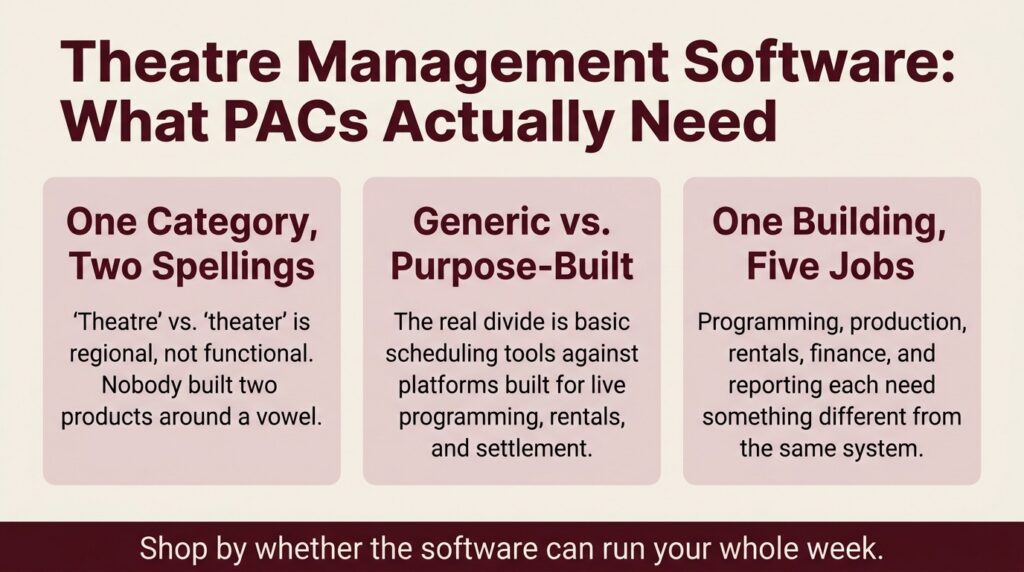
- The two spellings, “theatre” and “theater,” describe one software category, not two. The difference is regional, not functional.
- The real divide is generic scheduling tools against platforms built for live programming, rentals, and settlement.
- A PAC runs five jobs from one calendar: programming, production, rentals, finance, and executive reporting. Each team needs something different from the same system.
- Generic tools can book a room. They can’t model a rental rebill, a box-office settlement, and a co-promotion split in one financial layer.
Shop by whether the software can run your Tuesday: a school matinee, a rental load-in, and a touring headliner in the same room, settled the same day.
Search for theatre management software, and you’ll get two very different products wearing the same language. One is a generic event calendar with a box-office bolt-on. The other runs the full operational life of a performing arts center, from the first hold to the board report. Telling them apart matters more for a PAC than any other venue because a PAC stacks more event types into the same rooms than a club or arena ever will.
The category is growing fast. According to Grand View Research, the event management software market hit $16 billion in 2025 and is on track to reach $39.6 billion by 2033 at a 11.5% CAGR, with cloud platforms already past 64% share. This guide clears up the terminology, then maps what your programming, production, rentals, finance, and reporting teams each need.
Theatre Management Software or Theater Management Software: Is There a Difference?
There isn’t one worth acting on. “Theatre” is the traditional arts spelling, used in the names of most American venues, from the Auditorium Theatre to the Broward Center. “Theater” is standard American English for the building and the art form. When a vendor markets theater management software, they’re selling the same category as one using the British spelling. Nobody built two products around a vowel.
The confusion that actually costs buyers money is different. Three phrases blur together and don’t mean the same thing. Arts management software is the widest umbrella, often centered on patron databases, fundraising, and donor CRM for any cultural nonprofit, museums and orchestras included. Performing arts center software is the operational subset built for venues that program and present live shows. A tool can be excellent for donor stewardship and useless for settling a co-promoted concert. The real question is whether the platform can handle the density of a live PAC operation.
Why Doesn’t Generic Software Work for a Performing Arts Center?
Generic event tools center on one transaction: book a room, send a confirmation, and collect payment. That model fits a hotel banquet hall. It falls apart when a venue runs three deal structures through one stage in a week. A rental bills a flat fee. A self-promoted show settles on box office against guarantees. A co-promotion splits the profit with a partner. Generic platforms treat all three as “an event,” so the financial truth lands in a spreadsheet someone rebuilds every show, and each error sits between your box office and your board. Solid performing arts center management starts by killing that layer.
The stakes keep tightening. SMU DataArts reports in its 2025 National Trends analysis that 44% of arts organizations ran a deficit in 2024, the highest rate in six years, with median working capital down to about four months of expenses. At those margins, a settlement error or a late report is money the institution can’t spare. Arts management software that can’t tie the box office to the ledger is a liability, not a tool.
What Does Each PAC Team Need from the Software?
A performing arts center isn’t one user with one job. It’s four or five teams sharing one building, one calendar, and one set of financial truths. The right platform gives each team its own view of the same data instead of separate tools that never reconcile.

Programming and Talent Buying
Programmers live on availability and risk. They need stacked holds with clear priority, so a soft hold for a touring act doesn’t block a rental inquiry. They need a pro forma that models revenue, expenses, and breakeven before an offer goes out. And they need real demand data from comparable shows to back a booking with evidence instead of instinct.
Production and Operations
Production runs on time and space, not dates. A calendar that shows a room as simply “booked” hides the load-in, tech rehearsal, performance, and strike that compress into 18 hours on show day. Operations needs a system that models multi-performance runs, matinees alongside evening shows, and parallel bookings across the rehearsal hall, lobby, and studio. Miss that layer, and you double-book a crew while the calendar still looks clean.
Rentals and Outside Events
Rentals are a revenue engine that generic tools treat as an afterthought. This team needs to track outside promoters, generate rental agreements, and rebill staffing and services against each booking. Rental and presented-show income have to live in the same financial picture, or leadership never sees the true contribution of the rentals business. A platform built for the way performing arts centers actually operate keeps rentals and presented events on one ledger.
Finance and Settlement
Finance either holds the operation together or collapses into rekeyed spreadsheets. It needs native settlement math for every deal type, real-time ticketing integration so financials update as tickets sell, and co-promotion splits that calculate the moment sales close. When settlement runs inside the platform, the actuals become a benchmark library that feeds next season’s decisions. The Auditorium Theatre’s co-promotion workflow shows a complex split running inside one system instead of a side spreadsheet.
Executive and Board Reporting
Leadership needs one trustworthy number and role-based permissions that keep sensitive figures where they belong. Your box office manager shouldn’t see artist guarantees, and your board deck shouldn’t require rebuilding show economics by hand. The reporting layer has to roll every event type into one live financial picture, so the number that settles a show is the same number a funder sees. If you settle a show once and report it again from scratch, the tool is the problem.
Theatre Management Software vs. PAC Software: How Do They Compare?
Put the two side by side on the capabilities a PAC actually uses, and the difference stops being about spelling. It’s about whether the software understands live programming at all.
| Capability | Generic Theatre / Event Software | Purpose-Built PAC Software |
| Calendar and holds | Date is open or booked | Stacked soft holds, hold priority, matinee and evening avails |
| Deal structures | One event type, flat pricing | Rentals, versus deals, guarantees, co-promotion splits |
| Rentals | Basic invoicing | Rental agreements, rebills, outside-promoter tracking |
| Settlement | Manual, exported to a spreadsheet | Native settlement math per deal type |
| Ticketing | Manual import | Real-time integration, financials update as tickets sell |
| Permissions | All-or-nothing access | Role-based, so the box office doesn’t see guarantees |
| Reporting | Static exports | Live roll-up from box office to board |
| Programming data | None | Real demand data from comparable shows |
A few generic tools offer slicker private-event features like floor-plan design and catering menus. If you book more weddings than concerts, weigh that. For a building that lives on holds, rentals, and settlements, purpose-built wins on the work that pays your calendar.
How Do the Deal Structures Differ in One Room?
To see why category fit matters, watch one hall run three deals in a week. Here’s illustrative math for an 800-seat house, with hypothetical numbers but real deal structures.
- Rental (Monday): An outside dance company pays a flat $3,500 hall fee plus $900 in rebilled services. The PAC books $4,400 against its direct event costs.
- Self-promoted show (Friday): 720 tickets at $45 sell out to $32,400 gross. Subtract an $11,000 guarantee, $7,500 in production and marketing, and $2,900 in staffing. Promoter profit is $32,400 minus $21,400, or $11,000, all yours.
- Co-promotion (Saturday): Same $32,400 gross, $21,400 in costs, $11,000 net. Split 50/50 with a partner after costs, and each side earns $5,500.
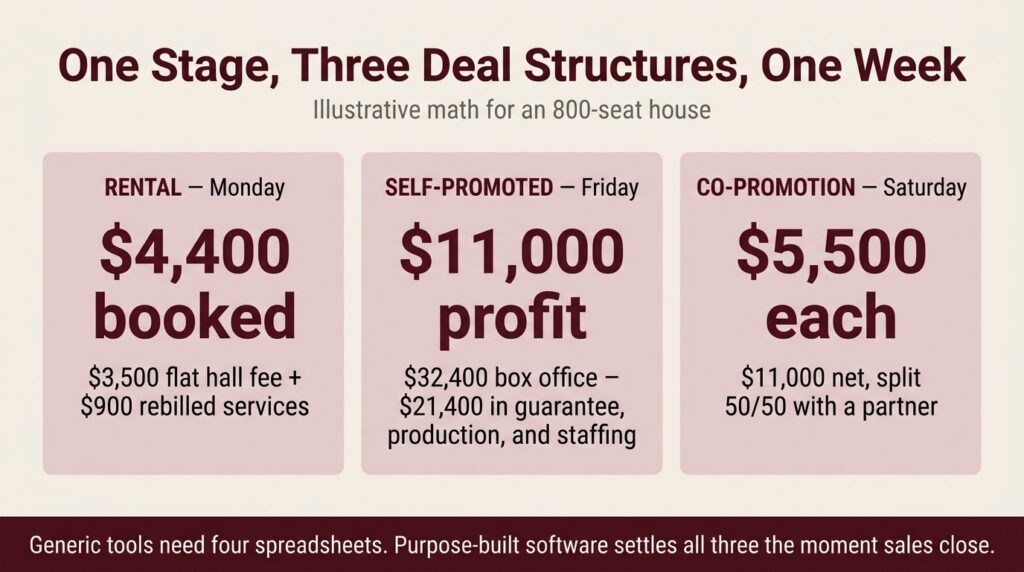
Three deal structures, three sets of expenses, one week, one room. Generic theatre management software needs three separate spreadsheets to track that, and a fourth to reconcile them. A purpose-built platform settles all three the moment ticket sales close, then rolls every number into the same board report with no rekeying.
What Should a PAC Look For in Theatre Management Software?
Not every “all-in-one” claim survives a real PAC week. Build your evaluation around the capabilities that separate a live-programming platform from a glorified calendar.
- Native deal structures. The platform should handle rentals, versus deals, guarantees, and co-promotion splits without a spreadsheet in the loop.
- One financial layer. Every event type, from a rental to a co-pro, should automatically roll into the same profit-and-loss picture.
- Real-time ticketing integration. Financials should update as tickets sell, not after a manual export the morning after the show.
- Role-based permissions. Sensitive numbers like artist guarantees should reach only the people who need them.
- Board-ready reporting. The same figure that settles a show should flow straight into the board deck, with no second build.
- Demand data for programming. Real ticket-sales history from comparable shows lets buyers price and schedule with evidence.
- Multi-performance support. Matinees, Broadway-style runs, and stacked evening holds all belong on one calendar.
Score any tool against those seven criteria, and the terminology question answers itself. Clear the list, and you have a real PAC platform, whatever it’s called.

Choose Software That Can Actually Run Your Building
Stop shopping by the word on the box. The decision isn’t theatre versus theater, and it isn’t even software versus spreadsheet. It’s whether the platform understands that a rental, a self-promoted show, and a co-promotion are three different animals on one stage. Map your teams first, then buy the tool that serves all of them from one source of truth. Live music industry veterans built Prism to run that complexity, connecting programming, rentals, finance, and board reporting for performing arts centers nationwide. To see how it handles your building’s real week, get started with a demo and speak to an expert.
Frequently Asked Questions
Is theatre management software the same as theater management software? Yes. The spelling changes by region and house style, but the software category is identical. Both describe tools for running a performing arts venue, from scheduling to settlement.
What’s the difference between performing arts center software and general venue management software? General venue management software covers any bookable space, from hotels to wedding venues. The PAC subset models holds, versus deals, rentals, co-promotion splits, and multi-performance runs because a PAC runs several deal structures through the same rooms every week.
Do performing arts centers need arts management software or a live-programming platform? Often both, but they solve different problems. One centers on donor CRM and fundraising. A live-programming platform runs the operational and financial side of presenting shows. Many PACs pair the two rather than force one tool to do everything.
Can one platform handle rentals, presented shows, and co-promotions together? The right one can. A purpose-built platform tracks rental agreements, settles self-promoted shows against guarantees, and calculates co-promotion splits natively, then rolls all three into one financial report. Generic tools push the rental and co-pro math into spreadsheets.
How does the software help with board reporting? When settlement runs inside the platform, the numbers that close each show feed the board report directly. That removes the rebuild step, cuts rekeying errors, and gives leadership a live view across every event type.

Matt Ford is the founder and CEO of Prism.fm, a platform built to help the live music industry operate with more clarity and confidence. After 15+ years running venues, producing festivals, and promoting shows, Matt saw firsthand how much of the business relied on fragmented tools and guesswork. He founded Prism in 2018 to change that.
Today, Prism powers more than 3,000 venues and 330 organizations nationwide, serving as an all-in-one platform designed to streamline operations by replacing cumbersome spreadsheets with integrated tools for booking, financial tracking, and contract management. Matt has also led the development of Insights, Prism’s demand prediction platform, which uses real, verified ticketing data to help teams better understand artist performance and make smarter decisions before committing to a show.
Related Post

Best Performing Arts Management Software for PACs: 2026 Buyer’s Guide
Most performing arts management software only runs half your building, and the half it skips is where your margin lives. Before you sign anything in 2026, buy for the workflow you actually run: book, confirm,…
Performing Arts Center Software: How PACs Manage Complex Events & Reporting
A performing arts center runs more event types through the same rooms than any other venue in live entertainment, and generic scheduling tools collapse under that complexity. If your calendar, deals, and financials live in…

Performing Arts Center Financial Reporting & Settlement
Your board report is only as clean as the show settlements feeding it. If you’re rebuilding the same numbers twice, once to settle the show and once to report it, your tools are the problem.…