

Performing Arts Center Financial Reporting & Settlement
Your board report is only as clean as the show settlements feeding it.
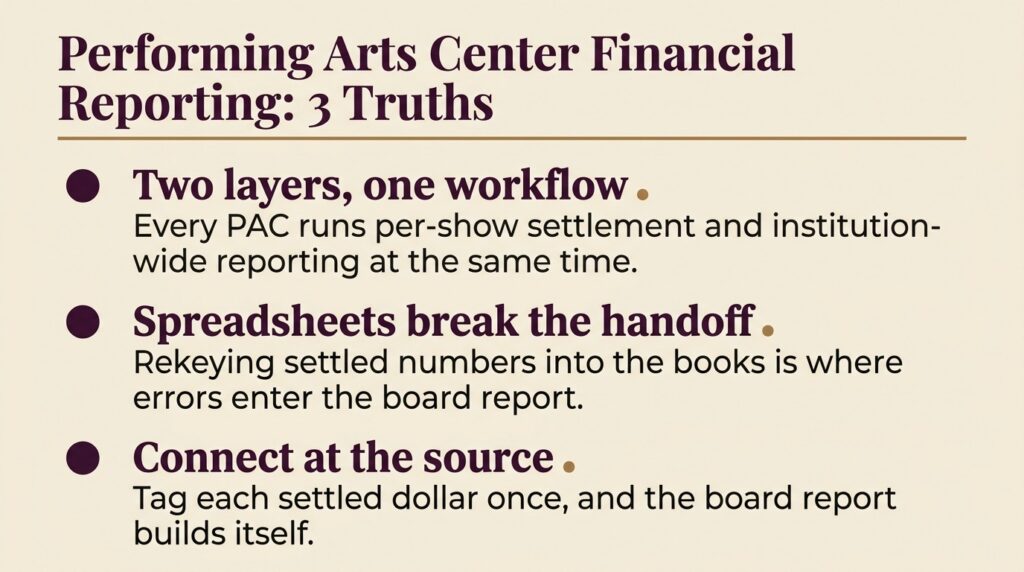
- A performing arts center runs on two financial layers at once: per-show settlement and institution-wide reporting to boards, funders, and auditors.
- When settlement lives in a spreadsheet, every show becomes a rekeying job, and reconciliation errors travel straight up into the numbers your board sees.
- PACs carry reporting demands most venues don’t: deferred season revenue, restricted funds, and grant accountability that generic event tools ignore.
- The fix is connecting settlement to reporting at the source, so each settled show posts clean to the right line.
If you’re rebuilding the same numbers twice, once to settle the show and once to report it, your tools are the problem.
Performing arts center financial reporting carries a weight most live music venues never feel. A club settles a show, pays the artist, and moves on. A PAC settles a show, then has to roll that result into deferred season revenue, restricted grant funds, and a board deck that a finance committee will pick apart line by line. The work doesn’t end when the box office closes. It ends when the auditor signs off. Yet most centers still run that entire chain through spreadsheets stitched to a ticketing export, which is exactly when the numbers start drifting.
According to a 2025 SMU DataArts analysis, the median arts nonprofit barely broke even in 2024, and roughly one-third hold working capital worth less than two months of expenses. When margins are that thin, a reporting error can threaten the next grant. The centers that stay ahead treat reporting as the back half of the same workflow that settles the show, and they run it on a platform built for how live venues actually operate rather than a stack of disconnected files.
Why Does Performing Arts Center Financial Reporting Break at Settlement?
Performing arts center financial reporting breaks at the seam between the show and the statement. The settlement produces the truth of what a performance earned and spent. The financial report has to carry that truth upward without distortion. Every manual handoff in between is a place for the number to change.
Where Does the Number Get Lost?
A settled show generates gross box office receipts, facility fees, artist payout, production costs, bar and merch splits, and promoter profit. In a spreadsheet workflow, someone reads those figures off the settlement and re-types them into the accounting system, often days later. Each re-entry is a fresh chance to fat-finger a split point or drop a per-ticket fee. By the time the controller builds the month-end statement, the show on paper no longer matches the show that happened.
Why Do Spreadsheets Fail at PAC Scale?
A spreadsheet works fine for one show a year. A PAC running 120 performances across a season, layered with rentals, co-presentations, and a subscription series, quickly overwhelms it. A peer-reviewed review in Frontiers of Computer Science surveyed more than 35 years of research and confirmed what finance teams already feel: faults are common in operational spreadsheets, and they compromise the decisions built on them. Our guide to why venue management software replaces spreadsheets makes the point bluntly: holds, versus deals, and settlement math are foreign concepts to tools built for weddings and conferences. When you force a PAC’s reporting through generic software, you inherit the hours spent reconciling as a permanent line item.
What’s Different About Financial Reporting for a PAC?
A PAC’s financial reporting answers to constituencies that a commercial venue never deals with: a board, a finance committee, foundation program officers, and an external auditor. That changes what every settled show has to support downstream.
How Do Restricted Funds and Grants Change the Math?
Most performing arts centers operate as nonprofits, which means fund accounting isn’t optional. Revenue arrives tagged: a foundation grant restricted to education programming, a sponsorship tied to a specific series, and unrestricted single-ticket income. Each stream carries its own recognition rules and reporting deadline. A settlement tool that dumps everything into one undifferentiated “revenue” bucket forces your finance team to re-sort it by hand before anything can go to a funder.
Why Does Season Subscription Revenue Complicate Reporting?
Season subscriptions are the wrinkle that generic event tools miss entirely. As the accounting advisory firm Insero Advisors notes, ticket sales for a season that spans two fiscal years require deferred revenue accounting, recognizing income as each performance occurs rather than when the subscriber pays in June. A subscriber’s check covers eight shows across two reporting periods. Recognize it all at once, and you overstate this year and understate next year. Your finance tools have to hold that revenue and release it performance by performance, so the settlement of each show also triggers recognition of its slice of subscription income.
How Does the Venue Settlement Process Work?
Before reporting can be clean, the settlement underneath it has to be right. The venue settlement process is the post-show reconciliation of every dollar in and out: ticket revenue, expenses, taxes, fees, and the deal math that splits what’s left. With the right workflow, the report builds itself.

What Does a Settlement Look Like, Step by Step?
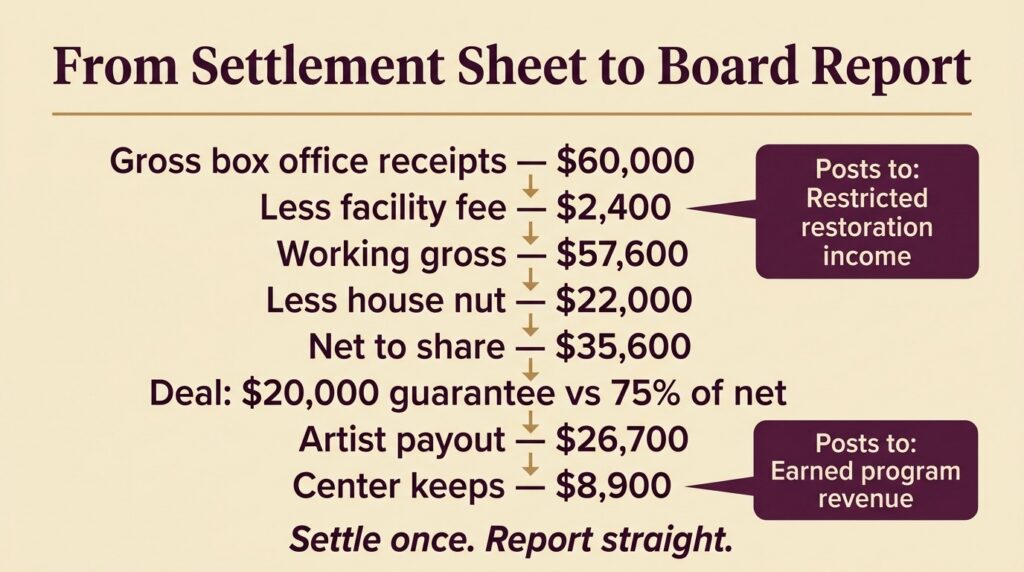
Here’s that workflow as a concrete, illustrative example. Say your 1,500-seat hall sells 1,200 tickets at $50. Gross box office receipts come to $60,000. Strip out a $2 per-ticket facility fee, which is $2,400 feeding your restoration fund, and you’re working from $57,600. Your house nut, the fixed cost of opening the doors, runs $22,000 across rent equivalent, production, front-of-house staff, and insurance. That leaves $35,600 to share. The deal is a $20,000 guarantee versus 75% of net after the house nut. Seventy-five percent of $35,600 is $26,700, which beats the guarantee, so the artist earns $26,700, and the center keeps $8,900 plus the facility-fee income.
How Does That Settlement Become a Financial Report?
Now watch the handoff. That $8,900 does more than tally the promoter’s profit on the night. It posts to the earned program revenue on your income statement. The $2,400 facility fee posts to restricted restoration income. The artist payout and production costs hit their own expense lines. When settlement best practices for live venues are followed and the numbers are tagged at the source, the board report assembles itself from settled shows. When they aren’t, someone rekeys all of it, and the budget-to-settlement-to-report chain develops the gaps that show up in audit. Treating the budget as a living document through advance, show day, and settlement is what keeps that chain intact.
What Should Event Settlement Software Do for a PAC?
Event settlement software closes the gap between the show and the statement. For a performing arts center, the bar runs higher than for a commercial club because the output has to satisfy a board and a funder, whereas a club answers only to an agent. Strong software for a PAC handles all of the following.
- Pull live ticket counts from your ticketing integration. The settlement should read real GBOR straight from your ticketing platform as sales happen, so day-of numbers are accurate the moment the box office closes. No export, no copy-paste, no version mismatch.
- Run the full deal math, including versus deals and split points. Guarantees, percentage backends, per-ticket bonuses, and split points all have to be automatically calculated against the current ticket count. If your tool can’t model a versus deal, it can’t settle a real show.
- Handle co-promotion splits without a side spreadsheet. When a center co-presents with an outside promoter, the platform should calculate each partner’s share, track shared expenses, and produce a clean split for both sides. Side spreadsheets are where co-pro disputes are born.
- Output a signable settlement document. An agent should be able to review and sign a clean, branded settlement on the spot, not wait for someone to format a PDF the next morning.
- Tag revenue by fund, series, and restriction. This is the PAC-specific requirement. Each settled dollar needs to carry its accounting context so restricted grants, subscription series, and unrestricted income stay separated for reporting.
- Roll show-level results into period and series reporting. The single show has to automatically aggregate up into the month, the series, and the full season, which is the difference between settlement software and a settlement calculator.
Those fifth and sixth points are where most general-purpose event tools stop short. They settle the show, then leave your finance team to rebuild the institutional view by hand.
How Do PAC Finance Tools Turn Settlements Into Board-Ready Reports?
The payoff of good PAC finance tools is a report you didn’t have to build twice. Real-time financial reporting baked into the workflow means you know where you stand down to the show, the series, and the funder the moment a settlement closes. That visibility is exactly what a finance committee wants and what a grant report demands.
What Does Real Customer Proof Look Like?
The Auditorium Theatre in Chicago, a 3,900-seat hall with more than a century of history, lived the spreadsheet version before switching platforms. Senior Talent Buyer Matt Rucins, a 26-year industry veteran, called the change “extremely game-changing in simplifying a once convoluted, error-prone, complex settlement process” in the center’s co-promotion case study. That’s the settlement layer cleaning up, which is the foundation the reporting layer stands on. For benchmarking how shows performed against the wider market, centers also lean on pooled box office data shared across the industry.
Is This Worth the Investment?
The market says PAC operators have already decided. Grand View Research values the event management software market at $16 billion in 2025, growing to $39.6 billion by 2033 at a 11.5% compound annual rate, with 64% of deployments already cloud-based. Purpose-built live music platforms hold a clear edge over generic event software here because they understand holds, versus deals, and co-promotion splits natively rather than bolting settlement on as an afterthought. A center evaluating solutions built for performing arts venues should weigh that fit directly because the gap between a purpose-built tool and a general one shows up every single settlement night.
Close the Gap Between Settling and Reporting
Your performing arts center financial reporting will only ever be as reliable as the settlements feeding it. When you connect those two layers, the month-end stops being a reconstruction project. Leave them disconnected, and you’ll keep paying the spreadsheet tax in staff hours and audit risk. When you’re choosing live music management software that handles the settlement workflow and the board report in one connected system, Prism was purpose-made for how PACs, theaters, and promoters actually run. Schedule a demo and see how clean settlements turn into reports your board can trust.
FAQ
What is performing arts center financial reporting? It’s the practice of reporting a PAC’s financial activity to its stakeholders: boards, finance committees, funders, and auditors. It combines earned revenue from ticket sales and rentals with contributed revenue from grants and sponsorships, tracked through fund accounting that separates restricted from unrestricted dollars. Every settled show feeds into it.
How is event settlement software different from accounting software? Settlement software reconciles an individual show: ticket revenue, expenses, deal math, and payouts. Accounting software books the resulting numbers into your general ledger and financial statements. The strongest setups connect the two so that settled figures flow into accounting tagged by fund and series, without manual re-entry.
What makes the venue settlement process harder for PACs than clubs? PACs layer institutional requirements on top of show-level settlement. A club settles and pays. A PAC settles, then has to recognize deferred season revenue, allocate restricted funds, and produce reporting that survives an audit and a grant review. The settlement is the same, but the downstream reporting burden is far heavier.
Can PAC finance tools handle deferred season subscription revenue? Purpose-built finance tools can hold subscription revenue and recognize it performance by performance across the season, rather than booking it all when the subscriber pays. This keeps each fiscal period accurate and matches the deferred revenue accounting that auditors and GAAP expect of nonprofit performing arts organizations.
Does settlement software replace a controller or auditor? No. It removes the manual rekeying and reconciliation that eat a finance team’s time and introduce errors. Your controller and auditor still own classification, compliance, and sign-off. The software gives them clean, source-tagged numbers to work from instead of a stack of PDFs to reconcile by hand.

Matt Ford is the founder and CEO of Prism.fm, a platform built to help the live music industry operate with more clarity and confidence. After 15+ years running venues, producing festivals, and promoting shows, Matt saw firsthand how much of the business relied on fragmented tools and guesswork. He founded Prism in 2018 to change that.
Today, Prism powers more than 3,000 venues and 330 organizations nationwide, serving as an all-in-one platform designed to streamline operations by replacing cumbersome spreadsheets with integrated tools for booking, financial tracking, and contract management. Matt has also led the development of Insights, Prism’s demand prediction platform, which uses real, verified ticketing data to help teams better understand artist performance and make smarter decisions before committing to a show.
Related Post

Best Performing Arts Management Software for PACs: 2026 Buyer’s Guide
Most performing arts management software only runs half your building, and the half it skips is where your margin lives. Before you sign anything in 2026, buy for the workflow you actually run: book, confirm,…

Theatre Management Software vs. Performing Arts Center Software: What PACs Actually Need
The label on the software matters far less than whether the tool models how a performing arts center actually runs a week. Shop by whether the software can run your Tuesday: a school matinee, a…
Performing Arts Center Software: How PACs Manage Complex Events & Reporting
A performing arts center runs more event types through the same rooms than any other venue in live entertainment, and generic scheduling tools collapse under that complexity. If your calendar, deals, and financials live in…