
Performing Arts Center Software: How PACs Manage Complex Events & Reporting
A performing arts center runs more event types through the same rooms than any other venue in live entertainment, and generic scheduling tools collapse under that complexity.
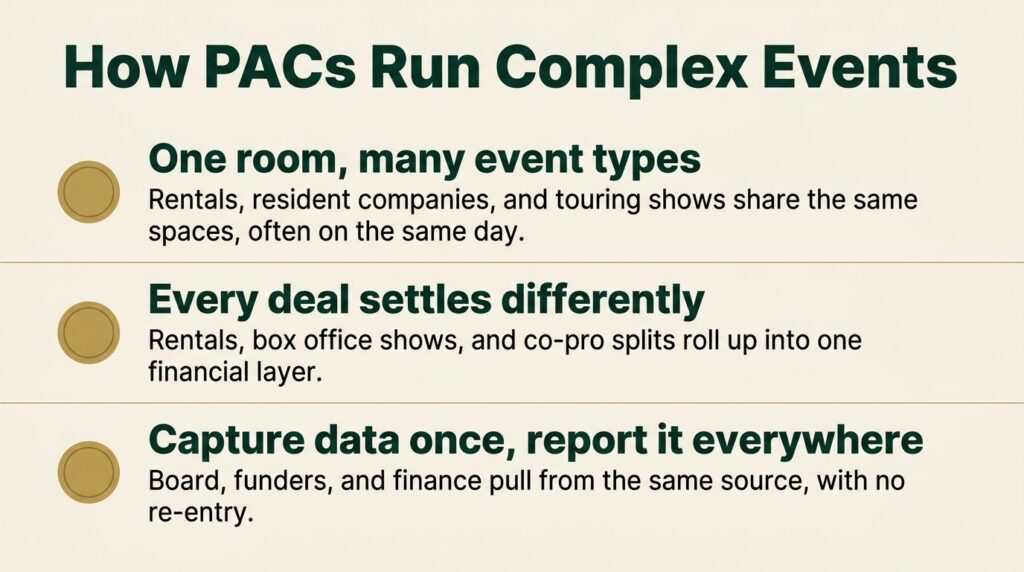
- PACs stack rentals, resident companies, touring shows, and education programs into the same spaces, often on the same day. Calendars built for single-use venues can’t model that.
- The deal math changes per event type. Rentals bill flat or hourly, self-promoted shows settle on box office, and co-promotions split profit. One financial layer has to roll all of it up.
- Real-time ticketing integration turns settlement from a week of spreadsheet reconciliation into a same-day report.
- Your board, funders, and department heads all pull from the same underlying data, so the system has to capture it once and slice it many ways.
If your calendar, deals, and financials live in three different tools, you’re already paying for that gap in staff hours and missed bookings. Consolidate.
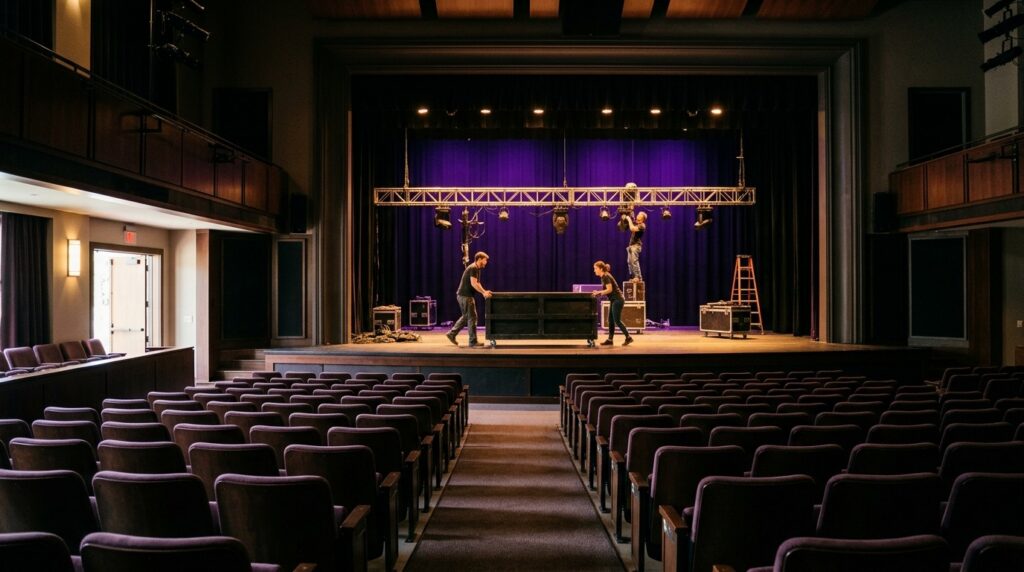
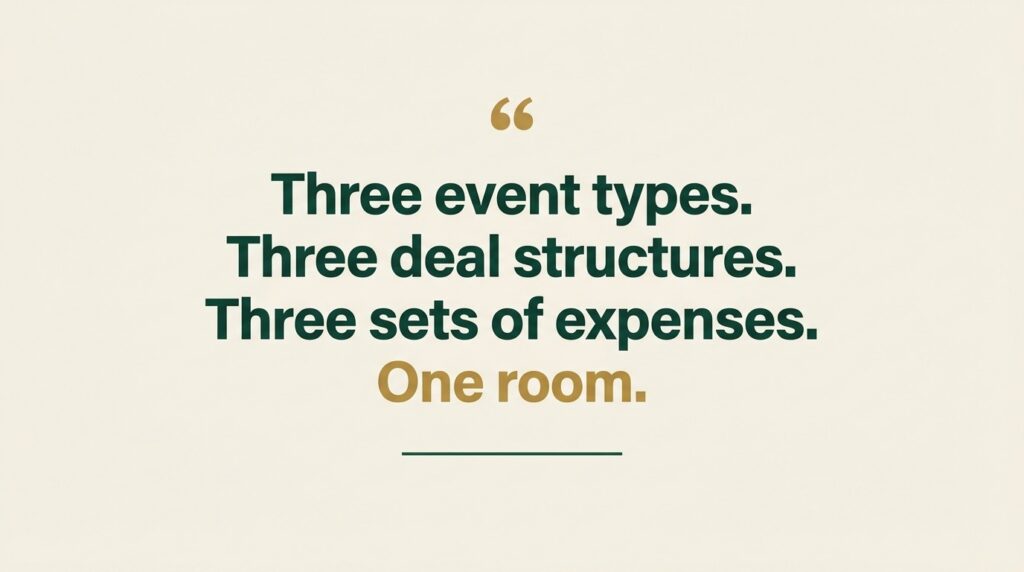
A performing arts center is the hardest venue in live entertainment to run on software, and most operators know it the moment they try to fit their week into a standard calendar app. A single hall might host a school matinee at 9 am, a resident dance company’s tech rehearsal at 2 pm, and a self-promoted touring act at 8 pm. Three event types, three deal structures, three sets of expenses, one room. Performing arts center software exists to manage that density without the spreadsheet sprawl that swallows your staff’s week.
The category is growing for a reason. According to Grand View Research, the event management software market reached $16 billion in 2025 and is on track to hit $39 billion by 2033, with cloud-based platforms already holding more than 64% of the market. PACs are part of that shift because the old way, juggling Outlook holds, emailed contracts, and a settlement spreadsheet someone rebuilds every show, costs real money in missed bookings and slow payouts. A platform built specifically for live event venues replaces that patchwork with one system your whole building works out of.
What Is Performing Arts Center Software?
Performing arts center software is a centralized platform that handles the full operational lifecycle of a PAC: the booking calendar, holds and confirms, rental agreements, offers and contracts for promoted shows, advancing, run of show, financial tracking, settlement, and reporting. You run programming, production, and finance from the same source of truth instead of stitching together a calendar tool, a CRM, and accounting exports.
General platforms treat a wedding, a corporate conference, and a touring concert as the same kind of event. A PAC tool understands that a rental and a promoted show generate completely different paperwork and completely different money. It knows what a hold priority is, how a versus deal pays out, and why your box office manager shouldn’t see artist guarantees. Strong performing arts center management starts with that specificity.
It also has to flex across your tenant mix. Resident companies, visiting promoters, community renters, and your own self-promoted programming each touch the calendar differently, and the software has to keep all of them from colliding on the same date.
Why Won’t General Event Scheduling Software Run a PAC?
General event scheduling software handles availability and double-booking prevention well enough. The problem starts the moment money enters the picture. A PAC’s revenue arrives through at least four channels: rental fees, ticket-driven settlements, co-promotion splits, and ancillary income like bar, parking, and facility charges. Generic tools have no native concept of any of that, so your team rebuilds the math by hand every time.
Settlement is where the gap gets expensive. A promoted show settles on gross box office revenue, deducts taxes and fees to reach net, subtracts the house nut and production costs, pays the artist guarantee, and then often calculates a backend split. A rental settles on a flat fee plus reimbursable expenses. A co-promotion splits the profit (or the loss) with a partner. When your scheduling tool can’t run those calculations, you export to a spreadsheet, and that’s where errors and delays creep in. Teams that automate performing arts center management report saving hours every week on settlement prep alone.
There’s a reporting cost too. When deal data lives in spreadsheets, you can’t answer simple questions quickly: which rentals are most profitable, how your self-promoted shows performed against projection, or what your space utilization actually was last quarter. Purpose-built event scheduling software for PACs captures that data once, at the point of booking, so the reporting builds itself.
How Does PAC Software Handle Multiple Events in One Space?
The defining PAC challenge is turning one room over multiple times a day for different users, and good PAC software treats that as a first-class workflow rather than an edge case. It starts with a calendar that distinguishes a hard confirm from a soft hold, layers performance setups and changeovers onto the same date, and flags conflicts before they reach a contract.
Consider a realistic day in a 1,500-seat hall:
- 9:00 am, school matinee (rental). A flat facility fee plus staffing reimbursement. No box office settlement, but it needs front-of-house and a house manager.
- 2:00 pm, resident company rehearsal. No revenue, but it occupies the stage and crew, so it has to hold the room and pull production resources.
- 8:00 pm, self-promoted touring act. Full box office settlement, an artist guarantee, a versus deal, and live ticketing data flowing in all day.
Three events, three financial models, one calendar, one crew schedule. Software built for PACs keeps each one’s deal terms, expenses, and permissions separate while showing the building as a whole. Medium-capacity venues like this carry real weight in the market: Mordor Intelligence reports that venues between 1,001 and 10,000 seats held 48.15% of the U.S. live music market in 2025, the single largest share by venue size. That’s the heart of the PAC segment, and it’s the operation most punished by tools that assume one event per room.
How Do You Settle and Report on So Many Deal Types?
The answer is real-time data and a settlement engine that already knows your deal. When your settlement process connects to live ticketing instead of a weekly emailed report, you watch a show’s performance as tickets sell, and you settle the night of the show instead of three days later.
Here’s the math a PAC tool should run for you on that 8:00 pm self-promoted show, using illustrative figures:
- Gross box office revenue: 1,200 tickets × $45 = $54,000
- Less 8% tax and ticketing fees: −$4,320 → Net box office revenue: $49,680
- Less house nut and production: −$15,000
- Less artist guarantee: −$25,000
- Promoter profit before backend: $9,680
If the deal includes an 85/15 backend split over the guarantee, the platform automatically applies it and produces a branded settlement sheet on the spot. Run that same logic across a co-promotion, and it splits the $9,680 by the partner’s percentage and any per-ticket bonus, then tracks who owes whom. When you do it by hand across 200 shows a year, you’ve built a part-time job out of arithmetic.
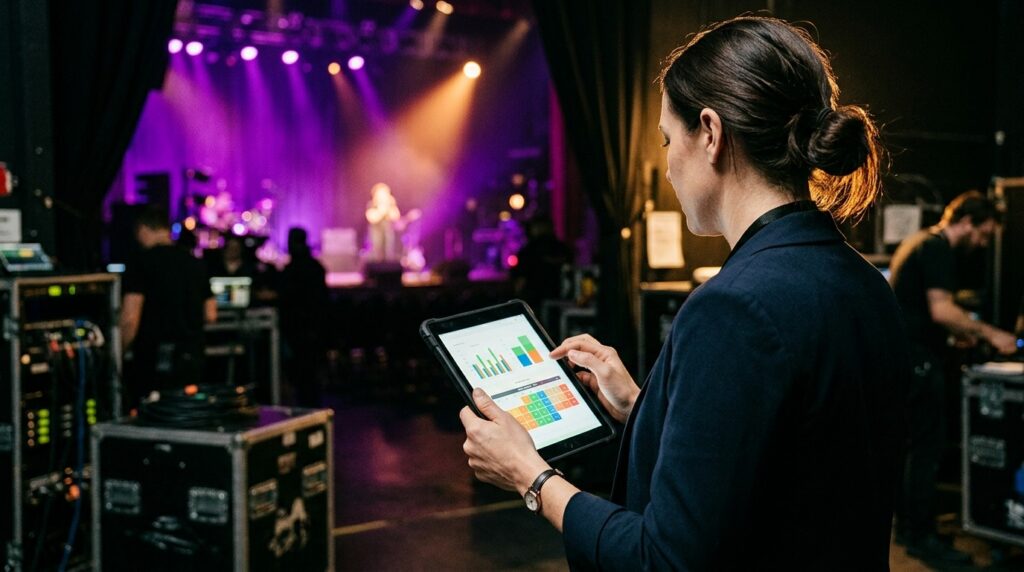
Reporting is the payoff. Because every event captured its deal terms and actuals at the source, you can roll the whole season into the views different stakeholders need: profitability by event type for your board, attendance and utilization for programming, and payout status for finance. The same data that settled one show feeds the reporting that your whole calendar depends on. For programming decisions, pooled box office benchmarks from platforms let you check an artist’s real draw history before you commit a date.
What Should You Look for in Performing Arts Center Software?
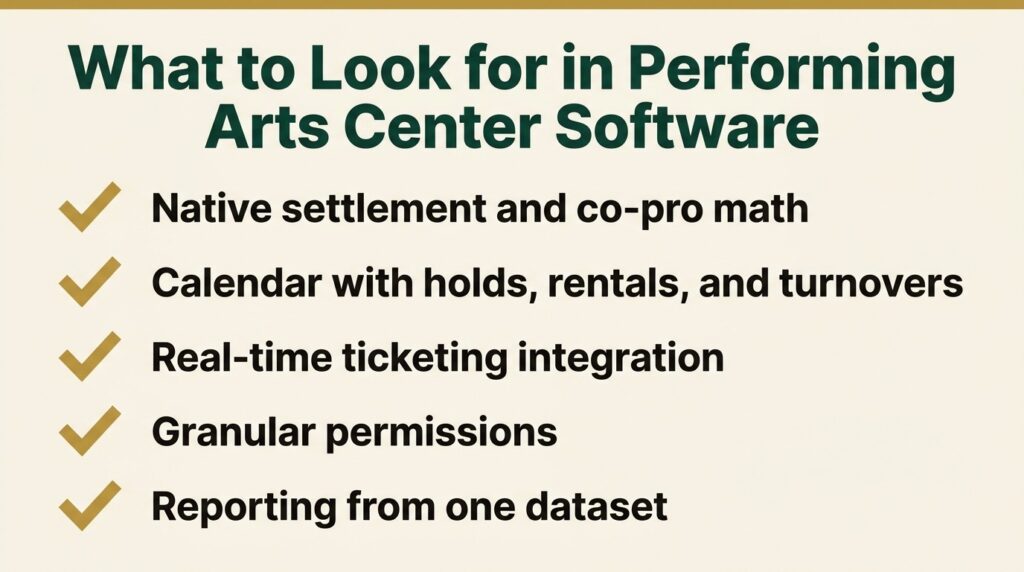
Evaluating performing arts center software comes down to whether it understands how a PAC actually operates. Feature checklists look similar across vendors, so press on the workflows that break generic tools. Use these five criteria.
- Native settlement and co-promotion math. The platform should calculate settlements and co-pro splits itself, not hand you off to an exported spreadsheet or a third-party tool. If a vendor’s answer to settlement is “we integrate with X,” that’s a gap.
- A calendar that models holds, rentals, and turnovers. It needs hold priorities, multi-use days, changeover blocks, and conflict detection across every room and resource, not just an availability grid.
- Real-time ticketing integration. Live sales data should automatically flow into financials so settlement and pacing reports are current, not pulled from a weekly export.
- Granular permissions. Your lighting tech, box office manager, and finance lead should each see exactly what they need and nothing more. Sensitive deal terms stay protected.
- Reporting that slices one dataset in many ways. Board reports, funder reports, utilization, and per-event P&L should all build from the same captured data without re-entry.
A multi-venue operation proves the point. The Pabst Theater Group runs six venues and over 700 events a year on a single platform, which only works when the calendar, deals, and financials share one system. When spread across six disconnected tools, the model falls apart.
Run Your Whole Building From One System
A PAC doesn’t fail because its programming is weak. It strains when great programming runs on tools that were never built for overlapping shows, mixed deal types, and the reporting your board and funders expect. The fix is consolidation: one platform where the calendar, contracts, ticketing data, and settlement math live together, so your team spends its hours on the season instead of on spreadsheets.
When you’re evaluating performing arts center software built for this kind of complexity, Prism gives PACs one system for booking, settlement, and reporting across every room and every deal type. Book a demo and see your whole building in one view.
Frequently Asked Questions
What is performing arts center software? It’s a centralized platform that manages a PAC’s full operation: the booking calendar, holds, rental agreements, offers and contracts, advancing, financial tracking, settlement, and reporting. It replaces the spreadsheets, email chains, and disconnected calendar tools that most venues outgrow, putting programming, production, and finance in one source of truth.
How is PAC software different from general event scheduling software? General event scheduling software handles availability and prevents double-bookings, but it has no native concept of box office settlement, co-promotion splits, hold priorities, or rental versus promoted-show deal math. PAC software runs those calculations directly and captures the data that your reporting needs at the point of booking.
Can performing arts center software handle rentals and self-promoted shows together? Yes. The right platform models different event types on the same calendar with their own deal terms, expenses, and permissions, including a flat-fee rental, a no-revenue resident rehearsal, and a fully settled promoted show on the same day in the same room.
Does PAC software integrate with ticketing platforms? Purpose-built platforms integrate with major ticketing providers so sales data automatically flows into your financials. That gives you real-time pacing during the on-sale and lets you settle a show the night it happens instead of waiting on a weekly report.
What reporting should a performing arts center expect from its software? Expect profitability by event type, per-event and per-season P&L, space utilization, payout and settlement status, and board- or funder-ready summaries. Because the data is captured once at booking, the same dataset should produce every view without manual re-entry.

Matt Ford is the founder and CEO of Prism.fm, a platform built to help the live music industry operate with more clarity and confidence. After 15+ years running venues, producing festivals, and promoting shows, Matt saw firsthand how much of the business relied on fragmented tools and guesswork. He founded Prism in 2018 to change that.
Today, Prism powers more than 3,000 venues and 330 organizations nationwide, serving as an all-in-one platform designed to streamline operations by replacing cumbersome spreadsheets with integrated tools for booking, financial tracking, and contract management. Matt has also led the development of Insights, Prism’s demand prediction platform, which uses real, verified ticketing data to help teams better understand artist performance and make smarter decisions before committing to a show.
Related Post

Best Performing Arts Management Software for PACs: 2026 Buyer’s Guide
Most performing arts management software only runs half your building, and the half it skips is where your margin lives. Before you sign anything in 2026, buy for the workflow you actually run: book, confirm,…
Theatre Management Software vs. Performing Arts Center Software: What PACs Actually Need
The label on the software matters far less than whether the tool models how a performing arts center actually runs a week. Shop by whether the software can run your Tuesday: a school matinee, a…

Performing Arts Center Financial Reporting & Settlement
Your board report is only as clean as the show settlements feeding it. If you’re rebuilding the same numbers twice, once to settle the show and once to report it, your tools are the problem.…