

Best Performing Arts Management Software for PACs: 2026 Buyer’s Guide
Most performing arts management software only runs half your building, and the half it skips is where your margin lives.
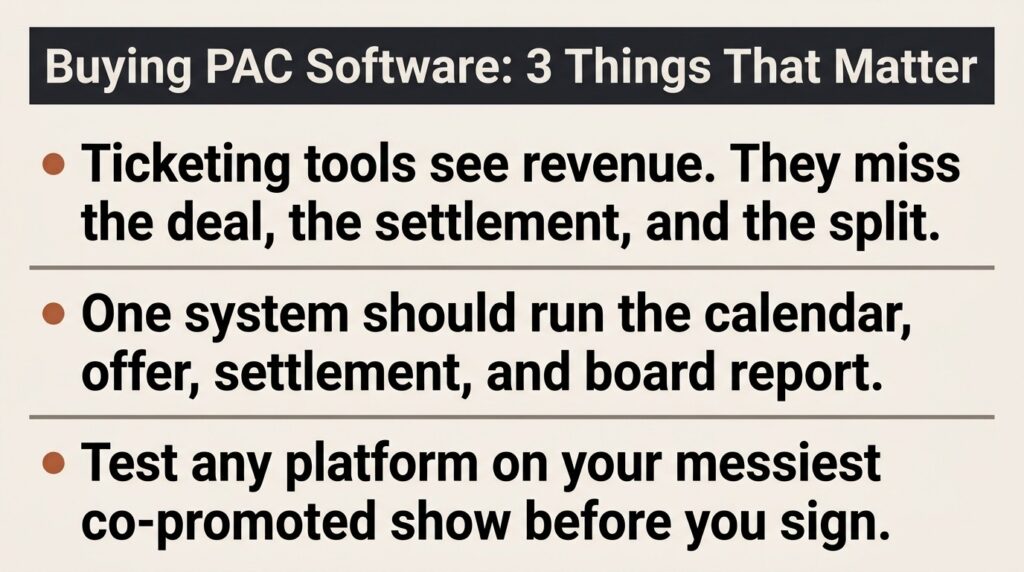
- Ticketing-only platforms sell tickets and manage patrons, but they don’t book talent, settle shows, or split co-promotion deals.
- Scheduling-only tools stop conflicts and track rooms, but they never touch the deal economics that decide whether a show made money.
- A PAC that buys and co-promotes shows needs one system that connects the calendar, offer, settlement, and board report.
- The feature matrix and use cases below show where each category of tool wins and where it leaves you rebuilding numbers in a spreadsheet.
Before you sign anything in 2026, buy for the workflow you actually run: book, confirm, settle, report, repeat.
Performing arts management software promises one system to run a building where a Broadway tour, a symphony rehearsal, a rental wedding, and a touring rock act all hit the same calendar in the same week. Most platforms sold to performing arts centers deliver only a slice of that. According to SMU DataArts’ 2025 National Trends report, 44% of arts organizations ran a deficit in 2024, and median working capital fell to roughly 4.2 months of expenses, the thinnest cushion in six years. When margins get that tight, the tool you use to book, settle, and report on every event becomes an operating decision, not an IT purchase. The right PAC management software closes the gap between programming, finance, and operations instead of making three teams reconcile three versions of the truth.
This guide compares the categories a PAC evaluates, hands you a feature matrix to take into a demo, and shows how each type performs for programming, finance, and operations.
What Is Performing Arts Management Software, and What Should It Do?
Performing arts management software is the operating system for a venue that programs, hosts, and settles live events. At a minimum, it should hold your calendar, manage holds and confirms, generate offers, track deal terms, settle shows, and produce financial reporting that your board and funders trust. Anything that handles only one of those jobs is just a point solution.
The real test is whether a single show flows through the platform end-to-end. You place a hold, turn it into a confirmed offer, advance the date, run the night, settle the money, and roll it into a report, without exporting to a spreadsheet halfway through. A tool that breaks that chain turns your team into the integration layer.
Which Jobs Do PACs Need It to Cover?
A performing arts center runs more distinct event types through the same rooms than any other venue in live entertainment. The platform has to distinguish a bought show from a rental, a co-promoted date from a four-wall, and a hard hold from a tentative inquiry. For the operational details on how those types coexist on one calendar, this performing arts center software walkthrough covers it. This guide stays focused on choosing between categories.
Why Do Ticketing-Only Tools Fall Short for PACs?
Ticketing platforms are excellent at what they were built for: selling tickets, managing patron data, and running fundraising campaigns. The catch is that a PAC’s financial picture starts long before a ticket sells and doesn’t close until the show settles. Ticketing tools see revenue. They don’t see the guarantee you promised the artist, the production costs you carried, or the split you owe a co-promoter.
That blind spot matters because the box office is one line in a settlement. Your net depends on the deal you struck, the expenses you carried, and any partner splits, none of which live in a ticketing system. When a ticketing tool reports strong sales on a night that lost money after the guarantee, that’s a category problem, not a reporting glitch. Enterprise suites anchor the patron and revenue side well, and many PACs will keep one. Pair it with dedicated booking and settlement software, and you get the full show economics that ticketing alone can’t produce.
What Should a PAC Software Feature Matrix Include?
Bring a matrix to every demo. The fastest way to expose a point solution is to score it against the full lifecycle of a show rather than the features a sales deck leads with. The table below maps the capabilities a programming, finance, and operations team touches in a normal week against the three categories you’ll evaluate.
| Capability | Enterprise ticketing/CRM suites | Scheduling & resource tools | Booking + settlement platforms |
| Public ticketing and box office | Core strength | Limited | Via integration |
| Patron CRM and fundraising | Core strength | No | No |
| Calendar, holds, and confirms | Basic | Core strength | Core strength |
| Room and resource conflicts | Basic | Core strength | Strong |
| Talent offers and deal terms | No | No | Core strength |
| Show settlement | No | Partial | Core strength |
| Co-promotion splits | No | No | Core strength |
| Board and whole-show reporting | Revenue side only | Cost side only | Whole-show P&L |
| Artist research and benchmarking | No | No | Yes |
| Mobile use in the field | Varies | Varies | Core strength |
Read the matrix by row, not column. Any single tool looks impressive in isolation. What matters is how many rows go dark when you commit to one category because every dark row is a spreadsheet your team maintains by hand.
How Do the Main Categories of Arts Management Software Compare?
Buyers get overwhelmed because vendors describe themselves in overlapping language. Cut through it by sorting every option into one of five categories, then match the category to the way your PAC actually makes money. Here’s how the landscape breaks down.
- Enterprise ticketing and CRM suites. Built around patrons, subscriptions, and fundraising. They excel at audience data and donor cultivation, but they never generate an artist offer or settle a show, so the deal happens somewhere else.
- Scheduling and resource-management tools. Built to prevent double-bookings and coordinate rooms, crews, and equipment. They shine on operations and struggle with money because tracking a room isn’t settling a deal.
- General event and venue-booking platforms. Broad tools marketed to weddings, conferences, and corporate events. They handle rentals fine but miss the versus deals, radius clauses, and co-promotion math that define touring programming.
- Registration and education platforms. Software aimed at studios, schools, and class-based programs. Useful for enrollment, irrelevant for a PAC buying a national touring act.
- Booking and settlement platforms. Built for talent buyers, where the offer, advance, settlement, and co-promotion split are first-class features. This category closes the loop that the others leave open, and most PAC evaluations underweight it because ticketing vendors own the search results.
Most PACs run a ticketing platform alongside a booking and settlement platform because those two categories cover opposite ends of the same show. Assuming a single ticketing suite covers both is where the settlement gets expensive.
How Does the Right Software Serve Programming, Finance, and Operations Teams?
A buyer’s guide is useless if it only compares features. What matters is whether each team gets its job done inside one system. Grand View Research projects the event management software market will climb from $16 billion in 2025 to $39.6 billion by 2033, a 11.5% CAGR, with roughly 64% of deployments cloud-based. More options mean more sales pitches, so a function-by-function evaluation is the only way to stay honest.

What Do Programming and Talent-Buying Teams Need?
Programmers live in the calendar and the offer. They need holds and confirms that don’t collide, offers they can generate and send fast, and a clear view of what’s booked versus what’s penciled. When the calendar and the deal share one place, a talent buyer moves from inquiry to signed offer without leaving the platform. If your team is managing complex event schedules across multiple rooms, the scheduling logic has to understand event types, not dates alone.
What Do Finance Teams Need?
Finance needs the settlement and the report to be the same object. The biggest time sink in a PAC back office is rebuilding a show’s numbers twice, once to settle and once to report. Software that pushes a settled show straight into board-ready financial reporting and settlement kills the double entry, the difference between closing the books in an afternoon and chasing tabs across a shared drive for a week.
What Do Operations Teams Need?
Operations needs advancing, run-of-show detail, contacts, and mobile access. A platform that only works on an office laptop fails the people running the night. Mobile access to the same live data that the office sees keeps the door, stage, and box office aligned in real time.
How Do You Evaluate Performing Arts Center Software Before You Buy?
Run every finalist through the same four checks, using real shows from your own calendar instead of the vendor’s demo data. For a broader capability list to build your scorecard from, this event management software features checklist is a solid starting point.
- Run a full lifecycle. Book a hold, confirm it, settle it, and report it inside the tool. Note every place you had to export.
- Test a co-promotion split. If the platform can’t model a partner deal, you’ll settle those shows in a spreadsheet forever.
- Check who sees the truth. Confirm programming, finance, and operations all read from the same live data, not three copies.
- Pressure-test reporting. Ask whether a settled show automatically becomes a board report or whether someone rekeys it.
Purpose-built matters because the money is real. Mordor Intelligence projects the U.S. live music market will grow from $18.51 billion in 2025 to $26.93 billion by 2031, a 6.45% CAGR. A PAC capturing even a sliver of that through bought and co-promoted shows can’t afford software that goes blind at settlement. Tools built for performing arts centers treat the deal and the settlement as core, not as an afterthought bolted onto a ticketing engine.
What Does a Co-Promotion Settlement Actually Look Like?
Here’s an illustrative example of the math ticketing-only tools can’t produce. Say your PAC co-promotes a touring act with an outside promoter on a 50/50 split of show profit, plus a $1-per-ticket bonus to the partner.
- Gross ticket revenue: 2,000 tickets at $40 = $80,000
- Show costs (guarantee, production, marketing): $52,000
- Show profit: $80,000 minus $52,000 = $28,000
- 50/50 split: $14,000 to each side
- Partner per-ticket bonus: 2,000 tickets at $1 = $2,000
- Partner total: $14,000 plus $2,000 = $16,000; your PAC keeps $12,000
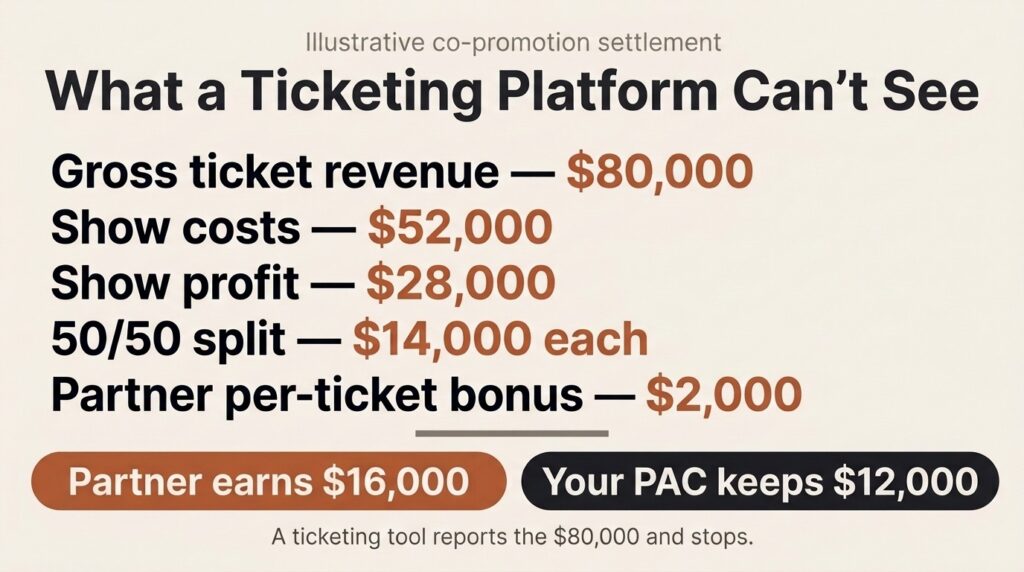
A ticketing platform reports the $80,000 and stops. It never sees the $16,000 you owe your partner or the $12,000 you actually kept. A platform that runs the whole settlement, the way the Auditorium Theater does in this co-promotion case study, stores that result and automatically rolls it into your reporting.
Pick the Platform That Settles the Whole Show
The best platform for your building carries a show from hold to confirmed offer to settlement to board report without dropping you into a spreadsheet. Ticketing tools stop at the box office. Scheduling tools stop at the calendar. Your building needs a system that closes the loop on the money because that’s where thin margins get won or lost.
When you’re comparing PAC software built for how performing arts centers actually book, settle, and report, Prism connects programming, finance, and operations in one platform trusted at over 10,000 venues worldwide. See how it fits your building and schedule a demo to run one of your own shows through it end-to-end.
Frequently Asked Questions
What Is Performing Arts Management Software?
It runs a venue’s live-event operations: the calendar, holds and confirms, talent offers, deal terms, show settlement, and financial reporting. The strongest options connect programming, finance, and operations in one system, so a single show flows from booking to board report without manual exports.
How Is Performing Arts Center Software Different From Ticketing Software?
Ticketing software sells tickets and manages patrons, donors, and subscriptions. Booking-focused software adds the buy side: generating offers, tracking deal terms, settling shows, and splitting co-promotion deals. A ticketing platform sees ticket revenue, while booking and settlement software sees whole-show profit after guarantees, costs, and partner splits.
Do PACs Still Need PAC Software if They Already Use a Ticketing Platform?
Yes, in most cases. Ticketing platforms and booking software cover opposite ends of the same show. A ticketing suite handles the box office and patron data, but it doesn’t book talent or settle deals. Pairing the two gives every team a complete picture instead of a revenue-only snapshot.
What Features Matter Most When Buying Arts Management Software for a PAC?
Prioritize the full show lifecycle: a calendar with real holds and confirms, offer generation, deal-term tracking, settlement, co-promotion splits, and reporting a settled show feeds automatically. If a platform can’t run one of your co-promoted shows end-to-end in a demo, it will create manual work every week after you buy it.
How Much Does This Software Cost?
Pricing varies by category and venue size. Enterprise ticketing and CRM suites often involve quote-based contracts and long implementations, while booking and settlement platforms typically run on subscriptions scaled to your volume. Ask every vendor to price the full workflow you run rather than the module they lead with, then demo it before committing.

Matt Ford is the founder and CEO of Prism.fm, a platform built to help the live music industry operate with more clarity and confidence. After 15+ years running venues, producing festivals, and promoting shows, Matt saw firsthand how much of the business relied on fragmented tools and guesswork. He founded Prism in 2018 to change that.
Today, Prism powers more than 3,000 venues and 330 organizations nationwide, serving as an all-in-one platform designed to streamline operations by replacing cumbersome spreadsheets with integrated tools for booking, financial tracking, and contract management. Matt has also led the development of Insights, Prism’s demand prediction platform, which uses real, verified ticketing data to help teams better understand artist performance and make smarter decisions before committing to a show.
Related Post
Theatre Management Software vs. Performing Arts Center Software: What PACs Actually Need
The label on the software matters far less than whether the tool models how a performing arts center actually runs a week. Shop by whether the software can run your Tuesday: a school matinee, a…
Performing Arts Center Software: How PACs Manage Complex Events & Reporting
A performing arts center runs more event types through the same rooms than any other venue in live entertainment, and generic scheduling tools collapse under that complexity. If your calendar, deals, and financials live in…

Performing Arts Center Financial Reporting & Settlement
Your board report is only as clean as the show settlements feeding it. If you’re rebuilding the same numbers twice, once to settle the show and once to report it, your tools are the problem.…