

Performing Arts Center Software: How PACs Manage Events, Finance & Reporting
A performing arts center has to run events, finances, and institutional reporting as one connected workflow, and the right software holds those jobs together.
- PACs program more deal structures in a week than most venues see in a month: touring concerts, resident companies, rentals, and education programs, each with its own money and paper trail.
- Generic event tools can book a room, but they can’t model a versus deal, split a co-promotion, and roll both into a board report without an export and a spreadsheet in between.
- The financial pressure is real: 44% of arts nonprofits ran a deficit in 2024, so every reconciliation error and late report costs an institution that has no margin to spare.
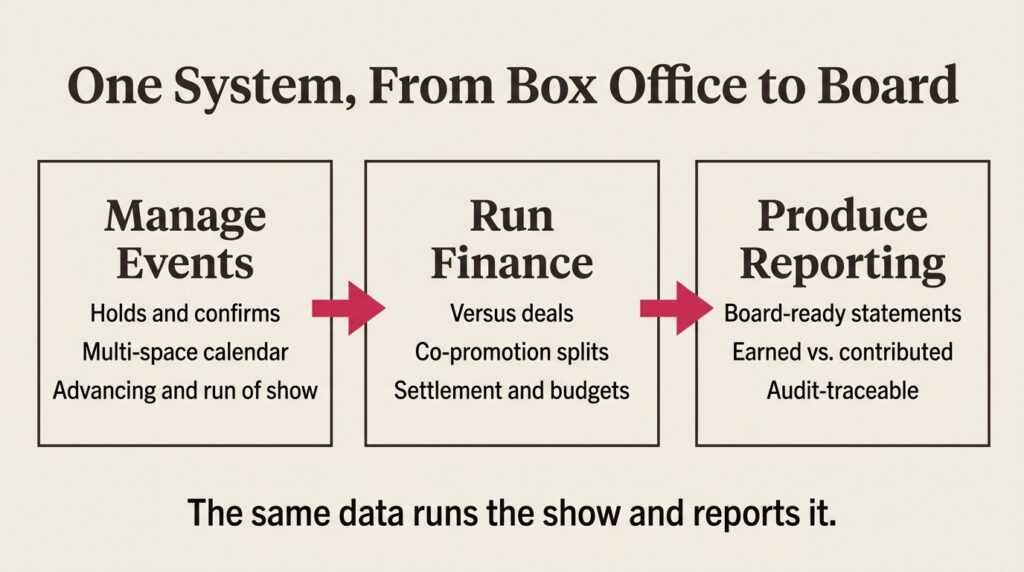
- The platforms that win connect the calendar, settlement, and report so the same number flows from the box office to the board with no rekeying.
If your PAC still reconciles shows in a spreadsheet and rebuilds reports by hand, you’re paying for that workflow in staff hours and audit risk every single season.
A performing arts center runs more kinds of events in a week than most venues run in a month. A touring concert on Friday, a resident ballet matinee Saturday, a corporate rental Monday, and a school workshop Tuesday. Each one carries its own deal structure, expenses, and reporting trail. Performing arts center software holds all of that in one place, from the first hold on the calendar to the final number a board sees. According to Grand View Research, the event management software market reached $16 billion in 2025 and is projected to hit $39.6 billion by 2033 at a 11.5% CAGR, with 64% of deployments already cloud-based. That shift points straight at the kind of purpose-built venue management software that runs a modern PAC.
What Does Performing Arts Center Software Do for a PAC?
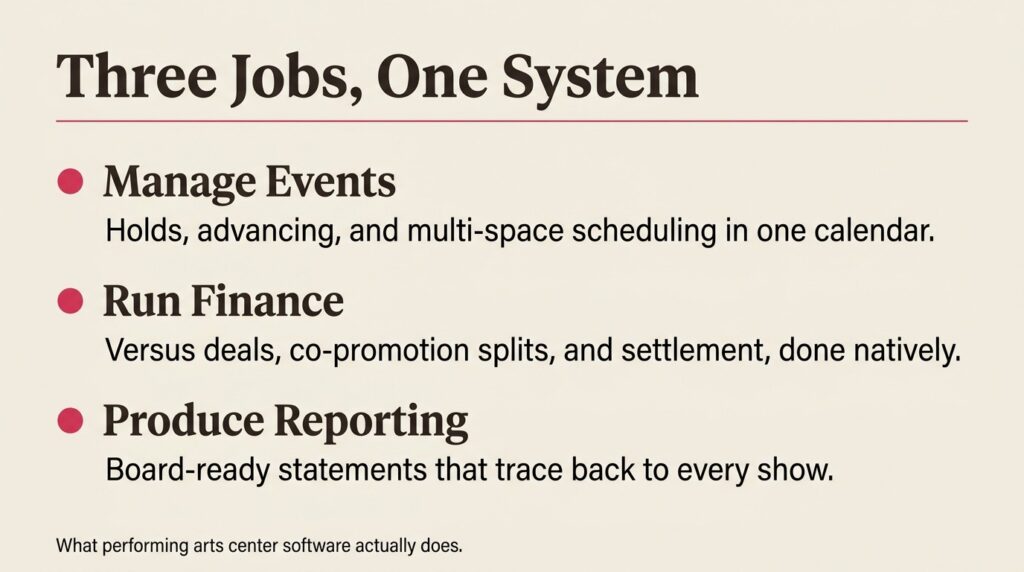
A PAC platform does three jobs at once. It manages the events, it runs the finances, and it produces the reporting that keeps the institution funded. You have one system where the calendar, the deal, and the report all reference the same data.
A touring rock show, a season subscription series, a wedding rental, and a youth matinee don’t just look different on the calendar. They settle differently, carry different cost structures, and answer to different stakeholders. A generic tool treats them all as “events with a date.” A platform built for live entertainment understands that a versus deal and a flat rental are not the same financial object, a distinction that’s explored in this guide to performing arts center venue management.
The stakes are tied to a growing market. Mordor Intelligence values the U.S. live music market at $18.51 billion in 2025, on track for $26.93 billion by 2031 at a 6.45% CAGR. PACs that program touring work compete inside that market, and the margin on a touring night is thin enough that one reconciliation error can erase it.
How Does the Software Manage a PAC’s Events and Schedule?
Scheduling is where a PAC’s complexity shows up first. One stage might host a load-in, a rehearsal, a performance, and a strike inside 18 hours, and the rehearsal hall, lobby, and education studio are all booking in parallel. Arts center scheduling software has to manage that density without double-booking a room or losing a tentative hold.
Why Do Holds and Confirms Matter More in a Shared Building?
In a single-purpose club, a date is open or booked. In a PAC, a date can carry three competing soft holds while a fourth promoter waits on a confirm. Good arts center scheduling software ranks those holds, tracks who’s first in line, and converts a hold to a confirmed show the moment the offer closes. That hold logic prevents the most expensive scheduling mistake a venue makes: promising the same Saturday to two acts.
How Does Advancing Stay Connected to the Calendar?
Advancing a show means locking the technical details, hospitality, timing, and run of show before doors. When advancing lives in the same system as the calendar, the production team and the box office work from one source instead of a chain of forwarded emails. The result is fewer day-of surprises and a cleaner handoff between the people who book the show and those who run it.
How Do PACs Handle Finance and Settlement in One System?
Finance is where purpose-built PAC management software earns its keep. Booking a room is easy. Settling a versus deal, splitting a co-promotion, tracking deposits, and reconciling the box office against the deal terms are where spreadsheets fail. A spreadsheet works for one show a year and breaks for a venue running 200, which is the same reasoning behind building a concert budget that holds from offer to settlement.
What Does a Co-Promotion Settlement Look Like?
Here’s an illustrative example. A PAC co-promotes a touring show with an outside promoter on a 50/50 split of net profit, plus a $1-per-ticket bonus to the co-promoter.
- Tickets sold: 900
- Show net profit after the artist payout and all event expenses: $20,000
- 50/50 split of net profit: $10,000 to each partner
- Per-ticket bonus to the co-promoter: 900 × $1 = $900
- Co-promoter’s total: $10,900. The PAC keeps $9,100.

When the platform calculates that split natively, the per-show settlement and the partner balance are done the moment ticket sales close. This example mirrors the workflow behind the Auditorium Theatre’s co-promotion case study, where a complex co-pro settlement runs inside the platform instead of a side spreadsheet. Getting the deal math right at the source is the foundation of every venue settlement best practice that follows.
How Do Budgets Connect to the Next Season?
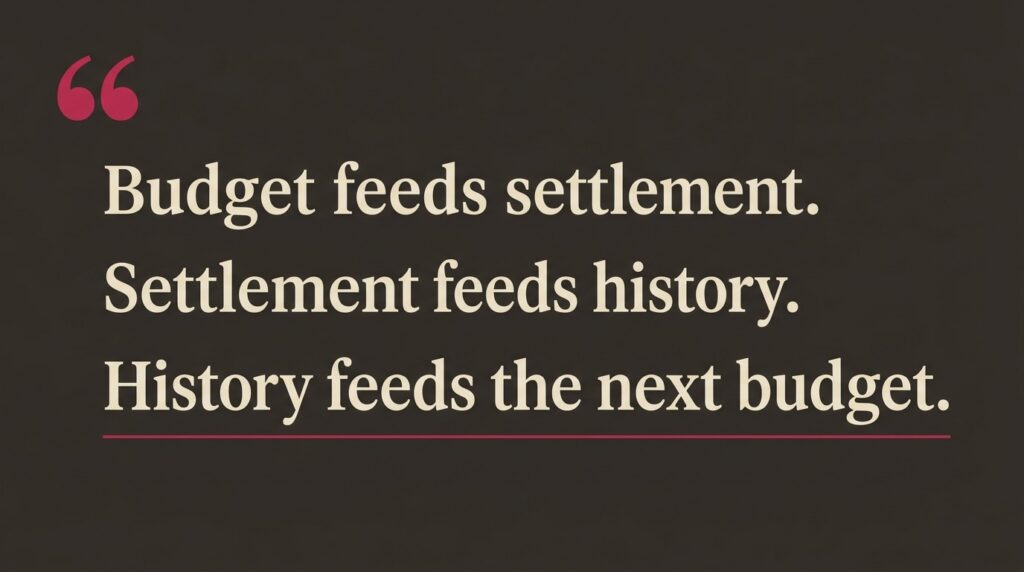
Budget feeds settlement, settlement feeds history, and history feeds the next budget. When a PAC settles every show inside one system, the actuals become a benchmark library. A programmer can see which day-of-week and price combinations protected margin last season, which genres overperformed projections, and which rentals carried real overhead. That feedback loop turns finance from a backward-looking chore into a forward-looking planning tool.
What Reporting Do Boards and Funders Require?
Reporting is the job that separates a PAC from a commercial venue. A nightclub answers to its owner. A performing arts center answers to a board, a roster of funders, an auditor, and often a municipal authority. Venue reporting tools have to roll per-show settlements up into institutional financial statements that survive scrutiny.
The pressure behind those reports is intensifying. According to SMU DataArts’ 2025 National Trends report, contributed revenue at arts nonprofits fell 30% from 2023 to 2024, 44% of organizations ran a deficit, and median working capital dropped from 6.75 months of operating expenses in 2021 to 4.25 months in 2024. When reserves get that thin, a board reviews the numbers closely, and the venue reporting tools producing those numbers have to be fast, accurate, and traceable to source.
Shared data changes the conversation. Platforms that pool real, opt-in box office reports let a programmer see how an artist actually performed in comparable rooms before extending an offer. Budgets and projections built on real comparable draws beat budgets built on memory, and they hold up better when a funder asks how a number was reached.
Which Features Separate Performing Arts Center Software From Generic Event Tools?
Plenty of platforms claim to serve performing arts centers. The ones built for the work share a specific feature set that generic event software can’t fake. Use this evaluation checklist when you compare options.
- Native settlement math. The platform models versus deals, guarantees, co-promotion splits, and per-ticket bonuses without an export. If settlement happens in a spreadsheet, it isn’t real PAC software.
- Multi-space scheduling with ranked holds. Shared rooms, competing holds, and load-in-to-strike density all live in one calendar with conflict detection that actually prevents double-bookings.
- Real-time ticketing integration. Box office data flows into the financials as tickets sell, so projections and settlement update on their own instead of waiting for a manual import.
- Role-based permissions. A lighting tech doesn’t need artist payouts, and a box office manager doesn’t need production schedules. Granular permissions keep the operation lean and secure.
- Unified, board-ready reporting. The same data that runs the show produces the report, so the number a funder sees traces straight back to the settlement that generated it. This is exactly what platforms built for performing arts centers are designed to deliver.
A platform that nails all five runs the whole season as one connected system. A platform that nails three of five sends you back to the spreadsheet for the other two, which is where the hours and errors pile up.
Run Your Whole Season on One System
A PAC doesn’t have the staff hours to run scheduling in one tool, finances in another, and reporting in a third, then stitch them together by hand every week. The institutions that operate cleanly run events, finance, and reporting as one workflow, where the box office number and the board number are the same number.
Prism is the live music and venue management platform built by industry veterans, with native settlement, multi-space scheduling, real-time ticketing, and reporting that goes straight from the show to the board. Book a demo and see what running your PAC on one system looks like.
Frequently Asked Questions
What is performing arts center software? Performing arts center software is a platform that manages the full lifecycle of running a PAC: the calendar and holds, offers and advancing, settlement and financials, and the reporting that goes to boards and funders. The defining feature is that all of it references the same data, so a settlement and a board report never disagree.
How is PAC software different from general event management software? General event software treats every booking as “an event with a date.” PAC management software understands that a versus deal, a co-promotion split, a flat rental, and a subscription series settle in completely different ways and have to roll up into one institutional financial picture. The difference shows up most in settlement and reporting.
Can performing arts center software handle co-promotion deals? Yes. Strong platforms calculate co-promotion splits natively, including profit-share percentages and per-ticket bonuses, then automatically track each partner’s balance. That removes the side spreadsheet most venues use to reconcile co-pro shows.
What reporting do funders and boards expect from a PAC? Boards and funders expect institutional financial statements that roll up per-show results, separate earned and contributed revenue, and trace every figure back to its source. Venue reporting tools that connect settlement to reporting make those statements fast to produce and easy to defend.
Does PAC software integrate with ticketing platforms? Yes. The best arts center scheduling software integrates with major ticketing systems so that box office data updates the financials in real time as tickets sell, which keeps projections and settlement current without manual imports.

Matt Ford is the founder and CEO of Prism.fm, a platform built to help the live music industry operate with more clarity and confidence. After 15+ years running venues, producing festivals, and promoting shows, Matt saw firsthand how much of the business relied on fragmented tools and guesswork. He founded Prism in 2018 to change that.
Today, Prism powers more than 3,000 venues and 330 organizations nationwide, serving as an all-in-one platform designed to streamline operations by replacing cumbersome spreadsheets with integrated tools for booking, financial tracking, and contract management. Matt has also led the development of Insights, Prism’s demand prediction platform, which uses real, verified ticketing data to help teams better understand artist performance and make smarter decisions before committing to a show.
Related Post

Best Performing Arts Management Software for PACs: 2026 Buyer’s Guide
Most performing arts management software only runs half your building, and the half it skips is where your margin lives. Before you sign anything in 2026, buy for the workflow you actually run: book, confirm,…
Theatre Management Software vs. Performing Arts Center Software: What PACs Actually Need
The label on the software matters far less than whether the tool models how a performing arts center actually runs a week. Shop by whether the software can run your Tuesday: a school matinee, a…
Performing Arts Center Software: How PACs Manage Complex Events & Reporting
A performing arts center runs more event types through the same rooms than any other venue in live entertainment, and generic scheduling tools collapse under that complexity. If your calendar, deals, and financials live in…