

What Is Venue Management Software? Features, Benefits & Best Tools
Generic management software wasn’t built for live music. The platforms that win are built specifically for how concerts, theaters, and clubs actually operate.
- The right platform replaces spreadsheets, email chains, and disconnected tools with one system that handles bookings, holds, offers, settlements, and reporting.
- The global event management software market is projected to reach $17.33 billion by 2030, with cloud-based platforms dominating over 63% of deployments.
- Most platforms in this category are built for weddings, hotels, and corporate conferences. Live music venues need a different toolset.
- A purpose-built platform pays for itself by recovering hours per week, killing settlement errors, and giving you real-time visibility into every show.
If you operate a music venue, theater, club, amphitheater, or PAC, pick venue management software that was actually built for live music.
If you’re running a venue with spreadsheets, email threads, and a paper calendar, you already know the cost. Double-bookings. Missed holds. Settlement errors that take days to untangle. A team that spends more time hunting for information than using it. The right venue management software changes everything with one platform, one source of truth, and every show in one place. According to Grand View Research’s report, the global event management software market hit $8.4 billion in 2024 and is on track to reach $17.33 billion by 2030 at a 13.2% CAGR. Operators have figured out that disconnected tools cost more than the software does.
This guide breaks down what the category covers, what features matter, and how to tell the difference between a generic platform and one built for live music venues.
What Is Venue Management Software?
Venue management software is a centralized platform that handles the full lifecycle of running events at a venue: calendar and holds, offers and contracts, advancing, run of show, financials, settlements, contact management, and reporting. You operate the whole venue out of one system.
The category covers a wide range of platforms. Some are built for hotel banquet halls, some for wedding venues, and some for convention centers. A small handful are built for concerts, theaters, performing arts centers, and live music venues, which is a fundamentally different operation.
A live music platform has to understand holds vs. confirms, versus deals, radius clauses, co-promotion splits, internal and external settlement, and the operational reality that most of your team’s work happens before doors open.
What Are the Core Features to Look For?
The features that matter depend on the use case. A music venue cares about offer generation and settlement math. Here are the capabilities that separate useful tools from glorified calendars.
Calendar and Hold Management
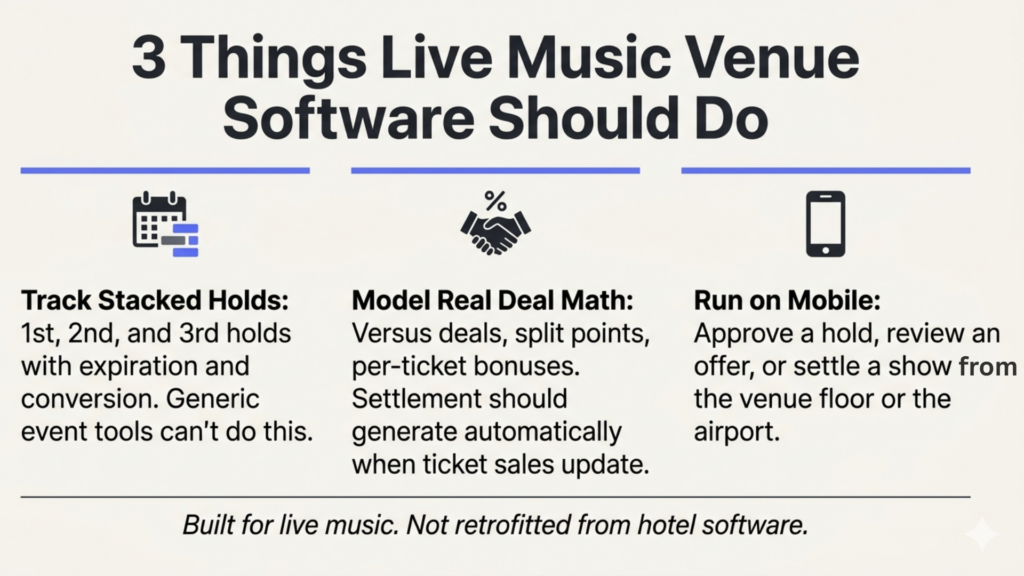
Every platform starts with a calendar, but holds are where live music gets specific. A hold is a tentative reservation that lets an agent route a tour without committing to the date. Solid hold management tracks priority (1st hold, 2nd hold, 3rd hold), expiration, and conversion. When an agent challenges a hold, you need to know within minutes whether to release the date or push the lower hold to confirm. Generic event tools treat holds as single-tier reservations, which fail fast when a date stacks three or four holds.
Offer Generation and Deal Tracking
Once a hold converts, you build the offer. The right event venue management software lets you generate branded offers, model deal scenarios (flat guarantee, versus deals, door deals, plus bonuses), and send the offer directly from the platform. Deal tracking continues from offer to confirmation to settlement, with every change logged.
Advancing and Run of Show
Advancing is its own workflow: confirming all show-day logistics with the artist’s tour manager. Hospitality riders, technical riders, load-in times, sound check, set lengths, dressing rooms, comp tickets, settlement procedures. A solid system gives you a structured advancing tab where this data lives, instead of a messy email chain the day-of crew has to reconstruct under pressure.
Settlement and Financial Reporting
Settlement is the post-show financial reconciliation: ticket revenue, expenses, talent payout, internal profit. The math gets complicated with co-promotion deals, percentage splits, bonus thresholds, and split points. A platform that handles settlement properly pulls live ticketing data, automatically calculates payouts, and generates clean PDFs for the artist or agent to sign on the spot.
Co-Promotion Management
Partner with another promoter on a show, and co-pro settlement becomes its own beast: which revenue streams are part of the split, which expenses each party covers, percentage shares, per-ticket bonuses, and final reconciliation. The Auditorium Theatre handles this complexity in an all-in-one platform. Their co-pro case study walks through a real-world example.
Real-Time Ticketing Integration
Your software has to talk to your ticketing platform. Sales should automatically flow into financial reports, not via a spreadsheet someone exports at midnight. The best platforms integrate directly with major ticketing providers, so every ticket sold updates your gross box office in real time.
Reporting and Analytics
Calendar utilization. Average ticket price. Promoter profit per show. Genre performance. Year-over-year revenue. The reporting layer is where the platform stops being an operational tool and starts being a strategic one.
What Are the Benefits of Using a Venue Management System?
The benefits show up in time, money, and visibility. Here’s what changes when you move from spreadsheets to a real venue management system.
Time Recovered
According to Eventbrite’s research on live music venues, the average venue employee spends one to four hours every day on booking and ticketing tasks alone. The right tool pulls those hours back. The Pabst Theater Group runs six venues and thousands of events a year on a single platform. RisingSun reports a four-person team doing the work of eight after consolidating their stack. That’s the difference between booking 100 shows a year and booking 200.
Fewer Errors That Cost Real Money
Settlement errors are expensive. A miskeyed expense, a missed bonus threshold, a forgotten radius clause: any of these can cost thousands per show. When financial data flows automatically from ticketing to settlement to reporting, the error surface shrinks.
Visibility Across the Operation
When every show, hold, and settlement lives in one place, you can answer questions in seconds that used to take an hour. What’s our average per-cap on country shows? Which promoter delivers the best margins? Are we leaving Mondays empty in Q3? Visibility transforms your approach from reactive to insight-driven and proactive.
Mobile Access
Live music doesn’t happen at a desk. The best venue operation software runs on mobile so you can approve a hold, review an offer, or check a settlement from the venue floor or the airport on the way home. McMenamins, with venues spread across the Pacific Northwest, runs operations across geographies with mobile-first tools. Their case study gets specific.

Better Collaboration With Outside Stakeholders
Your platform should let you collaborate with agents, promoters, tour managers, and ticketing partners without giving them access to your full system. Shared calendars, advancing portals, and structured email integrations turn what used to be a phone-and-fax operation into a connected workflow.
How Does General Venue Software Compare to Live Music Venue Software?
General venue software is built for hotels, wedding venues, conference centers, and banquet halls. It assumes the customer is a client booking a room for an event they’ll plan themselves. Workflows revolve around BEOs, floor plans, F&B minimums, and proposal tools. Pricing is dynamic and posted publicly. Customers walk in cold or come through inbound leads.
Live music venue operation software is built for promoters, talent buyers, agencies, and venue operators where the venue is the producer of the event, not the host. Workflows revolve around holds, offers, deal terms, advancing, and settlement. Pricing is negotiated per show, often with multi-layered deals. Customers are agents and tour managers, not retail buyers.
The two share surface features like calendars, contacts, and payments, but the underlying logic is different. Trying to run a music venue on hotel software means constantly working around the tool.
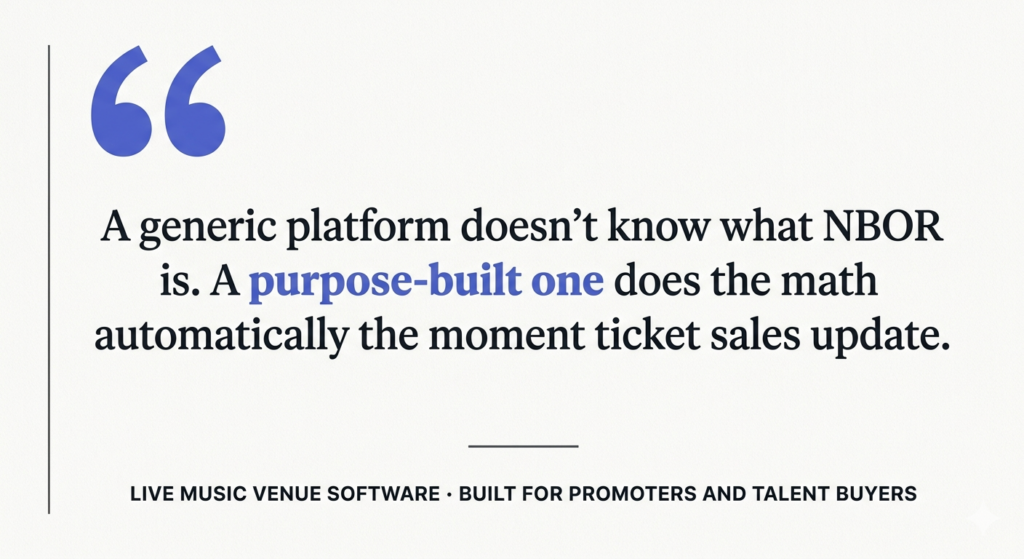
Here’s an example. You book a show with a $10,000 guarantee versus 85% of net box office receipts (NBOR) after a $30,000 split point. The show grosses $58,000 in tickets. Show expenses run $14,000. NBOR equals gross minus expenses: $58,000 minus $14,000 equals $44,000. Subtract the $30,000 split point, and you have $14,000 over the split. The artist gets 85% of that, or $11,900, on top of the $10,000 guarantee, for a total payout of $21,900. The venue keeps $58,000 minus $14,000 in expenses minus $21,900 in talent, leaving $22,100 in promoter profit before fixed costs.
A generic platform doesn’t know what NBOR is. A purpose-built event venue management software does that math automatically the moment ticket sales update.
What Are the Best Tools for Live Music?
The “best” depends on what you’re managing. A wedding barn, a 200-cap club, a 2,500-seat theater, and a 20,000-cap amphitheater have wildly different needs. Here’s how to think about the categories.
- Live music venue and promoter platforms. Built for music venues, theaters, clubs, amphitheaters, arenas, and promoters. Handle holds, offers, advancing, settlement, co-promotion, and ticketing integration as core workflows.
- Performing arts center platforms. Built for venues that program touring artists, resident companies, rentals, and educational programming. Need subscription series, multi-tenant scheduling, and donor relationships alongside touring shows. The right PAC tool covers all of it without forcing workarounds.
- Talent agency and booking software. Built for agents and managers. Tracks rosters, offers across multiple venues, contracts, and commissions. Some expand into venue features, but the core workflow stays agency-side.
- General event venue software. Built for hotels, wedding venues, banquet halls, and corporate conference centers. Strong on floor planning, BEOs, and F&B. Weak on holds, deal modeling, and music settlement.
- Generic event management platforms. Built for ticketing, registration, and attendee management at conferences. Useful for the ticketing layer but not the operational side of running a music venue.
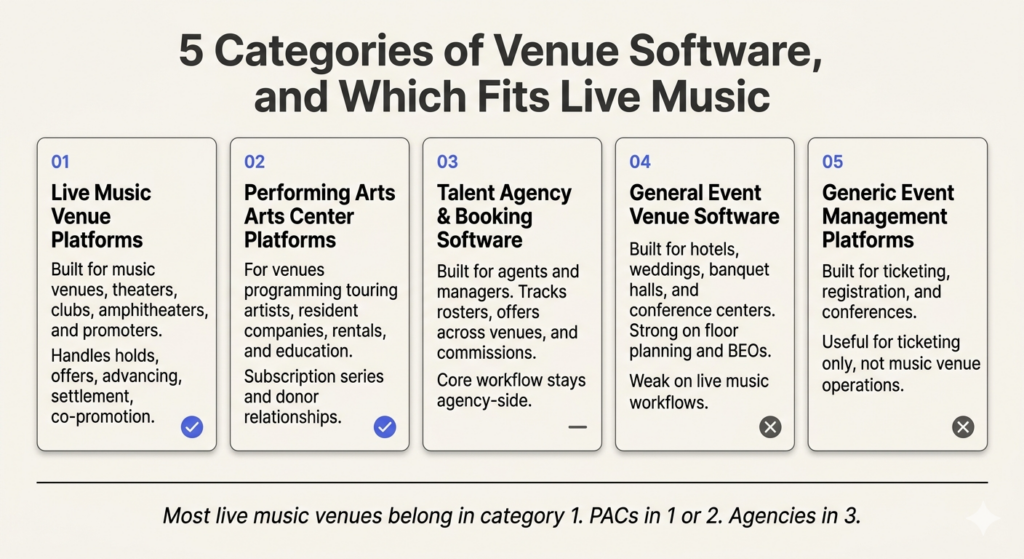
Most live music venues will find the right answer in category one. PACs typically need category one or two. Agencies need category three. Categories four and five rarely fit cleanly into live music operations.
How Do You Choose the Right Platform?
Start with your actual workflow, not the feature list. Map a typical week (holds, offers, advancing, day of show, settlement, reporting) and find the tool that handles all of it without workarounds. Filter on these questions:
- Does it handle hold priorities (1st, 2nd, 3rd) and conversion tracking?
- Can you build offers with versus deals, bonuses, and per-ticket structures?
- Does it integrate with your ticketing platform for live financial updates?
- Can it produce a clean settlement PDF that an agent will sign on the spot?
- Does it handle co-promotion if you ever split shows with another promoter?
- Does it run on mobile so your team can use it from the venue floor?
- Does the company that built it actually understand live music?
That last question matters more than people realize. You don’t want to be the customer educating your software vendor on how the industry works.
Stop Running Your Venue Like It’s Still 1998
The venues that grow are the ones that turn operational work into background noise so they can focus on programming, relationships, and revenue. Spreadsheets and email chains were never going to scale.
Prism is the live music management platform built by industry veterans for the people who book and run shows for a living, and it powers thousands of venues from independent clubs to performing arts centers to arenas. If you’re tired of running your venue on 15 browser tabs, get started with a demo and see what one platform can do.
Frequently Asked Questions
What is venue management software?
It’s a centralized platform that handles bookings, holds, offers, contracts, advancing, settlements, financial reporting, and team communication for venues. The best platforms replace spreadsheets and disconnected tools with one system. For live music venues specifically, the platform needs to handle industry workflows like hold priorities, deal structures, co-promotion splits, and settlement math.
How much does live music management software cost?
Pricing varies based on venue size, feature set, and number of locations. Specialized live music platforms for independent venues, theaters, and PACs are priced based on event volume, team size, and venue count. Most live music vendors offer custom pricing, so request a demo to get a number for your operation.
What’s the difference between venue management and event management software?
Venue management focuses on the operations of a specific venue or set of venues: calendar, holds, settlements, and ongoing relationships with agents and promoters. Event management is broader and often more attendee-facing, covering registration, ticketing, attendee engagement, and event marketing for one-off conferences, expos, and corporate events. Venue management is operations-first; event management is event-first.
Do small venues need a venue management system?
Yes, often more than larger venues. Small and independent venues run leaner teams, which means manual processes eat a higher percentage of available time. A 300-cap club running 200 shows a year manages essentially the same operational complexity as a 2,000-cap theater, with a fraction of the staff. The right platform pays for itself fast at small venues.
Can event software handle co-promotion deals?
The best live music platforms do. Co-promotion adds layers of complexity: percentage splits, per-ticket bonuses, which revenue streams are part of the split, which expenses each party covers, and final reconciliation. Generic venue software doesn’t model any of this. Specialized platforms handle co-pro as a built-in workflow with templated deals, automatic settlement calculations, and clean exports for cash reconciliation.
What integrations should venue software have?
At a minimum, integration with your ticketing provider so that financial data flows automatically. Beyond that, look for integrations with accounting software, email and calendar tools, marketing platforms, and any payment processors you use for deposits or settlements. The fewer manual data transfers between systems, the fewer errors and the more time recovered.

Matt Ford is the founder and CEO of Prism.fm, a platform built to help the live music industry operate with more clarity and confidence. After 15+ years running venues, producing festivals, and promoting shows, Matt saw firsthand how much of the business relied on fragmented tools and guesswork. He founded Prism in 2018 to change that.
Today, Prism powers more than 3,000 venues and 330 organizations nationwide, serving as an all-in-one platform designed to streamline operations by replacing cumbersome spreadsheets with integrated tools for booking, financial tracking, and contract management. Matt has also led the development of Insights, Prism’s demand prediction platform, which uses real, verified ticketing data to help teams better understand artist performance and make smarter decisions before committing to a show.
Related Post
Concert Budget Template: How to Plan Profitable Events in 2026
A concert budget template only works when it connects planning, ticketing, and settlement into one live picture of the show. If your budget template can’t model a versus deal and a co-promotion split in real…

What to Look for In Music Promoter Tools
The best music promoter tools are built around how promoters actually work, not how generic event software thinks they should. If your platform can’t run a settlement and a co-pro split without a spreadsheet, it’s…
How Venue Management Software Can Automate Scheduling & Reporting
Venue management software eliminates the chaos of spreadsheets and manual processes that drain live music operators of time and money. The venues pulling ahead are treating technology as an operational advantage rather than an afterthought.…