

Concert Marketing Software: Your 2026 Guide to Selling Out Shows
The right software has moved from a nice-to-have to the operating system of a modern promotion campaign, connecting your marketing plan directly to ticket sales and the bottom line.
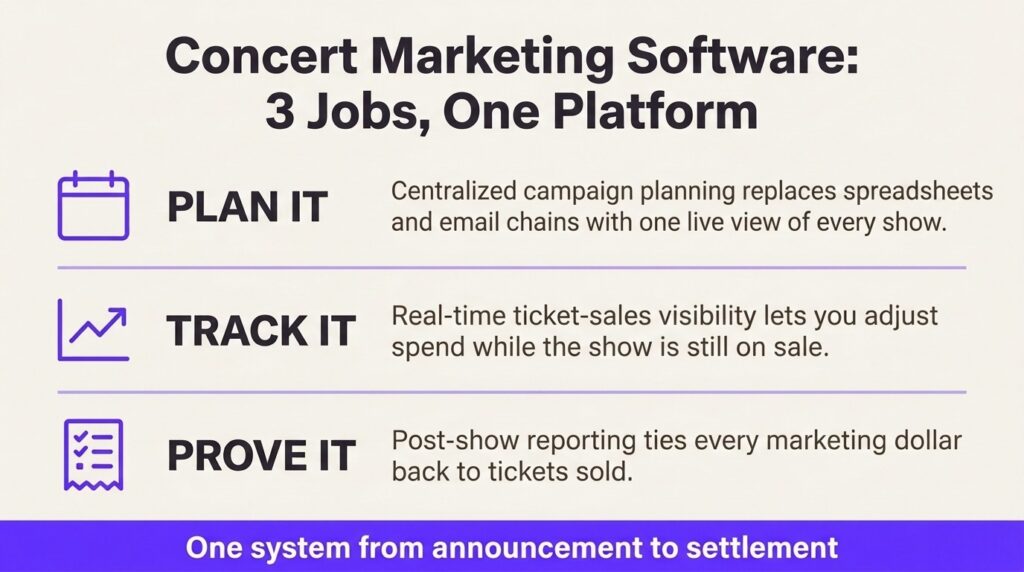
- Centralized campaign planning replaces scattered spreadsheets, shared drives, and email chains with one live view of every show.
- Real-time ticket-sales visibility lets you adjust spend while a show is still on sale, not after settlement.
- Post-show reporting ties every marketing dollar back to tickets sold, so the next campaign starts smarter.
- Generic event tools weren’t built for live music, and the gaps show up in your settlement.
If you’re still running campaigns out of a spreadsheet in 2026, the promoters using purpose-built software are already a step ahead of you.
Live music is bigger business than ever, and the tooling has caught up. According to Mordor Intelligence, the U.S. live music market sits at $18.51 billion in 2025 and is projected to reach $26.93 billion by 2031, with concerts alone accounting for roughly 45% of that revenue. More money in the room means more competition for every ticket buyer, and gut feel no longer covers the gap. This concert marketing guide leads with software instead of flyers. Top promoters run their campaigns on purpose-built live music management software, not memory.
Concert marketing software is the system that plans your campaign, tracks your ticket sales, and reports on what worked, all in one place. It replaces the tangle most teams still cobble together: a spreadsheet for the budget, a folder for artwork, a ticketing dashboard for sales, and an inbox for everything else. When those systems don’t talk, you lose hours to manual entry and money to decisions made on stale numbers.
How Does Centralized Concert Marketing Software Beat Scattered Spreadsheets?
The first job of a good platform is to put the entire campaign in one view. Every show, every asset, every deadline, and every dollar lives in a single calendar your whole team can see. When a show gets confirmed, the marketing clock starts, and centralized planning means nothing falls through the cracks between booking and announcement.
Scattered spreadsheets fail in predictable ways. Someone updates the wrong version. A banner sits in a folder nobody can find. An ad-buy deadline passes because it lived in one person’s inbox. Centralized planning kills those failure points by giving every task an owner, a due date, and a home. You stop asking “where’s the latest budget?” and start asking “how do you sell more tickets?”
Centralization compounds across a season. When last year’s on-sale data, artwork, and channel performance live in one platform, this year’s campaign starts from a template instead of a blank page. Teams that template recurring work move faster on every show, and speed is a real edge when an on-sale window is measured in days.
What Belongs in Your Pre-Show Marketing Plan?
Any concert marketing guide worth reading starts before the announcement because the work you do here decides how the campaign performs. Start the moment a show confirms, and gather your assets early. Request the artist’s approved press photos, logos, and any tour ad mat as soon as the deal closes. Chasing assets after the on-sale date is a losing game.
Build a varied asset library so you’re not posting the same flyer on repeat: a ticketing banner, a Facebook event image, a square social graphic, and print files if you run paper campaigns. Video deserves its own line in the plan. Wyzowl’s State of Video Marketing 2026 found that 85% of people have been convinced to buy something after watching a video, and concert content is tailor-made for the format. A 15-second artist shoutout (“What’s up, Chicago, we can’t wait to see you Friday”) beats a static graphic almost every time.
The right platform stores that whole library against the show it belongs to, so the flyer, the sizzle reel, and the ticket link are one click away when it’s time to post.
How Do You Announce a Show and Build Early Momentum?
The announcement is your one shot at a first impression, so treat it like a coordinated launch, not a single post. Set the date with the artist’s management, aim for eight weeks out, and time the drop for a weekday between 10 a.m. and 3 p.m. when your audience is online. If you have a fan club or venue list, give them a heads-up a day early to build goodwill and buzz.
When the show goes public, hit every channel at once and always include a ticket link:
- Social posts across all your platforms, with the venue, promoter, and artist tagged as co-hosts on the Facebook event.
- Your website and listing sites like Bandsintown and Songkick, so fans outside your following can find the show.
- Press and email, including a release to local outlets and college radio, plus a dedicated email blast to your list.
Early ticket sales anchor everything that follows. Every buyer becomes a word-of-mouth marketer, so front-load your effort to move tickets fast. Paid campaigns on Meta and Google extend your reach beyond your following, and precise targeting keeps those dollars efficient. This sequenced, measured approach separates modern campaigns from the old broadcast-and-pray model, and a sequenced campaign playbook shows how the phases stack up.
Why Is Real-Time Ticket-Sales Visibility a Competitive Edge?
When your concert marketing software connects to your ticketing provider, you see every sale the moment it lands instead of waiting for a weekly report. That visibility turns marketing from a guessing game into a dashboard you can act on.
The bigger payoff comes when ticket data connects to your financials. Integrate the two, and you can connect ticket sales to your bottom line in real time, watching each sale move your margin as it happens. You catch a slow on-sale on day three instead of week three, and you still have runway to add spend, adjust targeting, or trigger a pre-sale push.
Consider an illustrative example. You’re marketing a 700-capacity show with a $6,000 budget and a break-even of 450 tickets. Real-time data shows 180 tickets sold in the first week, against a pace that usually hits 250 by then. Because you see the gap now, you shift $1,500 into retargeting people who visited the ticket page but didn’t buy. If you wait for the monthly report, that gap surfaces after the window to fix it has closed. Visibility buys you time, and time sells tickets.
Which Features Separate Concert Marketing Software From Generic Event Promotion Software?
Plenty of platforms call themselves event promotion software, but most were built for conferences, weddings, and trade shows. Live music runs on its own logic, and the features that matter to a promoter rarely make a generic list. Here’s what to demand when you evaluate one:
- Ticketing integration that automatically updates financials. The moment a ticket sells, your budget and margin should update. If you’re still exporting CSVs and rekeying numbers, the software isn’t doing its job.
- Deal and settlement logic built for shows. Versus deals, co-promotion splits, and internal versus external terms are standard in live music and foreign to most generic tools. Your platform should handle them natively.
- A centralized asset and contact library. Artwork, press photos, and industry contacts tied to each show, not buried in a shared drive.
- Real-time reporting by show and by channel. You need to know which campaign drove which sale, instead of a lone attendance number after the fact.
- Mobile access that works at the venue. Promoters live on their phones. If the platform only works at a desk, it won’t survive a show night.
A generic event tool can technically sell a ticket, but it can’t model a co-pro split or tie a settlement to a marketing channel. A purpose-built platform closes that gap, which is why teams that manage real live music volume tend to outgrow the all-purpose tools fast.
How Do You Run Post-Show Reporting That Sharpens the Next Campaign?
The campaign isn’t over when the show ends. The day after, thank attendees in the Facebook event, post approved photos, and let fans tag themselves to keep the conversation alive. That’s the easy part. The valuable part is the reporting.
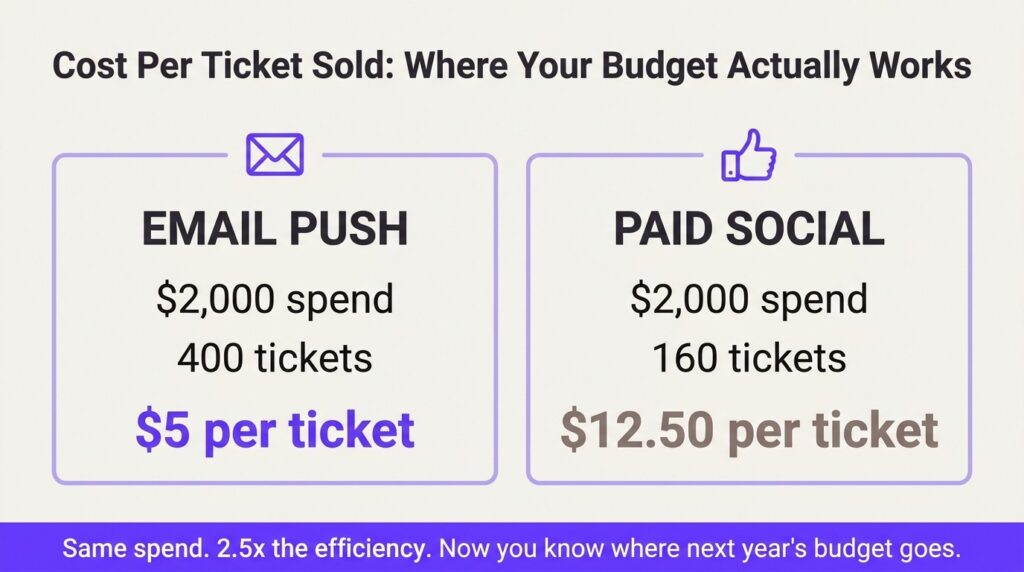
Post-show reporting answers the only question that improves your next campaign: what actually drove ticket sales? The cleanest metric is Cost Per Ticket Sold by channel. Divide the spend on a channel by the tickets it drove, and you learn where your money works. As an illustrative example, a $2,000 email push that sold 400 tickets runs $5 per ticket, while a $2,000 paid social buy that sold 160 tickets runs $12.50. Same spend, very different efficiency, and now you know where next year’s budget goes. You can measure concert marketing ROI by channel with that one calculation and refine from there.
The rest of this concert marketing guide has focused on selling the show; reporting is how you sell the next one. Tie it back to settled revenue rather than gross sales, and the picture gets sharper still. Pooled data raises the ceiling even higher. Platforms that aggregate verified box office benchmarking data let you compare your draw against real market performance instead of guessing. For the creative side of the loop, real-world venue marketing examples show how top rooms turn ticketing data into personalized campaigns that fill seats.
Turn Your Next Announcement Into a Sellout
Concert marketing software isn’t about replacing the instincts that make you good at this. It’s about backing those instincts with numbers you can trust in real time, so every show gets your smartest spend. Centralize the plan, watch sales as they happen, and let reporting make the next campaign sharper than the last.
Prism brings campaign planning, real-time ticketing integration, and settlement into one platform built by live music veterans for the way promoters actually work. Schedule a demo and see how much faster your team can move when you connect your marketing to your box office.
Frequently Asked Questions
What is concert marketing software? It’s a platform that centralizes campaign planning, ticket-sales tracking, and post-show reporting for live music events. It replaces scattered spreadsheets, folders, and inboxes with one system, and the best options integrate with your ticketing provider so financials update in real time as tickets sell.
How is it different from generic event tools? Most event promotion software targets conferences, weddings, and corporate events, so it lacks live music essentials like versus deals, co-promotion splits, and settlement logic. Purpose-built platforms are built for shows, handling the deal structures and real-time ticketing integration that promoters and venues depend on.
When should I start marketing a concert? Start the moment the show confirms. Gather artist assets right away, plan the announcement for roughly eight weeks before the date, and front-load your effort to drive early ticket sales, since early buyers fuel the word-of-mouth that carries a campaign.
Can this software help me sell more tickets? Yes. Real-time ticket-sales visibility lets you spot a slow on-sale while you still have time to react, and channel-level reporting shows which campaigns actually drove purchases. Both let you move budget toward what works instead of waiting until after settlement to learn what didn’t.
Does live event marketing software work for independent venues? It does, and independents often benefit most. Live event marketing software automates the manual work that eats a small team’s time, centralizes the whole campaign, and gives owners the real-time financial picture they need to make confident calls without a large staff.

Matt Ford is the founder and CEO of Prism.fm, a platform built to help the live music industry operate with more clarity and confidence. After 15+ years running venues, producing festivals, and promoting shows, Matt saw firsthand how much of the business relied on fragmented tools and guesswork. He founded Prism in 2018 to change that.
Today, Prism powers more than 3,000 venues and 330 organizations nationwide, serving as an all-in-one platform designed to streamline operations by replacing cumbersome spreadsheets with integrated tools for booking, financial tracking, and contract management. Matt has also led the development of Insights, Prism’s demand prediction platform, which uses real, verified ticketing data to help teams better understand artist performance and make smarter decisions before committing to a show.
Related Post
Beyond the Announcement: What Actually Drives Successful Live Event Marketing?
For live event marketers, getting the word out is only part of the job. Between coordinating announcements, managing campaigns, tracking ticket sales, and keeping up with a packed event calendar, it’s easy to spend the…
Future of Concert Event Management: Trends for 2025–26
The live music industry is experiencing unprecedented growth, but the game has fundamentally changed. Running concerts the same way you did five years ago is like trying to book shows with a flip phone. The…
How to Master Concert Scheduling and Planning
Concert scheduling mastery requires effective calendar management, technical coordination, team communication, and mobile accessibility. The live music industry generated over $29 billion globally in 2024, yet venue operators are struggling with unprecedented operational challenges that…