

Music Festival Marketing in 2026: A Promoter’s Playbook for Selling Out
Music festival marketing in 2026 is a multi-channel, data-driven campaign that lives or dies by attribution.
- The U.S. live music industry is projected to reach $19.7 billion in 2026, but more festivals were canceled or went bankrupt in the last 18 months than in any year since the pandemic.
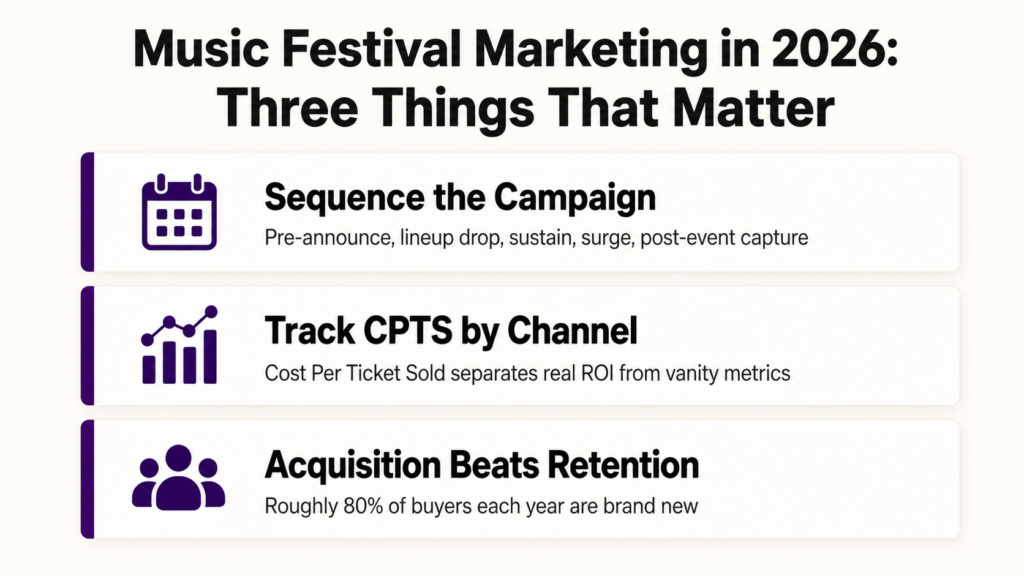
- The old playbook (lineup poster, Facebook event, hope for the best) is dead. Today’s festivals win on sequenced campaigns, paid retargeting, and first-party data loops.
- Roughly 80% of your audience has likely never attended your festival before. Net-new acquisition, not retention, is what fuels the campaign.
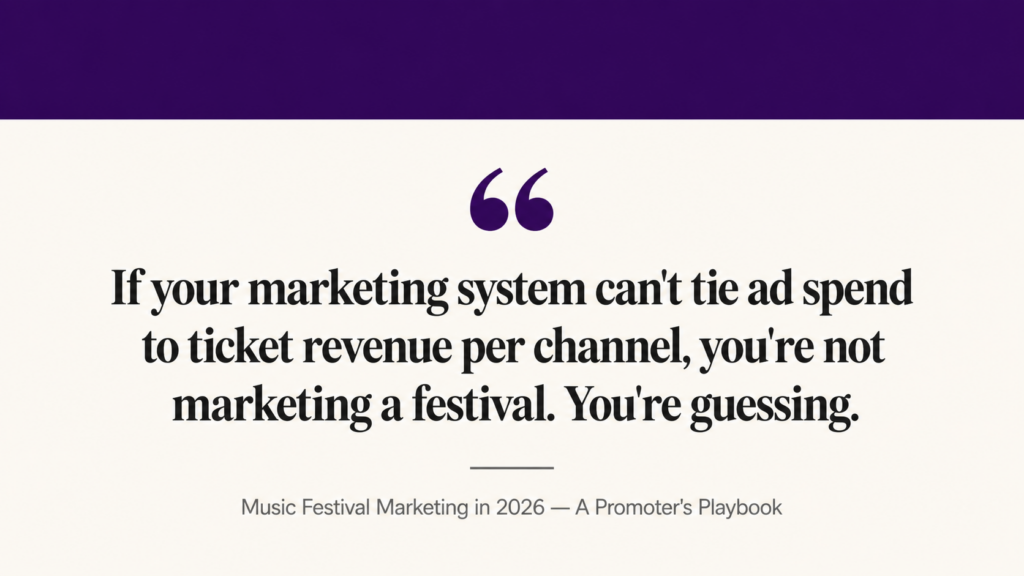
If your marketing system can’t tie ad spend to ticket revenue per channel, you’re not marketing a festival. You’re guessing.
Music festival marketing is no longer a poster, a Facebook event, and a prayer. The U.S. live music industry is bigger than ever. According to Mordor Intelligence, the U.S. live music market was valued at $18.51 billion in 2025 and is forecast to reach $26.93 billion by 2031. Bigger means more festivals, more competition, and a sharper line between events that sell out and events that fold mid-cycle. According to a 2026 industry analysis from Ticket Fairy, an unprecedented number of festivals were canceled or went bankrupt in 2025 due to weak sales and soaring costs. The festivals filling fields in 2026 share a common operating system: a sequenced campaign, paid media powered by first-party data, and an operations stack that connects every marketing dollar to a settled show.
This is the playbook.
Why Has Music Festival Marketing Changed?
Discovery moved off Facebook, attribution got harder thanks to iOS privacy changes, and ticket buyers got pickier. The reflex of dropping a lineup, posting a Spotify playlist, and waiting for word of mouth to do the rest has stopped working at the rate it once did.
Discovery Lives on Short-Form Video
TikTok and Instagram Reels are the new festival flyer. According to Demand Sage, TikTok has approximately 1.99 billion active users and serves as both a content discovery platform and a search engine. Quick clips of soundchecks, set transitions, and crowd reactions outperform polished lineup announcements because they read as authentic. If your content calendar is built around static graphics, you’re already behind the festivals you’re competing with.
The Audience Got Pickier
The average price for the top 100 worldwide concert tours hit $132.62 in 2025, according to Pollstar’s annual touring data. That spend pressure means attendees are weighing every festival against rent, gas, and three other events on the calendar. They want a reason to choose yours, and they want it spelled out in language their feed can deliver.
Attribution Got Harder, So Data Got More Valuable
iOS privacy updates broke clean tracking. The festivals that adapted built first-party data systems: pre-registration lists, referral programs, UTM-tagged campaigns, and lookalike audiences seeded from their own ticket-buyer files. The festivals that didn’t are stuck running broad ads they can’t measure. Paid media still works, but the shift away from third-party tracking killed lazy paid media.
Who Is Buying Festival Tickets in 2026?
Before you spend a dollar, know who you’re spending it on. Festival audiences are not monolithic, and the spend gap between segments is larger than most promoters realize.
Most of Your Audience Is Brand-New Every Year
According to Gupta Media’s TallyTickets analysis of multi-year festival sales data, the percentage of repeat ticket buyers ranges from 12% to 17% for most festivals, with 27% as the rare outlier. In other words, every year, roughly 80% of your audience has likely never attended your festival before. If you build your forecast around the assumption that your existing email list will carry the on-sale, you’re already playing from behind. Repeat customers matter, but net-new acquisition is the engine of your campaign. That data changes how you should be thinking about lookalike audiences, paid prospecting, and lineup-driven creative.
Casual Buyers Are Getting More Selective, Not Less
Ticket prices have run up faster than wages, and casual buyers have noticed. According to a 2024 Pirate.com survey of 1,700 festival-goers, 44% of respondents said they were attending fewer festivals than usual, and 49% said they would not spend more than £200 on a festival ticket. Another 29% said they were sticking to their favorite festivals rather than trying new ones. A meaningful chunk of the audience has triaged its summer down to a known-good event and is screening everything else out. Vague “the experience of a lifetime” copy does nothing for those buyers. Concrete benefits, headliner-driven angles, payment plans, and clear price tiers do.
Travelers Are a Bigger Slice Than Locals Think
Festival audiences travel. Coachella, Lollapalooza, and Bonnaroo report large out-of-state attendance percentages, and major artist tours move local hotel and travel bookings. According to Bloomberg reporting on Choose Chicago tourism data, Beyoncé’s May 2025 Cowboy Carter shows in Chicago drove 46,450 hotel rooms booked in a single day, the record high in the city. If your festival has a strong lineup, marketing only to locals is leaving real money on the table.
How Do You Build a Music Festival Marketing Campaign That Actually Sells Tickets?
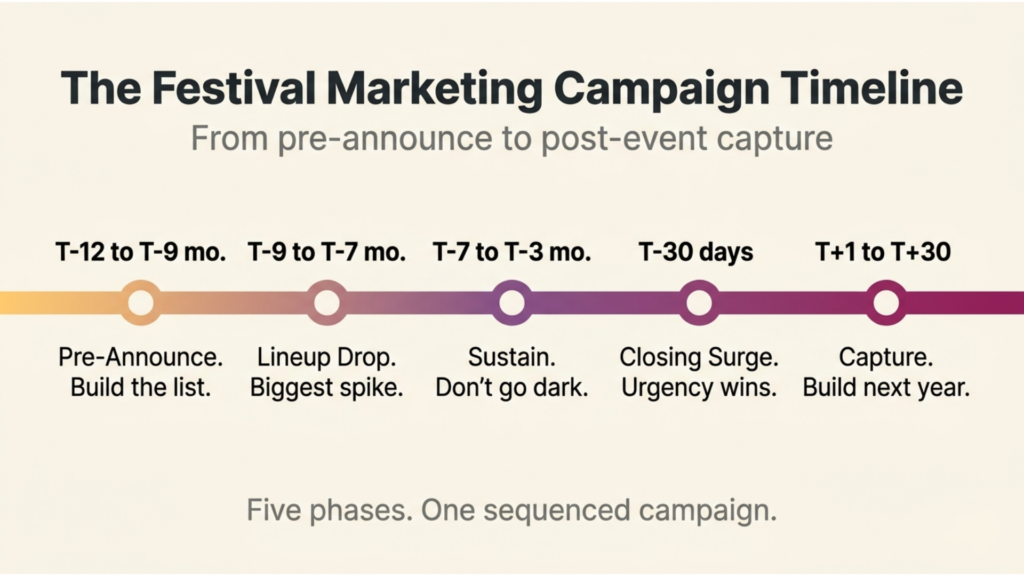
Knowing how to promote a music festival in 2026 means thinking in phases, not in posts. The festivals that sell out treat the on-sale cycle as a six-to-twelve-month sequenced campaign with distinct objectives at every phase. Here’s the structure that works.
- Pre-announce phase (T-12 to T-9 months). Build the email list before tickets go on sale. Run pre-registration ads with FOMO copy, drop teaser content, and capture first-party data. The goal is a list big enough to seed launch day.
- Lineup announcement and on-sale (T-9 to T-7 months). This is your biggest single sales spike of the cycle. According to Gupta Media’s TallyTickets data, about 30% of festivals come out of the gate extremely hot, typically those that announce the full lineup and put all ticket types on sale right away. Coordinate the lineup drop with email, paid media, artist co-posts, and PR.
- Sustain phase (T-7 to T-3 months). Most festivals go dark here and lose momentum. Don’t. Run mid-campaign content (artist spotlights, returning fan testimonials, sub-stage announcements), drive a second sales tier, and keep paid media on with retargeting against everyone who hit the ticket page but didn’t convert.
- Closing surge (T-30 days to event). Late-cycle ticket sales often deliver the second-largest spike of the campaign, driven by fence-sitters and last-minute travel decisions. Lean into urgency copy (“almost sold out,” “last chance,” countdown ads), retarget hard, and let your headliner content do the closing.
- Post-event capture (T+1 to T+30 days). Capture user-generated content, segment your buyer file, build the lookalike audience for next year, and send the post-event survey. This phase is where you earn next year’s campaign.
This kind of sequenced approach is what sets modern event marketing campaigns apart from the broadcast-and-pray model that dominated festival marketing years ago.
What Concert Promotion Strategies Move the Needle on Paid Media?
Paid is where most festival budgets get spent, and most festival budgets get wasted. The concert promotion strategies that actually convert are targeted, sequenced, and measured.
Lookalike Audiences From Your Own Buyer File
The single most efficient ad spend you can run is a Meta or Google lookalike audience seeded from your past ticket buyer email list. You’re telling the algorithm to find more people who already proved they buy festival tickets like ours. According to festival ticketing analysis, the most successful promoters focus on lookalike audience generation by exporting high-value buyer segments from their ticketing platform to train social media algorithms to find similar users. If you don’t have a clean buyer file segmented by tier, that’s the first thing to fix.
Retargeting Is the Cheapest Conversion You’ll Run
Anyone who hit your ticket page but didn’t buy is worth pennies on the dollar to bring back. Run cart abandonment ads, page-view retargeting ads, and email reminders to drop-offs. These audiences have already shown intent. The math is brutally favorable compared to cold prospecting.
Headliner-Driven Creative Outperforms Brand Creative
The festival itself isn’t usually the conversion trigger. The headliner is. Build creative variants for each major artist on the bill and serve them to lookalike audiences of those artists’ fans. Marketing analyses of 2026 festival campaigns identify a distinct buyer archetype called the “Act-Driven Buyer,” a fan who will purchase quickly once they see a specific artist on the lineup but who won’t respond to general festival messaging or experience-focused creative. The mistake is running the same brand creative to every audience segment. If a fan is a fan of a particular performing artist, show them an ad that speaks to their fandom, not an ad about food and beverage options. Save your spend on those audiences until the lineup drops, then hit them hard with artist-specific creative.
Mix Channels, But Track Every One
Smart promoters spread spend across Meta, TikTok, Google, programmatic, and influencer partnerships. But every channel needs UTM tags and a Cost Per Ticket Sold measurement (more on that below). For more on the multi-channel framework, this live event marketing guide walks through how to utilize music-specific software to run smarter campaigns.
How Should You Use First-Party Data to Drive Event Marketing Campaigns?
Data separates festivals that grow year over year from festivals that flat-line. The winning festivals treat their attendee data as a core asset, not an afterthought. Modern event marketing campaigns at the festival level depend on a clean data feedback loop, not on creative volume.

Build the Math Before You Spend
Every festival should be tracking Cost Per Ticket Sold (CPTS) by channel. Here’s the formula:
CPTS = Total Marketing Spend on Channel ÷ Tickets Sold Attributed to That Channel
Say you spend $40,000 on Meta in Q1, and your UTM-tagged links and pixel attribution show 500 tickets sold from those campaigns at an average price of $180. Your CPTS on Meta is $80, and your gross revenue from Meta-attributed sales is $90,000. Now compare that to your TikTok, Google, and influencer spend. Reallocate from the channels with high CPTS to the channels with low CPTS. That single discipline, run honestly across the campaign, separates festivals that grow margin year-over-year from festivals that bleed budget.
Segment, Don’t Blast
Email blasts to your full list waste your most valuable channel. Segment by past behavior: hardcore festies (multi-year multi-ticket buyers) get exclusive presale invites, casual buyers get headliner-led nudges, and lapsed buyers get win-back offers. Each segment converts at materially higher rates than a one-size-fits-all blast. The data on what to send each segment lives in your ticketing reports and your CRM.
Connect Marketing Data to Operations Data
You can have the best campaign attribution in the world, but if your settlement, expenses, and per-ticket profit live in a separate spreadsheet from your marketing data, you can’t actually answer the question that matters: was this festival profitable per ticket sold per channel? Closing that loop requires an event management platform that tracks ticket sales, marketing attribution, and financial settlement in one system.
How Do Operations and Software Factor Into How to Promote a Music Festival?
Promotion is upstream of operations, but operations decide whether your promotion paid off.
Real-Time Ticket Sales Visibility
When tickets are moving fast, your team needs to know. When they’re moving slowly, you need to know faster. Festival operations software that updates ticket sales and revenue in real time, integrated with major ticketing platforms, gives the marketing team the data to pivot mid-campaign. Need to flip on a flash sale because Tuesday sales lagged? You can only call that play if you can clearly see the data.
Settlement and Financial Tracking
Every festival has a moment of truth: what did we actually net? If your settlement is happening in a spreadsheet two weeks after the event, you’re learning lessons too late to apply them to the next on-sale. Modern music marketing tools and operations platforms generate clean settlement data that ties marketing spend to net profit per show, per stage, and per ticket tier.
Calendar, Holds, and Offer Management
Festivals are dozens or hundreds of artist deals stacked into a single weekend. Holds, offers, advancing, contracts, and run of show all have to live in one system, or they break. Spreadsheets cost time, time costs holds, and lost holds cost lineups. The operations stack you choose is upstream of every marketing campaign you run.
Build the Campaign That Sells the Show
Music festival marketing in 2026 rewards promoters who treat the on-sale cycle as a sequenced, measured, data-fed campaign and who close the loop between marketing spend and operational reality. The festivals selling out fields next summer use tools that talk to each other.
Prism gives promoters a single platform for calendar, holds, offers, ticket sales, settlement, and reporting, integrated with major ticketing platforms, so financial data updates in real time as tickets sell. Get started with a demo to see how the operations side of your festival can finally pay your marketing side back.
FAQ
What is the best way to promote a music festival in 2026? The most effective approach is a sequenced multi-channel campaign that runs from pre-announce through post-event. Build a first-party email list before lineup drop, coordinate the announcement with paid media and artist co-promotion, sustain with mid-cycle content and retargeting, and surge with urgency creative in the final two weeks. Track every channel with UTM tags and measure Cost Per Ticket Sold to reallocate budget mid-campaign.
How much should a music festival spend on marketing? Industry benchmarks vary, but most festivals target marketing as roughly 8–15% of total budget, with new or competitive-market festivals often running higher. The more important metric is marketing as a percentage of gross ticket revenue and the CPTS by channel. Both of those numbers should improve year over year if your data systems are working.
Which paid media channels work best for music festival marketing? Meta (Instagram and Facebook) and TikTok lead for short-form discovery and lookalike targeting. Google Search captures bottom-funnel intent. Programmatic and YouTube extend reach. The right mix depends on your audience, but the discipline that matters across all of them is UTM-tagged attribution and a clean buyer file to seed lookalikes.
How do you measure ROI on concert promotion strategies? The cleanest metric is Cost Per Ticket Sold by channel, calculated as marketing spend divided by tickets attributed to that channel. Layer in fan lifetime value if you run multiple events per year, since a buyer acquired this year may attend two or three more shows. Tie it all back to settled revenue, not just gross sales, to know what each channel actually contributed to net profit.

Matt Ford is the founder and CEO of Prism.fm, a platform built to help the live music industry operate with more clarity and confidence. After 15+ years running venues, producing festivals, and promoting shows, Matt saw firsthand how much of the business relied on fragmented tools and guesswork. He founded Prism in 2018 to change that.
Today, Prism powers more than 3,000 venues and 330 organizations nationwide, serving as an all-in-one platform designed to streamline operations by replacing cumbersome spreadsheets with integrated tools for booking, financial tracking, and contract management. Matt has also led the development of Insights, Prism’s demand prediction platform, which uses real, verified ticketing data to help teams better understand artist performance and make smarter decisions before committing to a show.
Related Post
What Is Speculative Ticketing? How It Works and Why the Live Music Industry Is Fighting It
Buying a concert ticket should be fairly straightforward: a ticket exists, someone sells it, and a fan buys it. But in the secondary ticket market, that isn’t always what happens. In some cases, resellers advertise…
Choosing the Right Live Music Management Software for Your Venue
The U.S. live music market is projected to exceed $19 billion in 2026, yet many venues still manage operations with spreadsheets and disconnected systems that cost them time, money, and sanity. If your current process…
How Venue Operations Software Streamlines Live Events
Modern venue operations software revolutionizes live event management by eliminating manual processes and consolidating workflows. Key benefits include automated scheduling that prevents double-bookings, streamlined logistics coordination with all stakeholders, enhanced communication tools that keep everyone…