
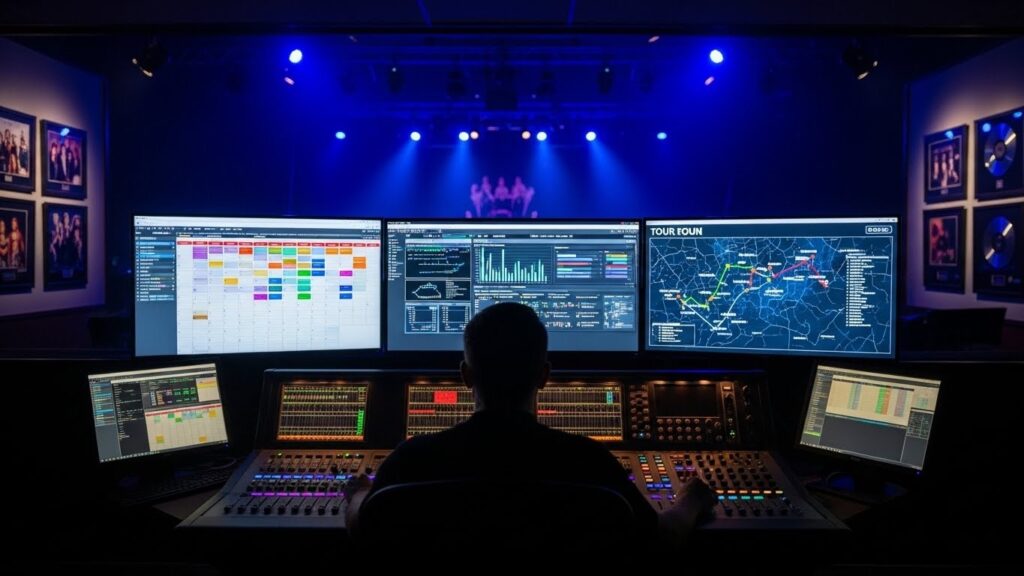
Music Tour Planning Tools That Unify Your Booking Workflow
Managing artist tours without a centralized system creates chaos, missed payments, and scheduling conflicts that cost real money.
- The global live music market is projected to reach $62.59 billion by 2034, making operational efficiency more critical than ever.
- Scattered spreadsheets and disconnected apps lead to double-bookings, payment delays, and communication breakdowns across your team.
- Modern music tour planning tools consolidate scheduling, financial tracking, and event management into a single workflow built for live music professionals.
If you’re still running your tour operations across five different apps, you’re working harder than you need to and leaving money on the table.
With the global live music market expected to grow at 8.78% annually through 2034, venues, promoters, and booking agents face increasing pressure to manage more shows with greater precision. Yet many professionals still rely on fragmented systems that were never designed for the complexity of tour management.
Music tour planning tools exist for a reason: managing live entertainment involves dozens of stakeholders, shifting timelines, and financial arrangements that generic project management apps can’t handle. Centralizing these operations is about building infrastructure that lets you book more shows, settle faster, and actually know where your money is at any given moment.
Why Do Scattered Systems Kill Your Tour Momentum?
The live music business runs on timing. An artist’s availability window might only be open for a few days. A venue needs confirmation before another promoter scoops up the date. Payment deadlines determine whether you’re cash-flow positive or scrambling to cover advances.
When your music tour planning tools aren’t integrated, every decision takes longer than it should. You’re checking one app for availability, switching to email to chase a contract, then opening a spreadsheet to figure out if you can afford the guarantee. By the time you’ve done all that, the opportunity might be gone.

Disconnected systems also create information silos. Your talent buyer might not know that a deposit has already been paid because it’s tracked in accounting software they don’t have access to. Your booking agent sends an offer based on outdated financial data because the latest numbers live in someone else’s folder.
The solution is bringing everything into a single environment where scheduling, payments, and event tracking work together instead of against each other.
What Should You Look for in Music Tour Planning Tools?
Not every platform marketed for event management actually understands live music. Generic solutions often lack the industry-specific features that make or break your operations. When evaluating artist scheduling software, focus on capabilities that address how tours actually work.
How Does Unified Calendar Management Improve Booking?
A centralized calendar gives your entire team visibility into holds, confirms, and potential conflicts across all your venues or roster artists. The best systems let you see what’s booked, what’s in negotiation, what’s pending approval, and what needs immediate attention.
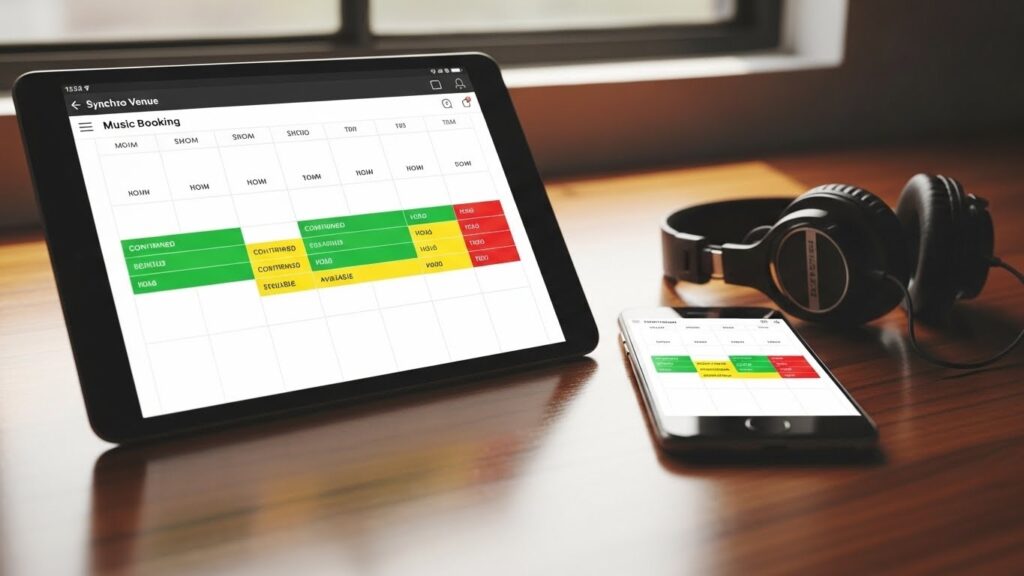
Look for platforms that support the hold-to-confirm workflow that’s standard in live music. You need to track multiple hold positions, convert them to confirmed dates when deals close, and immediately update availability across your organization. If a calendar can’t distinguish between a first hold and a confirmed show, it wasn’t built for this business.
Real-time syncing is essential when multiple team members manage different aspects of the same tour. Someone in Los Angeles confirming a date should instantly update the view for everyone else, whether they’re in Nashville, New York, or on the road with the artist.
Why Is Integrated Payment Tracking Essential?
Payment tracking in live music isn’t like invoicing for typical services. You’re dealing with deposits, guarantees, backend percentages, merch splits, and settlement calculations that depend on actual ticket sales. Generic accounting tools force you to build complicated workarounds that break the moment your deal structure gets creative.
Effective event planning tools should connect financial data directly to each show. When you look at an event, you should immediately see what’s been paid, what’s outstanding, and what the final settlement will look like based on current numbers. This integration eliminates the back-and-forth between your booking system and accounting spreadsheet.
Automated payment reminders also save time. Your system should flag overdue payments and prompt action before cash flow becomes a crisis.
How Does Tour-Wide Visibility Impact Your Bottom Line?
Managing a single show is doable in almost any system. Managing twenty shows across eight cities with three co-promotion partners requires something more sophisticated. Tour-level reporting lets you see aggregate performance, compare markets, and identify which segments of a run are underperforming before it’s too late to adjust.
Strong analytics improve your settlement processes. When you can pull accurate financial data for any show in seconds rather than hours, you walk into settlement meetings prepared. Discrepancies get caught early. Agents and managers appreciate working with professionals who have their numbers right.
Reporting capabilities should extend beyond individual events to show patterns across your entire operation. Which venues consistently outperform projections? Which artists bring repeat ticket buyers? This data turns operational software into strategic intelligence.

What Does Disconnected Workflow Actually Cost You?
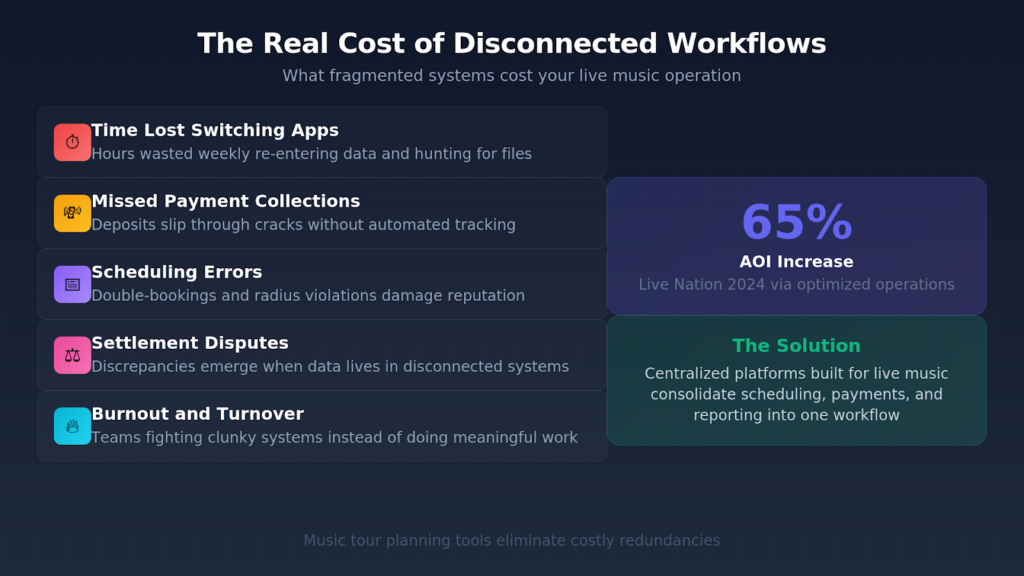
Operating without centralized systems isn’t free. The costs just hide in places you might not notice until they compound into serious problems. Live Nation’s 2024 results showed that optimized venue operations drove a 65% increase in adjusted operating income, reaching record profitability by focusing on arenas and amphitheaters where they could capture more revenue through streamlined processes and better data tracking.
Here’s what fragmented operations actually cost you:
- Time lost switching between apps. Every minute spent re-entering data or hunting for the right spreadsheet is a minute not spent building relationships or closing deals. Professionals lose multiple hours per week to tool-switching alone.
- Missed payment collections. Without automated tracking, deposits slip through cracks. A single missed $5,000 deposit doesn’t hurt cash flow alone; it erodes trust with partners who expect you to run a tight ship.
- Scheduling errors that damage reputation. Double-booking a venue date or missing a radius clause violation can cost you relationships that took years to build. The live music world is small. Word travels.
- Settlement disputes. When financial data lives in disconnected systems, discrepancies emerge. Resolving them takes time and goodwill from both parties.
- Burnout and turnover. Team members fighting clunky systems rather than doing meaningful work don’t stick around. High turnover means constantly retraining people on your patchwork processes.
These risks are the daily reality for teams that haven’t invested in proper infrastructure. Venues and promoters who centralize operations consistently report higher efficiency and fewer costly errors.
How Can You Make Centralization Work for Your Operation?
Adopting centralized event planning tools depends on how you implement and integrate these systems into your existing workflows.
Start by auditing your current processes. Map out where information currently lives, who needs access to it, and where handoffs typically break down. This clarity helps you evaluate platforms based on how they’ll solve your pain points rather than getting distracted by features you’ll never use.
Prioritize platforms built specifically for live music. Generic event management software often lacks crucial functionality around holds management, co-promotion tracking, and music-specific settlement calculations. The time you save by choosing the right music venue booking software compounds across every show you manage.
Plan for adoption across your entire team. A system only works if everyone uses it. That means training, documented processes, and accountability for keeping data current. The best platforms make this easier with intuitive interfaces and mobile access so people can update information whether they’re at a desk or backstage.

Finally, measure the impact. Track how long settlements take before and after implementation. Monitor how many scheduling conflicts occur. Calculate time spent on admin tasks versus relationship-building activities. These metrics justify the investment and highlight areas for continued improvement.
Frequently Asked Questions
What makes music tour planning tools different from generic event software? Music tour planning tools understand industry-specific workflows like hold management, artist guarantees, and settlement calculations. Generic event software lacks features for tracking multiple hold positions, calculating backend percentages, and managing co-promotion splits, all of which are standard in live music operations.
How does payment tracking integrate with artist scheduling? Integrated systems connect financial data directly to each event on your calendar. When you view a show, you immediately see deposit status, outstanding balances, and projected settlement amounts. This eliminates the need to cross-reference separate accounting spreadsheets and reduces errors in financial reporting.
Can centralized tools handle co-promotion arrangements? Yes, platforms built for live music include co-promotion modules that track partner contributions, calculate profit splits, and generate settlement reports for multiple parties. This functionality is essential for promoters who regularly partner with other companies to share risk and resources on larger shows.
What’s the typical return on investment for centralized booking software? Most venues and agencies report time savings within the first few months, particularly in settlement preparation and payment collection. Reduced scheduling errors and faster financial reconciliation also contribute to ROI, though exact figures vary based on operation size and previous system efficiency.
Build Your Booking Infrastructure Right
The live music industry rewards professionals who can move quickly without making mistakes. That combination requires systems designed for how this business actually operates, from initial holds through final settlement.
Scattered spreadsheets and disconnected apps might have worked when you were managing a handful of shows per year. Scaling beyond that demands infrastructure that keeps pace with your ambitions. Centralized scheduling, integrated payment tracking, and tour-wide visibility are operational necessities for anyone serious about growing their live music business.
Prism was built by live music professionals who understand these challenges firsthand. With comprehensive tools for calendar management, financial tracking, and team collaboration, Prism brings everything you need into one platform built specifically for venues, promoters, and agencies. Get started with Prism and see how centralization transforms your operations.

Matt Ford is the founder and CEO of Prism.fm, a platform built to help the live music industry operate with more clarity and confidence. After 15+ years running venues, producing festivals, and promoting shows, Matt saw firsthand how much of the business relied on fragmented tools and guesswork. He founded Prism in 2018 to change that.
Today, Prism powers more than 3,000 venues and 330 organizations nationwide, serving as an all-in-one platform designed to streamline operations by replacing cumbersome spreadsheets with integrated tools for booking, financial tracking, and contract management. Matt has also led the development of Insights, Prism’s demand prediction platform, which uses real, verified ticketing data to help teams better understand artist performance and make smarter decisions before committing to a show.
Related Post

Best Performing Arts Management Software for PACs: 2026 Buyer’s Guide
Most performing arts management software only runs half your building, and the half it skips is where your margin lives. Before you sign anything in 2026, buy for the workflow you actually run: book, confirm,…
Theatre Management Software vs. Performing Arts Center Software: What PACs Actually Need
The label on the software matters far less than whether the tool models how a performing arts center actually runs a week. Shop by whether the software can run your Tuesday: a school matinee, a…
Performing Arts Center Software: How PACs Manage Complex Events & Reporting
A performing arts center runs more event types through the same rooms than any other venue in live entertainment, and generic scheduling tools collapse under that complexity. If your calendar, deals, and financials live in…