

Talent Buying Software vs. Event Management Platforms: What’s the Difference?
Live music professionals need purpose-built tools, not generic event platforms that don’t speak their language.
- Talent buying software handles complex deal structures, including percentage splits, co-promotion agreements, tiered guarantees, and settlement calculations that generic platforms can’t process.
- Event management platforms work for conferences and weddings but lack the workflow logic for holds, confirms, and the financial intricacies of live entertainment deals.
- The music promoter software market is projected to reach $1.21 billion by 2035, reflecting massive demand for specialized solutions built by industry veterans.
Choose a platform that understands your workflow rather than forcing you to adapt your operations to generic business processes.
The live music industry is on a trajectory that demands operational excellence. Global music revenues are projected to nearly double from $105 billion in 2024 to almost $200 billion by 2035. That kind of expansion creates both opportunity and complexity for venues, promoters, and talent buyers managing packed calendars.
Yet many professionals in the space are still running their operations on disconnected spreadsheets, email chains, and calendar apps that weren’t designed for live music. The result? Double-bookings, settlement errors, missed deadlines, and hours burned on administrative work that should take minutes. Understanding the differences between talent buying software and generic event management platforms impacts your profitability and scalability.
What Is Talent Buying Software?
Talent buying software is designed for the workflows, deal structures, and financial complexities unique to the live music industry. These platforms manage the complete lifecycle of a show from initial hold through final settlement, speaking the same language as talent buyers, venue managers, and booking agents.
The critical distinction is specialization. Where general business tools offer calendar functionality and basic project management, talent buying software understands concepts like first and second holds, guarantee versus percentage deals, co-promotion splits, rider requirements, and the cascading financial calculations that define music industry contracts. We’re talking software built from the ground up by people who’ve actually booked shows.
Core Capabilities of Purpose-Built Platforms
The best talent buying software centralizes every aspect of booking operations into a single system. Hold management becomes automated rather than manual, with expiration alerts and status tracking that prevent the confusion of juggling multiple negotiations simultaneously. Offer generation leverages templates and historical data to create professional documents in minutes rather than hours.
Financial management is where these platforms truly separate themselves. Live music deals involve complex math: guarantees with backend splits, tiered percentage structures, agent commissions, co-promoter profit sharing, and expense reconciliation across multiple stakeholders. Purpose-built software automatically handles these calculations, generating accurate settlement sheets and maintaining clear audit trails throughout the process.
Communication tools keep everyone aligned without the chaos of scattered email threads. When an agent, venue manager, production coordinator, and marketing team all need access to the same information, centralized platforms ensure nothing falls through the cracks while maintaining appropriate permission controls.

How Does Event Management Software Fall Short for Live Music?
Event management platforms serve legitimate purposes for corporate events, conferences, weddings, and general venue rentals. These tools excel at registration management, attendee tracking, vendor coordination, and straightforward scheduling. The problem emerges when live music professionals try to force these systems into workflows they weren’t designed to handle.
Generic platforms treat all bookings as equivalent. A corporate meeting and a headlining concert appear functionally identical in the system. But the operational reality couldn’t be more different. Live music involves holds and confirms rather than simple reservations, ongoing negotiations rather than fixed contracts, and dynamic financial structures that shift based on ticket sales and ancillary revenue.

Where Generic Solutions Break Down
Consider co-promotion deals, a standard arrangement in live music where multiple parties share both risk and reward. A venue might partner with an outside promoter, splitting profits according to negotiated percentages while each party incurs different expenses. Generic event management software has no mechanism for tracking these arrangements, calculating split earnings, or generating the reconciliation documents both parties need for settlement.
Similarly, tiered guarantee structures, where an artist receives a base payment plus escalating percentages after certain ticket thresholds, require financial logic that doesn’t exist in platforms designed for straightforward venue rentals. When your software can’t handle an 85/15 split after expenses on top of a $5,000 guarantee, you’re back to manual spreadsheets and the errors that come with them.
The hold system presents another gap. Live music operates on a hold-confirm workflow where multiple venues might have overlapping holds on the same artist for different dates, with clear priority rules determining who gets first right of refusal. Event management platforms built around definitive reservations can’t accommodate this industry-standard practice.
What Are the Key Feature Differences Between Platform Types?
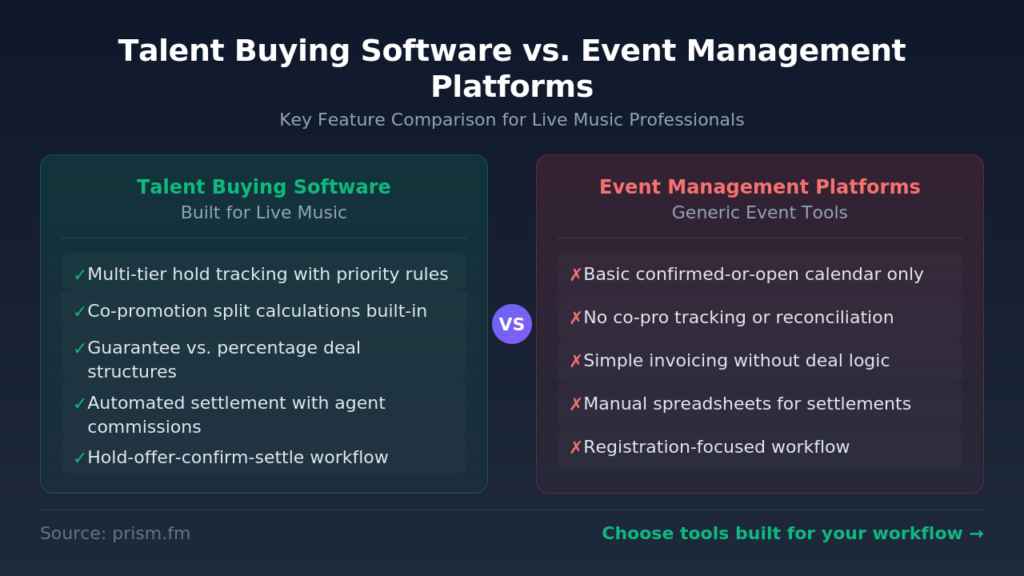
Understanding specific capabilities helps clarify which solution fits your operation. The following breakdown highlights where purpose-built talent buying software and generic event management platforms diverge.
Hold and Calendar Management
Talent buying software provides multi-tier hold tracking with automated expiration alerts, status visibility across team members, and integration with artist availability. These systems understand that a first hold isn’t a confirmed booking but a time-sensitive option requiring follow-up.
Event management platforms offer basic calendar functionality with confirmed-or-open status. They work fine when bookings are definitive but struggle with the provisional, negotiation-heavy nature of talent buying.
Financial Structures and Settlement
Talent buying software automatically calculates complex deal structures: guarantees versus backend splits, co-promotion profit sharing, tiered percentages, and agent commission deductions. Settlement documents are generated with accurate math and professional formatting.
Event management platforms handle invoicing and basic cost tracking but lack the financial logic for music industry deal structures. Users typically export data to external spreadsheets for actual settlement calculations.
Industry-Specific Workflows
Talent buying software is built around the hold-offer-confirm-advance-settle workflow that defines live music operations. Every feature connects to this progression.
Event management platforms follow registration-planning-execution workflows designed for conferences and corporate events, requiring significant adaptation for music industry use.
Communication and Collaboration
Talent buying software maintains conversation history by show, centralizes document sharing with appropriate stakeholders, and provides mobile access for professionals who spend a lot of time away from desks.
Event management platforms offer general collaboration features that work across use cases but lack the context-specific organization that keeps talent buying teams aligned.

When Should You Choose Talent Buying Software Over Event Platforms?
Not every operation requires specialized software. Venues hosting occasional private events alongside their music programming might use general tools for the rental side of their business. The decision depends on volume, complexity, and operational priorities.
Signs You Need Purpose-Built Solutions
If your operation books more than 50 shows annually, the efficiency gains from specialized event booking software justify the investment. Manual processes that seem manageable at lower volumes become time sinks as calendars fill. When you’re simultaneously managing multiple negotiations, the risk of errors or missed opportunities increases exponentially.
Co-promotion arrangements push generic platforms past their breaking point. Any venue or promoter regularly partnering with outside parties needs software that handles split calculations, tracks each party’s expenses, and generates clear settlement documentation.
Multi-venue operations face amplified complexity that demands specialized tools. Coordinating holds, routing, and financial performance across multiple rooms or properties requires centralized visibility that generic platforms can’t provide.
When Generic Platforms Work Fine
Facilities primarily hosting corporate rentals, weddings, or non-music events may find general event management software sufficient. These operations don’t need hold management, complex deal structures, or settlement automation, the core value propositions of talent buying software.
Small venues with limited booking volume might start with simpler tools, though growth typically necessitates upgrading as operational complexity increases.
What Questions Should You Ask Before Choosing a Platform?
Evaluating event booking software requires understanding both your current needs and likely future requirements. The following questions help clarify which solution category makes sense for your operation.
Operational Fit Questions
Does the platform understand hold versus confirm workflows, or does it treat all bookings as definitive reservations? Can it handle multiple simultaneous holds on the same date with clear priority tracking?
How does the system manage co-promotion arrangements? Can it calculate profit splits, track each party’s expenses, and generate settlement documents that both sides can reconcile?
Does the financial module handle guarantee versus percentage deals, tiered structures, and agent commission deductions, or will you need external spreadsheets for actual settlement math?
Scalability and Integration Questions
Will the platform grow with your operation if you add venues, expand your team, or increase booking volume? What integration capabilities exist with your ticketing platform, accounting software, and other business systems?
How does mobile access work for talent buyers and promoters who spend time at shows, on the road, or in meetings? Can critical functions happen from a phone or tablet?
Support and Industry Understanding Questions
Was this software built by people with actual live music industry experience, or was it adapted from general event management? Do support teams understand the concepts and terminology you use daily?
How do existing users in the live music space describe their experience? Are there case studies or testimonials from venues and promoters similar to your operation?
The Growing Market for Specialized Solutions
The music promoter software market reflects that generic tools don’t serve live music professionals. Market research projects this segment to reach $1.21 billion by 2035, growing at a nearly 18% compound annual rate as venues and promoters prioritize operational efficiency.
This growth is driven by the reality that live music operations differ substantially from other event types. Platforms built by industry veterans who understand holds, settlements, and deal structures save time and reduce errors in ways that adapted generic tools can’t match.
Cloud-based solutions now dominate the market, with approximately three-quarters of deployments using cloud infrastructure that enables mobile access and team collaboration. The shift toward automated venue management systems accelerated as organizations recognized the operational fragility of manual processes.

Frequently Asked Questions
What makes talent buying software different from regular booking software?
Talent buying software is designed specifically for live music workflows, including hold management, complex deal structures like guarantees versus percentages, co-promotion calculations, and industry-standard settlement processes. Regular booking software typically handles basic reservations and scheduling without the financial logic or workflow understanding that music industry professionals require.
Can event management platforms handle co-promotion deals?
Most generic event management platforms lack the functionality to properly track co-promotion arrangements. These deals require calculating profit splits between multiple parties, tracking each party’s expenses, and generating settlement documents that account for different revenue streams and cost allocations, capabilities that purpose-built talent buying software provides automatically.
How do I know when to upgrade from spreadsheets to specialized software?
Consider upgrading when you’re booking more than 50 shows per year, simultaneously managing multiple holds, regularly working with co-promotion partners, or finding that administrative tasks consume time better spent on relationships and deal-making. The efficiency gains from specialized software typically justify investment once operational complexity reaches these thresholds.
Is talent buying software only for large venues and promoters?
While larger operations see benefits, smaller venues and independent promoters also gain from specialized tools, particularly those managing growth, working with co-promoters, or seeking to professionalize their operations. The key consideration is whether your deal structures and workflows align with what generic platforms can handle versus what purpose-built solutions provide.
Bring Your Operations Into Focus
The choice between talent buying software and generic event management platforms ultimately comes down to whether you want tools that understand your business or tools you have to work around. Live music professionals managing complex deal structures, co-promotion relationships, and high-volume booking calendars need purpose-built software that speaks their language from day one.
Prism was built by live music veterans who experienced the same operational frustrations you face daily. The platform transforms those pain points into streamlined workflows that give you time back for booking great shows and building relationships. Get started with Prism today.

Matt Ford is the founder and CEO of Prism.fm, a platform built to help the live music industry operate with more clarity and confidence. After 15+ years running venues, producing festivals, and promoting shows, Matt saw firsthand how much of the business relied on fragmented tools and guesswork. He founded Prism in 2018 to change that.
Today, Prism powers more than 3,000 venues and 330 organizations nationwide, serving as an all-in-one platform designed to streamline operations by replacing cumbersome spreadsheets with integrated tools for booking, financial tracking, and contract management. Matt has also led the development of Insights, Prism’s demand prediction platform, which uses real, verified ticketing data to help teams better understand artist performance and make smarter decisions before committing to a show.
Related Post
Managing Complex Event Schedules with PAC Management Software
Performing arts centers juggle more scheduling variables than any other venue type, yet most still rely on methods that guarantee chaos. If your calendar system can’t distinguish between a hard hold and a tentative inquiry,…
Choosing the Right Live Music Management Software for Your Venue
The U.S. live music market is projected to exceed $19 billion in 2026, yet many venues still manage operations with spreadsheets and disconnected systems that cost them time, money, and sanity. If your current process…
Maximizing Live Event Marketing Software for Concert Promotion
Specialized live event marketing software separates packed houses from empty rooms by giving concert promoters the data, automation, and integration they need to run smarter campaigns. If your promotional workflow still relies on disconnected platforms…