

How Event Talent Buying Works: Venues, Promoters, and Agencies
Event talent buying is the engine that keeps live music venues full and artists paid.
- Venues, promoters, and agencies each play distinct roles, but their success depends entirely on tight coordination and clear communication.
- The typical talent buying workflow moves through holds, offers, confirmations, and settlements, with dozens of potential breakdown points along the way.
- Deal structures range from flat guarantees to percentage splits and hybrid “versus” deals, each carrying different risk profiles.
If your team is still managing this process through scattered emails and spreadsheets, it’s time to modernize with purpose-built software.
Every sold-out show, packed venue, and artist check that clears starts with event talent buying. This process connects artists who want to perform with venues that need to fill calendars and sell tickets. Yet for something so fundamental to live entertainment, talent buying remains surprisingly opaque to many industry newcomers.
The live music industry generated over $38 billion globally in 2025, with revenues growing 8.78%. Behind those numbers are thousands of deals negotiated daily between booking agents, venue talent buyers, independent promoters, and everyone in between. Getting those deals right requires understanding how each player operates, what motivates their decisions, and where the process typically falls apart.
This guide breaks down exactly how event talent buying works from every angle, whether you’re running a 200-cap club, promoting regional tours, or managing an agency roster.
What Is Event Talent Buying, and Why Does It Matter?
Event talent buying is the process of identifying, negotiating with, and booking artists or performers for live events. The term “talent buyer” typically refers to the person or team responsible for curating a venue’s entertainment calendar, but the function extends across promoters and agencies as well.
Talent buying involves matching the right artist with the right venue at the right time for the right price. Simple in concept, complex in execution. A talent buyer at a mid-sized venue might evaluate hundreds of routing requests per month, weighing factors like historical ticket sales, market saturation, artist trajectory, and available dates.
Book the wrong artist, and you’re staring at empty seats and a guaranteed payout you can’t cover. Miss the right artist, and your competitor down the street picks up the sellout. The talent buying workflow has real financial consequences, which is why the best operators treat it as a strategic function rather than an administrative task.
Who Are the Three Players in the Live Event Booking Workflow?
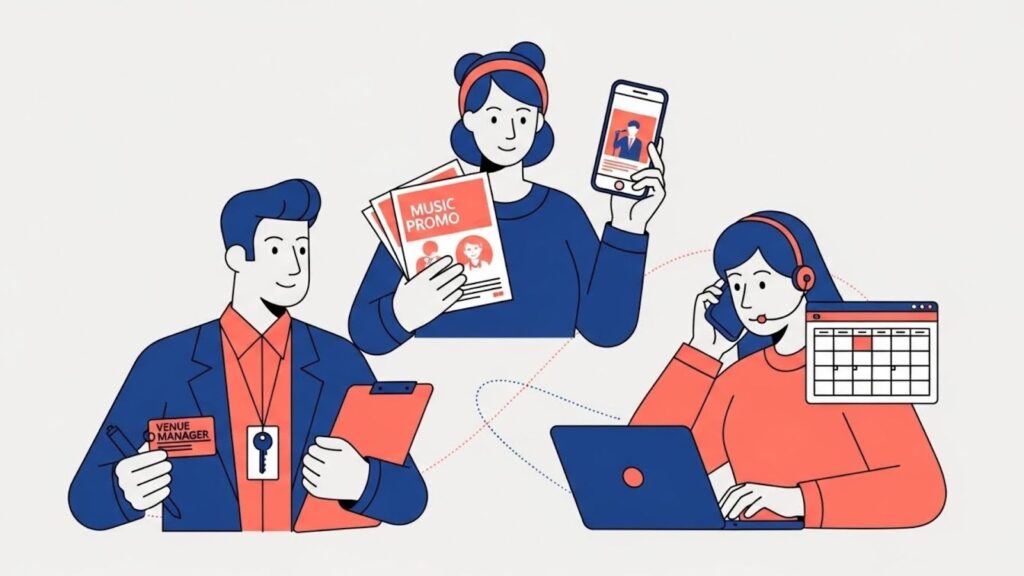
Understanding event talent buying requires understanding who’s involved. Three primary stakeholders drive the process, each with distinct responsibilities and incentives.
Venues and Their Talent Buyers
Venue talent buyers are responsible for filling the calendar with shows that match the room’s capacity, audience demographics, and brand. They work directly with booking agents to secure artists, negotiate deal terms, and manage the confirmation process. In smaller venues, the talent buyer might also be the owner or general manager. Larger operations have dedicated buying teams.
The scale of modern venue operations is staggering. Live Nation Entertainment alone served 145 million attendees in 2023, demonstrating the massive coordination required across the industry. Mid-sized venues and independent rooms compete for the same routing, making efficient talent-buying operations essential for survival.
Talent buyers need deep knowledge of their local market. They track which genres perform well in their room, monitor ticket sale trends, and maintain relationships with agents who control desirable routing. They’re also responsible for managing holds, those tentative date reservations that can either turn into confirmed shows or evaporate when a better offer comes along.
Independent Promoters and Promotion Companies
Promoters take on the financial risk of producing shows, often working in partnership with venues rather than as employees. A promoter might rent a venue, pay the artist guarantee, handle marketing, and either profit from strong ticket sales or absorb losses from weak ones.
The venue promoter coordination dynamic varies widely. Some venues handle all promotion in-house. Others rely entirely on outside promoters who bring shows to them. Many operate hybrid models where certain nights or genres are promoted externally while others stay in-house. Promoters need strong relationships with both venues and agents to assemble viable tours and one-offs.
Booking Agents and Agencies
Booking agents represent artists and are responsible for securing performance opportunities. They field inquiries from talent buyers, negotiate deal terms on behalf of their clients, and manage routing logistics for tours. Agents typically earn a commission on deals they close.
Agents control access to artists, which gives them leverage in negotiations. They’re evaluating offers based on financial terms, routing efficiency, venue reputation, and career strategy for their clients. A venue’s relationship with key agents directly impacts the quality of talent they can access.
How Does the Event Talent Booking Process Actually Work?
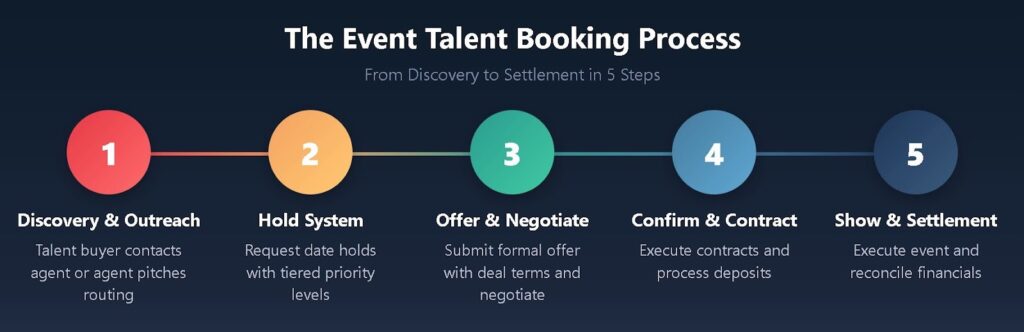
The talent buying workflow follows a predictable sequence, though the specifics vary based on artist level, deal complexity, and market conditions. Here’s how a typical booking moves from initial interest to settlement.
Step 1: Discovery and Outreach
The process begins when either a talent buyer reaches out to an agent about a specific artist or an agent contacts venues about available routing. Most communication still happens via email, though some larger operations use centralized booking platforms. Talent buyers maintain watchlists of developing artists and monitor announcement calendars to stay ahead of opportunities.
Step 2: The Hold System
When mutual interest exists, the venue requests a hold on a specific date. Holds are informal reservations that give the talent buyer time to evaluate the opportunity without committing. The industry uses tiered holds (first hold, second hold, etc.) to manage competing interest from multiple venues in a market.
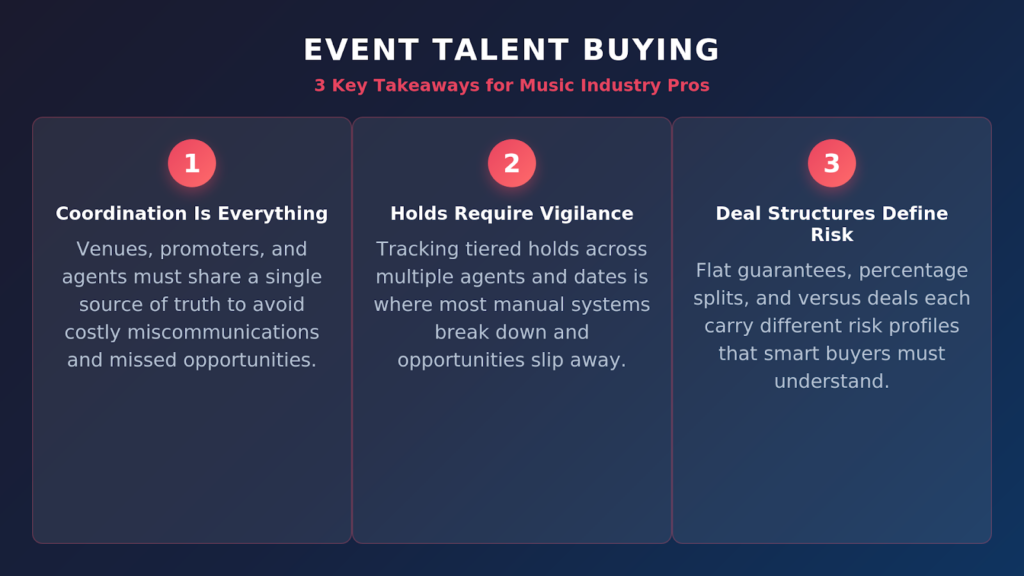
Hold management is where many operations get messy. Tracking dozens or hundreds of holds across different artists and agents, each with different response timelines, creates chaos. Venues that lose track of holds miss opportunities or accidentally double-book dates. Choosing the right venue booking software can eliminate this confusion entirely.
Step 3: Offer and Negotiation
Once a talent buyer decides to pursue a show, they submit a formal offer. This includes financial terms (guarantee, percentage split, or hybrid deal), production requirements, and any special provisions. Agents evaluate offers against competing bids from other venues in the market.
Negotiation can involve multiple rounds of back-and-forth on guarantee amounts, ticket scaling, radius clauses, and ancillary revenue splits. Both parties need accurate projections of ticket sales and expenses to negotiate effectively.
Step 4: Confirmation and Contracting
When both parties agree on terms, the show moves from hold to confirm status. Contracts are drafted, deposits are paid, and the event becomes official. This triggers downstream activities like marketing, ticketing setup, and production planning.
The confirmation process is where poor coordination causes the most damage. Missing contract signatures, unclear deal terms, and communication gaps between venues and promoters lead to disputes that surface at settlement.
Step 5: Show Execution and Settlement
After the show happens, both parties reconcile financials through settlement. This involves calculating actual ticket revenue, deducting agreed expenses, and determining the final payout. Settlement complexity increases with percentage deals, multiple promoters, or co-promotion arrangements. Following concert venue settlement best practices helps ensure everyone walks away satisfied and ready to work together again.
What Deal Structures Should Every Talent Buyer Know?
Deal structures define how financial risk and reward are distributed between artists and buyers. The right structure depends on artist level, market conditions, and each party’s risk tolerance.
Flat Guarantee: The artist receives a fixed amount regardless of ticket sales. Buyers assume all financial risk but capture all upside if the show overperforms. Common for developing artists or markets where the buyer has strong confidence.
Door Deal or Percentage Split: The artist receives a percentage of ticket revenue (typically 70–85%) with no guarantee. Risk shifts entirely to the artist, making this structure common for unproven acts or low-capacity rooms.
Versus Deal: The artist receives either a guarantee OR a percentage of revenue, whichever is higher. This hybrid structure shares risk while protecting both parties. The most common structure for mid-level and established artists.
Plus Deal: The artist receives a guarantee PLUS a percentage of revenue above a certain threshold. This rewards overperformance and is often used for artists with a consistent sellout history.
Co-Promotion Split: Two or more promoters share both the costs and profits of a show according to agreed percentages. Co-pro deals add complexity to settlement but allow parties to pool resources and share risk on larger productions.

Why Does Venue Promoter Coordination Break Down?
Even experienced operators run into coordination problems that cost money and damage relationships. The event talent booking process involves too many moving parts for informal systems to handle reliably.
Communication Gaps Between Stakeholders
When venues, promoters, and agents aren’t working from the same information, problems multiply. The agent thinks the show is confirmed while the venue still has it as a hold. The promoter expects certain production to be included while the venue priced it separately. These gaps emerge because each party tracks deals in their own system with no shared source of truth.
Manual Processes That Don’t Scale
Spreadsheets and email chains work fine when you’re booking a few shows per month. Scale to dozens or hundreds of events, and the whole system collapses. Manual hold tracking becomes impossible. Settlement calculations take hours. Institutional knowledge lives in individual inboxes rather than accessible systems.
Settlement Disputes and Financial Reconciliation
Most settlement disputes stem from unclear deal terms captured inconsistently across contracts, emails, and verbal agreements. When the show is over and it’s time to calculate payouts, competing interpretations emerge. Co-promotion settlements add complexity when multiple parties need to reconcile their respective revenues and expenses.
How Can You Streamline Your Live Event Booking Workflow?
The best operators have moved beyond manual processes to systems that support the full talent buying workflow from initial hold through final settlement.
Centralize Your Calendar and Holds
A single calendar view showing all holds, confirms, and available dates eliminates the chaos of tracking offers across spreadsheets and email. You need to see at a glance which dates have activity, which holds are aging, and where you have an opportunity to book. A comprehensive approach to talent buying software makes this centralization possible.
Standardize Deal Documentation
Every offer should flow into a consistent format that captures all relevant terms, including financial structure, production requirements, radius clauses, and co-promotion splits if applicable. Standardization prevents the miscommunications that surface at settlement.
Connect Your Systems
Your booking data should flow into ticketing, accounting, and settlement without manual re-entry. When ticket sales automatically update your event financials, you can monitor performance in real time and avoid surprises.
Build Reporting That Drives Decisions
Understanding which artists, agents, and deal structures perform best in your room requires data you can actually analyze. Reporting across your show history reveals patterns that improve future buying decisions.

Frequently Asked Questions
What’s the difference between a talent buyer and a promoter?
A talent buyer is typically employed by or contracted to a venue and is responsible for curating the entertainment calendar. A promoter takes on financial risk for shows, either in partnership with venues or independently. Some professionals operate in both roles depending on the situation. The key distinction is who carries financial risk for a given show.
How do holds work in the talent buying process?
Holds are informal date reservations that allow talent buyers to express interest without committing. The industry uses tiered holds where a first hold has priority over a second hold, and so on. Holds convert to confirms when both parties sign contracts, or they release when interest fades or competing offers win.
What is a “versus” deal in event talent buying?
A versus deal guarantees the artist either a flat fee OR a percentage of ticket revenue, whichever is greater. For example, “$5,000 versus 80% of net” means the artist receives the higher of $5,000 or 80% of ticket sales. This structure protects artists with a floor while allowing upside participation.
How do co-promotion deals affect settlement?
Co-promotion agreements split profits and losses between multiple promoters based on agreed percentages. Settlement becomes more complex because each party’s revenues and expenses must be reconciled before calculating the split. Some co-pros also include per-ticket bonuses or specific expense allocations that add calculation steps.
Take Control of Your Talent Buying Workflow
Event talent buying will always involve relationships, intuition, and negotiation. What’s changed is the infrastructure available to support those fundamentals. Venues, promoters, and agencies that systematize their live event booking workflow book more efficiently, settle more accurately, and make better decisions over time.
The teams seeing the biggest gains have moved to purpose-built platforms designed specifically for live music operations. Prism gives you the calendar, hold management, offer tracking, and settlement tools that generic software can’t match. Get started today to see how Prism can streamline your talent buying workflow.

Matt Ford is the founder and CEO of Prism.fm, a platform built to help the live music industry operate with more clarity and confidence. After 15+ years running venues, producing festivals, and promoting shows, Matt saw firsthand how much of the business relied on fragmented tools and guesswork. He founded Prism in 2018 to change that.
Today, Prism powers more than 3,000 venues and 330 organizations nationwide, serving as an all-in-one platform designed to streamline operations by replacing cumbersome spreadsheets with integrated tools for booking, financial tracking, and contract management. Matt has also led the development of Insights, Prism’s demand prediction platform, which uses real, verified ticketing data to help teams better understand artist performance and make smarter decisions before committing to a show.
Related Post
Managing Complex Event Schedules with PAC Management Software
Performing arts centers juggle more scheduling variables than any other venue type, yet most still rely on methods that guarantee chaos. If your calendar system can’t distinguish between a hard hold and a tentative inquiry,…
Choosing the Right Live Music Management Software for Your Venue
The U.S. live music market is projected to exceed $19 billion in 2026, yet many venues still manage operations with spreadsheets and disconnected systems that cost them time, money, and sanity. If your current process…
Maximizing Live Event Marketing Software for Concert Promotion
Specialized live event marketing software separates packed houses from empty rooms by giving concert promoters the data, automation, and integration they need to run smarter campaigns. If your promotional workflow still relies on disconnected platforms…