

What Makes a Great Music Booking Agent Platform?
The right music booking agent software separates thriving agencies from those drowning in spreadsheets and missed opportunities.
- Live music revenues are projected to reach $52.6 billion in 2030, making operational efficiency a survival requirement for booking agents.
- Purpose-built platforms outperform generic event tools by addressing music-specific workflows like holds, percentage deals, co-promotion splits, and settlement automation.
- Agents using centralized booking software eliminate double-bookings, accelerate contract turnaround, and gain real-time financial visibility across their entire roster.
If your agency still runs on email threads and color-coded spreadsheets, you’re losing deals to competitors who don’t.
Booking agents operate in one of entertainment’s most demanding roles. They juggle artist schedules, negotiate deal terms with venues, track deposits and payments, and simultaneously coordinate with managers, promoters, and tour staff. As the live music industry continues its aggressive growth trajectory, the operational complexity facing agents has intensified. Goldman Sachs projects the global live music market will surpass $50 billion by 2030, and agents who can’t keep pace with that growth will get left behind. The question isn’t whether you need a dedicated music booking agent software. It’s whether the one you’re using can actually handle the demands of modern live music.
Why Do You Need Dedicated Music Booking Agent Software?
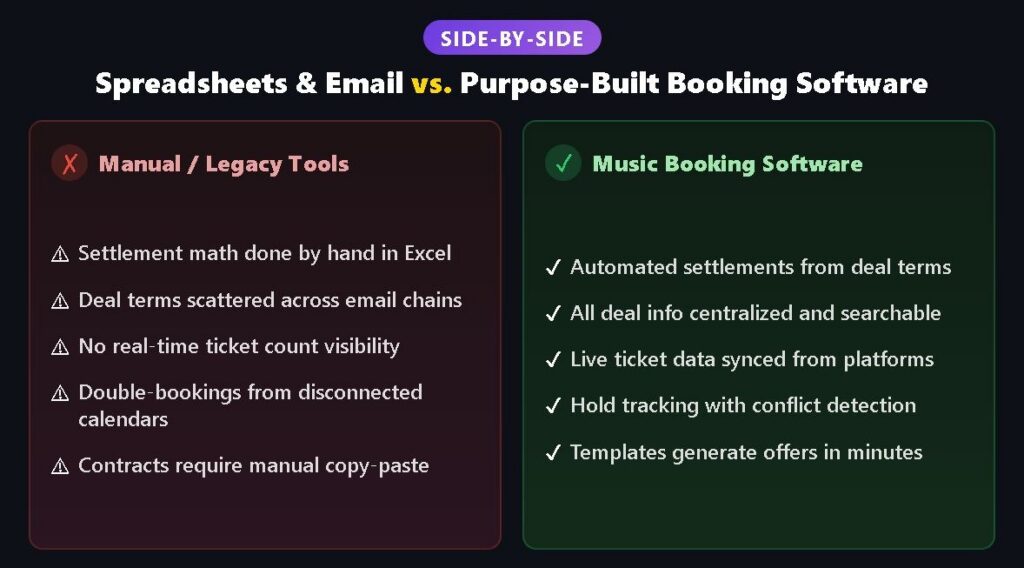
Generic project management apps and event planning platforms weren’t designed for the live music grind. They don’t understand holds versus confirms. They can’t calculate a percentage deal against gross ticket revenue. They have no concept of radius clauses, artist riders, or co-promotion settlements. That disconnect between generic tools and music-specific workflows creates friction that costs agencies real money.
The Real Cost of Outdated Tools
The average talent buyer spends hours every day on booking and ticketing tasks alone. Multiply that across a team of agents managing dozens of artists, and you’re looking at hundreds of hours each month burned on administrative busywork. Spreadsheets with 40-plus tabs, formulas that break when someone accidentally edits a cell, and email chains where critical deal terms get buried under reply-all threads are the norm for agencies still clinging to legacy systems.
A single settlement error can cost thousands. A double-booking can tank a venue relationship that took years to build. When live music revenues grew 25% in a single year, agencies that couldn’t scale their operations fast enough watched opportunities pass them by.
What Happens When You Outgrow Spreadsheets
There’s a ceiling to what manual systems can handle. An agent managing five artists can probably keep things straight with Google Calendar and a well-organized inbox. An agent managing twenty artists across multiple markets, negotiating with dozens of venues, tracking deposits, rider requirements, and tour routing? That agent needs a system built for the chaos.
The shift from spreadsheets to dedicated music booking agent software typically happens when an agency starts losing money to disorganization. Missed deposit deadlines, forgotten hold expirations, and settlement disputes are warning signs that your tools have become a liability rather than an asset.
What Core Features Define the Best Artist Booking Platform?
Choosing an artist booking platform requires understanding what actually moves the needle for booking agents. Feature lists are meaningless if the platform doesn’t address the pain points of managing a roster’s calendar and the financial complexity of live music deals.
Centralized Calendar and Scheduling
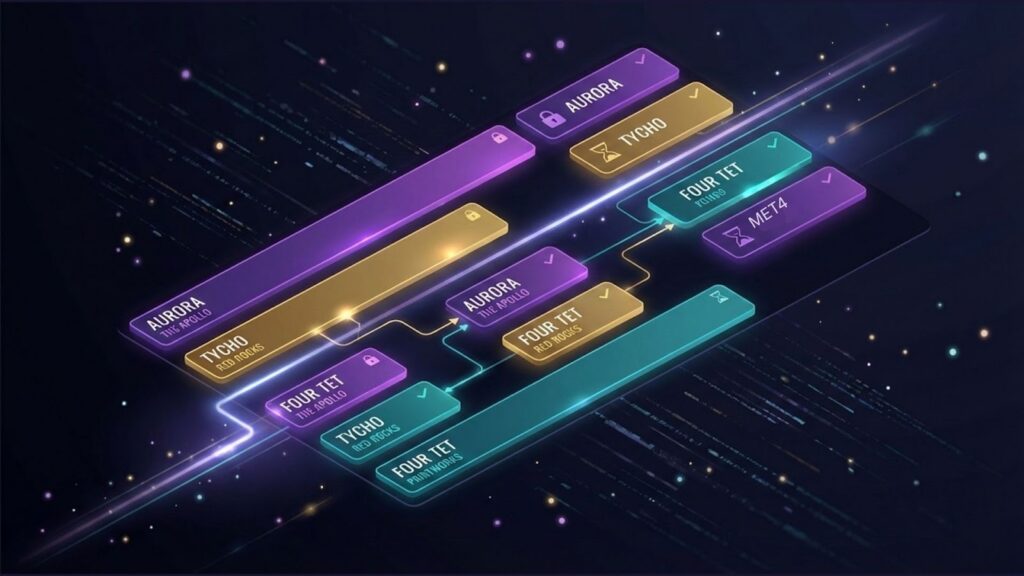
A booking agent’s calendar isn’t a simple date tracker. It’s a real-time operational dashboard that needs to display holds, confirms, pending offers, radius clause conflicts, and artist availability across an entire roster. The best platforms provide a bird’s-eye view where agents can spot open dates, identify routing opportunities, and prevent conflicts before they become problems.
Calendar integration with external tools like Google Calendar and Outlook keeps everyone synchronized without requiring manual updates. When a hold gets confirmed or a date falls through, every stakeholder sees the change immediately. That kind of real-time visibility is what separates professional operations from agencies that are constantly playing catch-up.
Automated Payments and Settlement Tracking
Settlement is where most agencies bleed time and money. Calculating splits between guarantees and percentage deals, factoring in co-promotion earnings, deducting expenses, and reconciling who owes whom requires precision that manual processes can’t guarantee.
Purpose-built music booking agent software automates these calculations based on the deal terms you’ve already entered. When ticket sales data flows in from integrated ticketing platforms, the settlement updates automatically. No re-entering numbers. No formula errors. No three-hour reconciliation sessions after every show.
Automation extends to payment tracking as well. Agents can monitor deposit schedules, flag overdue payments, and maintain clean financial records without toggling between their booking platform and an accounting spreadsheet.
Contract Generation and Deal Management
Speed wins deals. When a venue or promoter is ready to move, agents need to generate a professional offer in minutes, not hours. Customizable contract templates that pull in pre-set deal terms, artist information, and venue details eliminate the tedious copy-paste workflow that slows down negotiations.
The best platforms maintain a historical record of every deal, so agents can reference past offers, compare terms, and negotiate from a position of knowledge. That institutional memory becomes a competitive advantage over time, especially when building long-term relationships with key venues and promoters.
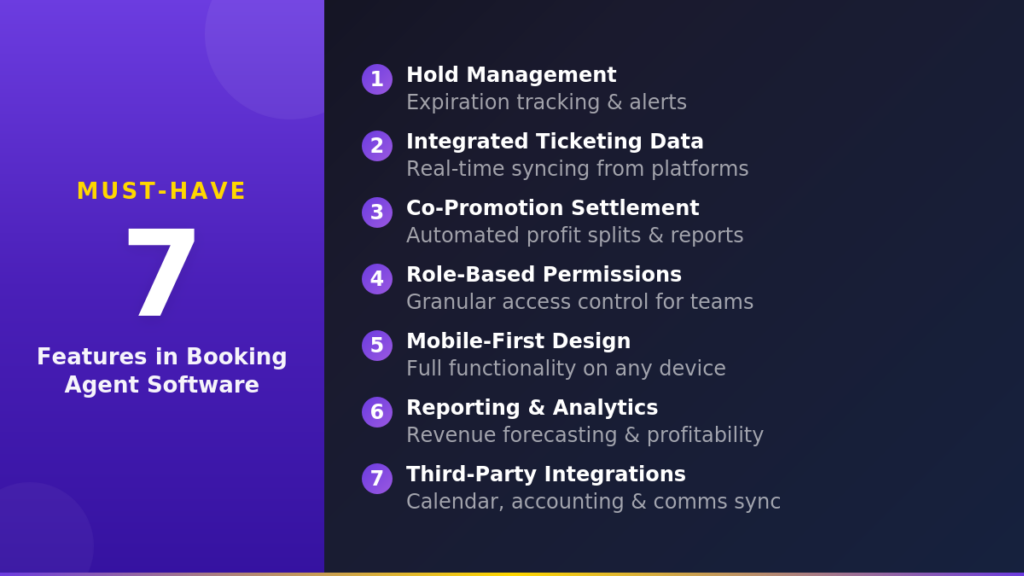
7 Must-Have Features in Music Booking Agent Software
When evaluating platforms, these are the capabilities that separate music-specific tools from generic event software:
- Hold management with expiration tracking: Automatically track hold positions and alert agents before holds expire, preventing lost bookings and damaged venue relationships.
- Integrated ticketing data: Real-time ticket count syncing from third-party ticketing platforms gives agents and promoters accurate financial projections without manual data entry.
- Co-promotion settlement tools: For shows involving multiple promoters, the platform should calculate profit splits, track shared expenses, and generate clean settlement reports for all parties.
- Role-based permissions: Control who sees financial data, artist details, and internal notes. Tour managers, artists, and venue contacts each need different levels of access.
- Mobile-first design: Agents work from venues, festivals, airports, and backstage areas. A platform that requires a desktop browser doesn’t understand the job.
- Customizable reporting and analytics: Revenue forecasting, show profitability analysis, and commission tracking help agents make data-driven decisions about which opportunities to pursue.
- Third-party integrations: Calendar sync, accounting software connections, and communication tool integrations reduce the number of disconnected systems in an agent’s daily workflow.
How Do Music Event Planning Tools Improve Daily Workflows?
The real payoff of music event planning tools is workflow transformation, where tasks that used to take hours get compressed into minutes and information that used to live in someone’s head becomes accessible to the entire team. Modern music event planning tools consolidate separate applications into a single operational hub.
Real-Time Data and Reporting
Booking agents make better decisions when they have access to current data. A platform that shows real-time ticket sales alongside deal terms and expense projections gives agents the full financial picture of every show. That visibility matters when deciding whether to confirm an additional date, adjust a guarantee, or renegotiate terms mid-tour.
Historical reporting adds another layer. Agents can analyze which markets perform best for specific artists, compare venue profitability across seasons, and identify trends that inform routing decisions. WhenLive Nation reported 151 million fans attending nearly 550,000 events in 2024, the agencies with the sharpest data game capture the most opportunity.
Mobile Access for On-the-Go Management
This industry doesn’t happen at a desk. Agents confirm shows from airport terminals, check availability between sets at festivals, and review settlement numbers from the back of a tour bus. Any artist booking platform that doesn’t deliver full functionality on mobile devices is immediately disqualified from serious consideration. Mobile access means more than a responsive website. It means push notifications for hold expirations, the ability to generate and send offers from a phone, and real-time calendar updates that sync across devices without delay.

What Should Music Manager Software Handle Beyond Booking?
The best music manager software recognizes that booking is one piece of a larger operational puzzle. Agents need tools that connect the dots between booking, financial management, team coordination, and long-term business strategy.
Team Collaboration and Permissions
Booking agencies are collaborative by nature. Agents, assistants, tour managers, and artists all interact with the same shows, but they don’t all need the same information. A sophisticated permissions system lets agencies control data access at a granular level. Financial details stay visible to senior agents while tour logistics flow to the road team. Internal notes remain internal. Settlement reports can be shared selectively. That control is essential for maintaining professionalism with external partners while enabling transparent collaboration within the team.
Ticketing Integration and Revenue Forecasting
Ticketing data is the lifeblood of informed booking decisions. When your music manager software integrates directly with ticketing platforms, agents gain automatic ticket count updates that feed into settlement calculations and revenue projections for talent buying. Revenue forecasting becomes more accurate when it’s based on real sales data rather than estimates scribbled on a napkin. A well-integrated artist booking platform lets agents project quarterly earnings for each artist, evaluate which tour legs are underperforming, and adjust strategy before a small problem becomes a financial crisis.
FAQ
What is music booking agent software?
Music booking agent software is a specialized platform designed to manage the end-to-end workflow of booking live music events. It typically includes calendar management, deal tracking, contract generation, settlement automation, and financial reporting features tailored specifically to the music industry’s unique deal structures and operational requirements.
How is music booking agent software different from generic event management tools?
Generic event platforms are built for weddings, corporate functions, and conferences. Music booking agent software understands industry-specific concepts like holds versus confirms, percentage deals, radius clauses, co-promotion splits, and artist settlement workflows. That specificity eliminates the workarounds and manual processes that generic tools require.
What should I look for when choosing an artist booking platform?
Prioritize platforms that offer centralized calendar management, automated settlement calculations, contract templates, ticketing integration, mobile access, and role-based permissions. The platform should also integrate with your existing tools, like Google Calendar and accounting software, so you’re not adding another disconnected system to your workflow.
Do booking agents really need dedicated software?
Agents managing more than a handful of artists across multiple markets will quickly hit the limits of spreadsheets and email. Dedicated software reduces administrative overhead, prevents costly errors like double-bookings and settlement miscalculations, and provides the data visibility needed to make smart booking decisions at scale.
Power Up Your Booking Workflow
The live music industry rewards speed, precision, and relationships. Music booking agent software that delivers on all three gives agents the bandwidth to focus on what actually matters: finding great artists the right stages and building careers. The agencies still cobbling together workflows with email, spreadsheets, and generic tools are working harder for worse results.
Purpose-built platforms designed by people who understand the live music business eliminate that gap. Prism was built specifically for live music professionals, offering an all-in-one platform that handles everything from holds to settlement in a single, mobile-friendly system. Get started with Prism today to stop fighting your tools and start booking smarter.

Matt Ford is the founder and CEO of Prism.fm, a platform built to help the live music industry operate with more clarity and confidence. After 15+ years running venues, producing festivals, and promoting shows, Matt saw firsthand how much of the business relied on fragmented tools and guesswork. He founded Prism in 2018 to change that.
Today, Prism powers more than 3,000 venues and 330 organizations nationwide, serving as an all-in-one platform designed to streamline operations by replacing cumbersome spreadsheets with integrated tools for booking, financial tracking, and contract management. Matt has also led the development of Insights, Prism’s demand prediction platform, which uses real, verified ticketing data to help teams better understand artist performance and make smarter decisions before committing to a show.
Related Post

How Event Management Software Simplifies Calendar and Roster Management
The operational chaos killing live music businesses isn’t a talent problem; it’s a systems problem. If you’re still running your operation on spreadsheets and scattered calendars, you’re leaving money on the table. The U.S. live…

Why Agency Booking Software Needs Centralized Analytics Tools
The agencies winning in today’s live music market aren’t booking more shows. They’re booking smarter ones. If your agency is still making booking decisions based on gut instinct alone, you’re leaving money on the table.…

Choosing the Best All-In-One Solution for Music Industry Professionals
Music industry professionals have to consistently navigate technological advancements and shifting consumer behaviors. According to the IFPI Global Music Report 2024, global recorded music revenues reached $28.6 billion, marking a 10.2% increase and the ninth…