

What Analytics Matter Most for Booking and Talent Agencies in 2026?
Data-driven agencies are pulling ahead while spreadsheet-bound competitors fall behind.
- Revenue from the top 100 worldwide tours hit $8.9 billion in 2025, with ticket prices averaging $132.62.
- Commission tracking, ticket velocity, and artist trajectory analysis now separate thriving agencies from struggling ones.
- Real-time event data tracking eliminates settlement disputes and accelerates cash flow.
- Dedicated booking analytics for agencies outperform generic platforms.
The agencies dominating 2026 will be the ones treating their data like the competitive weapon it actually is.
Anyone working in live music management can feel both the opportunity and the intensifying competition. Worldwide grosses for the top 100 tours reached $8.9 billion for 2025. Average revenue per show climbed to over $2.5 million, up 9.2% year-over-year, while ticket sales hit an all-time record of 19,104 per night. Despite this surge, many agencies still can’t answer basic questions about their own business performance.
Which artists in your roster actually generate profit after expenses? What’s your average commission per show across different venue sizes? Which promoters consistently deliver on ticket projections versus the ones who chronically underperform? If you’re fumbling through spreadsheets to answer these questions, your competitors aren’t. They’re using sophisticated agency software analytics to make faster, smarter decisions while you’re still reconciling last month’s settlements.
The agencies set to dominate 2026 are leveraging booking analytics for agencies to identify opportunities, eliminate waste, and scale intelligently. This guide breaks down exactly which metrics matter most and why the data you track today determines whether you’re leading or lagging tomorrow.
Why Do Booking Analytics for Agencies Demand Attention Now?
The live music economy rewards efficiency and punishes guesswork. With ticket sales hitting record highs and competition for premium routing intensifying, agencies can’t afford to operate on instinct alone.
Total recorded music revenue climbed to $29.6 billion in 2024, with streaming revenue surpassing $20 billion for the first time. This growth in recorded music translates directly to increased touring demand as artists capitalize on expanded fanbases. Agencies without proper analytics will struggle to capture their share of this expanding market.
Consider the operational complexity facing modern booking agents. You’re juggling artist rosters across multiple genres, negotiating with promoters in dozens of markets, managing commission structures that vary by deal type, and coordinating logistics that span continents. Without robust event data tracking, critical information gets lost between email threads, scattered notes, and outdated spreadsheets. Mistakes multiply, and opportunities slip through cracks you didn’t even know existed.
Data-driven decision-making is survival. Agencies that embrace analytics gain visibility into every aspect of their operation, from identifying which artists deserve more attention to understanding which markets deliver the best returns on touring investment.
What Revenue Metrics Should Agencies Track First?
Revenue is oxygen for any business, but booking agencies often track it poorly. Surface-level numbers like total gross commissions tell you almost nothing about the health of your operation. The metrics that actually matter require deeper analysis.
Commission Revenue Per Artist
This is the starting point for understanding roster profitability. Tracking total commission earned from each artist reveals who’s actually driving your business forward versus who’s consuming resources without proportional return. But the number alone isn’t enough. You need context about the effort required to generate that revenue.
An artist generating $50,000 in annual commission might seem valuable until you realize their demanding schedule and complex deal structures consume twice the administrative time as an artist generating $40,000 with straightforward bookings. Revenue per hour of agent time paints a far more accurate picture of true value.
Smart agencies also track commission trends over time. Is a developing artist’s revenue growing quarter over quarter? Has an established act plateaued or declined? These trajectories inform decisions about where to invest your attention and when it might be time to part ways with underperforming clients.
Average Deal Size and Growth
Monitoring your agency’s average deal size reveals broader business health. Are you consistently landing larger guarantees and better splits? Or has your deal quality stagnated while the industry around you grows?
Tracking this metric by venue type, market, and genre exposes specific areas needing attention. Perhaps your agency platform strategy crushes it in mid-size clubs but struggles to break into theaters. Maybe your hip-hop roster commands premium deals while your indie acts remain undervalued. Granular analysis transforms vague concerns into actionable intelligence.
Which Event Data Tracking Metrics Drive Tour Success?
Booking the show is only half the battle. Understanding how that show performs against projections determines whether you’re building sustainable success or riding luck that eventually runs out.
Ticket Sales Velocity and Conversion
How quickly tickets move after announcement matters enormously for tour optimization. Shows that sell steadily from day one behave very differently than those requiring last-minute marketing pushes. Tracking velocity patterns across different markets helps agents identify promising territories and avoid regions where demand consistently disappoints.
Conversion rate from announcement to sellout also deserves attention. If your artists regularly hit 60% capacity and stall, something systematic is broken. Maybe pricing is wrong for those markets, timing conflicts with local events, or venue selection doesn’t match audience size. Without tracking this data, you’re guessing at solutions for problems you can’t clearly define.

Real-time ticket tracking eliminates the painful process of chasing down box office reports from promoters. When sales data flows automatically into your agency software analytics system, you can spot problems early enough to actually fix them rather than conducting a post-mortem on another underperforming show.
Market Performance by Region
Not all markets perform equally, and your data should clearly reflect those differences. Regional analysis reveals where your roster resonates strongly and where marketing investment might unlock untapped potential.
Track metrics like average ticket sold per capita, typical venue fill rates, and repeat market performance over multiple tours. Some cities just love certain sounds while others remain stubbornly indifferent. Understanding these patterns prevents wasted routing into markets that never deliver while maximizing exposure in regions primed for growth.
Geographic music insights also inform pricing strategy. Premium markets can support higher ticket prices without sacrificing attendance. Secondary markets might require aggressive pricing to build an audience. Your analytics should automatically surface these distinctions, rather than requiring manual market-by-market research.
7 Essential Agency Software Analytics for 2026
The metrics separating elite agencies from average operations span financial, operational, and strategic categories. Here are the seven that matter most:
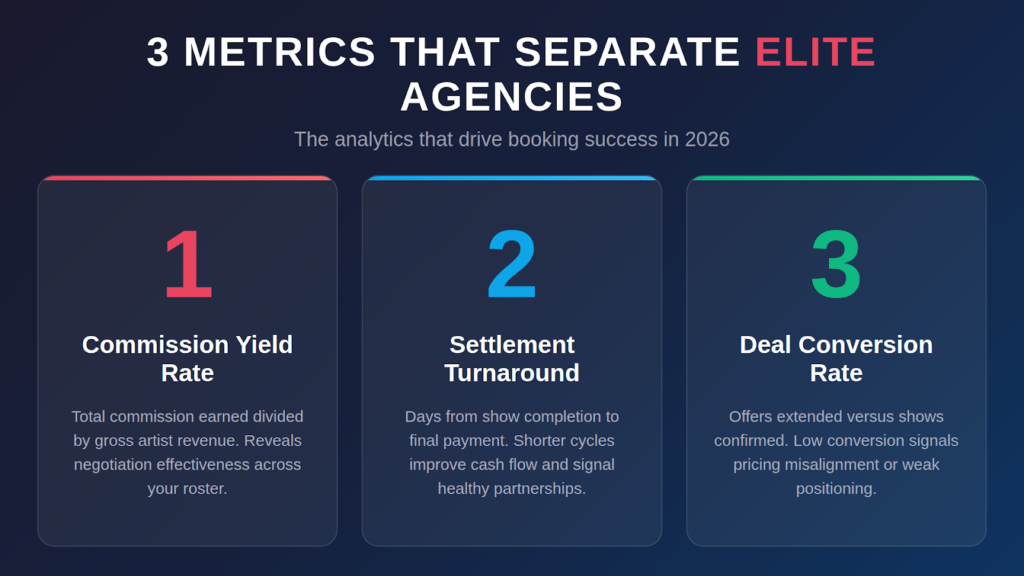
- Commission Yield Rate: Total commission earned divided by gross artist revenue handled. This efficiency metric reveals how well you negotiate deals on behalf of clients.
- Settlement Turnaround Time: Days from show completion to final settlement received. Shorter cycles improve cash flow and indicate healthy promoter relationships.
- Artist Revenue Growth Rate: Year-over-year commission growth per roster member. Identifies rising stars deserving more resources and declining acts requiring attention.
- Deal Conversion Percentage: Offers extended versus shows confirmed. Low conversion suggests pricing misalignment or weak market positioning.
- Promoter Reliability Score: Tracking which promoters consistently hit ticket projections versus those who chronically underdeliver. Informs future partnership decisions.
- Tour ROI by Route: Calculating net profit per tour, considering all expenses and time investment. Reveals whether routing strategies actually maximize returns.
- Pipeline Velocity: Speed at which potential bookings move from initial inquiry to confirmed contract. Indicates operational efficiency and market demand strength.
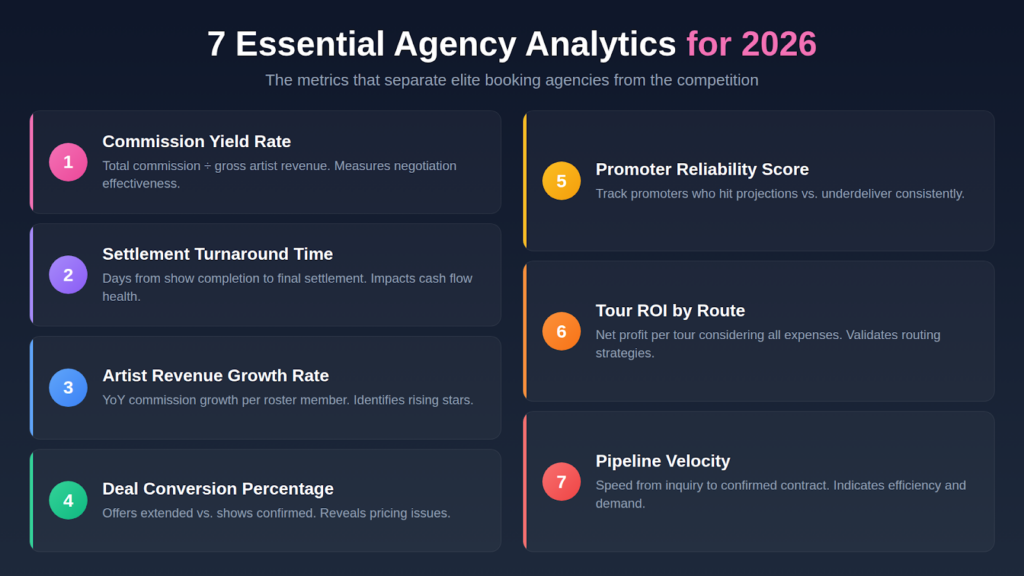
These data insights are the foundation of intelligent agency management that scales without sacrificing quality.
How Do Music Insights Shape Roster Development?
Raw booking data tells you where you’ve been. Strategic music insights tell you where opportunities are heading. The agencies winning in 2026 use both.
Artist Trajectory Analysis
Every artist on your roster follows a trajectory. Some are ascending rapidly, building larger audiences with each release and tour. Others have plateaued at sustainable but static levels. A few might be declining despite everyone’s best efforts.
Identifying these trajectories early enables proactive management. Ascending artists deserve investment in premium routing and festival submissions. Plateaued acts might benefit from market repositioning or creative reinvention. Declining artists require honest conversations about expectations and potentially transitioning representation before the relationship sours.
Tracking social growth, streaming performance, and press coverage alongside booking metrics creates a comprehensive artist health dashboard. When Spotify numbers climb but ticket sales lag, there’s an opportunity to convert digital fans into live attendees. When press coverage spikes ahead of tour announcements, marketing timing can capitalize on momentum.

Venue and Promoter Performance Scoring
Your relationships with venues and promoters directly impact artist success. Building performance scorecards for every business partner transforms subjective impressions into objective evaluations.
Which venues consistently provide excellent production support? Which promoters invest in marketing versus expecting artists to drive all awareness? Where do settlement disputes arise repeatedly? This knowledge becomes incredibly valuable for routing decisions and negotiation leverage.
Newer agents joining your team inherit this intelligence immediately rather than spending years learning through painful experience. Veteran agents avoid repeating mistakes already documented in your system.
What Common Analytics Mistakes Limit Agency Growth?
Even agencies attempting data-driven management often stumble on predictable pitfalls that undermine their efforts.
Tracking too many metrics creates noise that obscures the signal. When dashboards overflow with dozens of data points, nothing stands out as actionable. Focus on the handful of metrics directly tied to your priorities rather than measuring everything.
Inconsistent data entry destroys analytical reliability. If some shows get entered thoroughly while others receive minimal documentation, comparisons become meaningless. Establish clear standards and hold your team accountable for consistent input.
Ignoring qualitative context alongside quantitative metrics leads to poor decisions. Numbers rarely tell complete stories. A show that underperformed might have faced unexpected competition, terrible weather, or last-minute artist issues. Pure data analysis without situational awareness produces flawed conclusions.
Finally, failing to act on insights renders the entire exercise pointless. Analytics only create value when they inform decisions. If you’re generating beautiful reports that nobody reads or references when making booking choices, you’re wasting resources that could go toward actually improving operations.
FAQ
What is the most important booking analytics metric for talent agencies? Commission revenue per artist combined with the effort required to generate that revenue provides the clearest picture of roster profitability. This metric helps agencies identify which clients deliver value versus those consuming disproportionate resources.
How does event data tracking improve tour planning? Tracking ticket sales velocity, market performance, and venue fill rates across multiple tours reveals patterns that inform smarter routing decisions. Booking analytics for agencies can reveal high-performing markets deserving more attention versus regions that consistently underdeliver.
What’s the difference between agency software analytics and generic event management tools? Purpose-built agency platforms understand live music-specific workflows like commission calculations, split deals, settlement processes, and multi-artist roster management. Generic tools force workarounds that create inefficiency and increase error rates.
How often should booking agencies review their analytics? Weekly reviews of operational metrics like pipeline velocity and settlement turnaround keep day-to-day performance on track. Monthly or quarterly deep dives into strategic metrics like artist trajectory and market performance inform longer-term decisions about roster development and business direction.
Build Your Agency’s Data Advantage
The live music industry’s growth creates a massive opportunity for agencies positioned to capitalize. But opportunity favors the prepared. Agencies flying blind on operational performance will struggle to compete against data-driven rivals who can optimize every decision.
Building an effective booking agency requires moving beyond spreadsheets and disconnected systems toward unified platforms designed specifically for live music workflows. Generic CRMs don’t understand commission structures, split calculations, or settlement processes. Generic event software can’t handle the complexity of multi-artist rosters touring simultaneously across dozens of markets.
Prism delivers the booking analytics for agencies that serious professionals need. From real-time ticketing integrations to comprehensive financial reporting, it’s the platform built by live music industry veterans who understand exactly what agents face daily. Get started with Prism and transform how you track, analyze, and act on the metrics that matter most.

Matt Ford is the founder and CEO of Prism.fm, an Austin-based software company revolutionizing live music event management. With a background in entrepreneurship and a degree from the University of Wisconsin-Madison School of Business, Ford combined his self-taught coding skills with firsthand experience as a concert promoter to address the inefficiencies he observed in the industry. In 2018, he launched Prism.fm, an all-in-one platform designed to streamline operations for venues, promoters, and agencies by replacing cumbersome spreadsheets with integrated tools for booking, financial tracking, and contract management. Under his leadership, Prism.fm has grown significantly, achieving $3 million in annual recurring revenue post-COVID and securing over $15 million in funding . Ford’s commitment to building user-centric solutions has positioned Prism.fm as a trusted partner for over 1,500 venues and promoters worldwide.
Related Post
Music Tour Planning Tools That Unify Your Booking Workflow
Managing artist tours without a centralized system creates chaos, missed payments, and scheduling conflicts that cost real money. If you’re still running your tour operations across five different apps, you’re working harder than you need…

What Promoters Should Look for in a Talent Buying CRM
The right talent buying CRM transforms how promoters operate, replacing fragmented workflows with a unified system built for live music complexity. Stop evaluating CRMs by feature lists; start evaluating them by whether they understand how…

How AI is Reshaping Venue Scheduling and Artist Booking
AI venue scheduling is shifting how talent buyers and promoters manage holds, offers, and settlements. If you’re still manually juggling spreadsheets for every show, your competitors are already moving faster. The live music management industry…