

Venue Management in 2026: How Live Music Operators Reclaim Time and Protect Margins
Live music venue management has never been more punishing, or more solvable.
- 64% of independent stages operated unprofitably in 2024, per NIVA’s State of Live report.
- Manual workflows consume hours every day that should go to booking, marketing, and audience development.
- Specialized software built for live music combines calendar, holds, offers, advancing, and settlement into one workflow.
- The operators winning right now treat venue management as an operational system, not a job description.
If you’re still running your venue on a stack of disconnected tools, you’re losing time and margin you can’t afford to give back.
The job of running a live music venue has expanded into something nobody signed up for. You’re a talent buyer, a marketer, a financial controller, a hospitality manager, an HR lead, and an IT director. Costs are up, ticket revenue is unpredictable, and the workday is consumed by administrative drag. According to NIVA’s State of Live report, the top operational challenges across independent stages include marketing, rising artist fees, staffing costs, and inflation. None of those go away. But the time you spend chasing data across spreadsheets, inboxes, and ticketing dashboards is recoverable. That’s where modern all-in-one live music management tools earn their keep.
This piece breaks down what venue management actually looks like in 2026, where the time goes, and what an operations system needs to do to give that time back.
Why Is Venue Management So Time-Consuming Right Now?
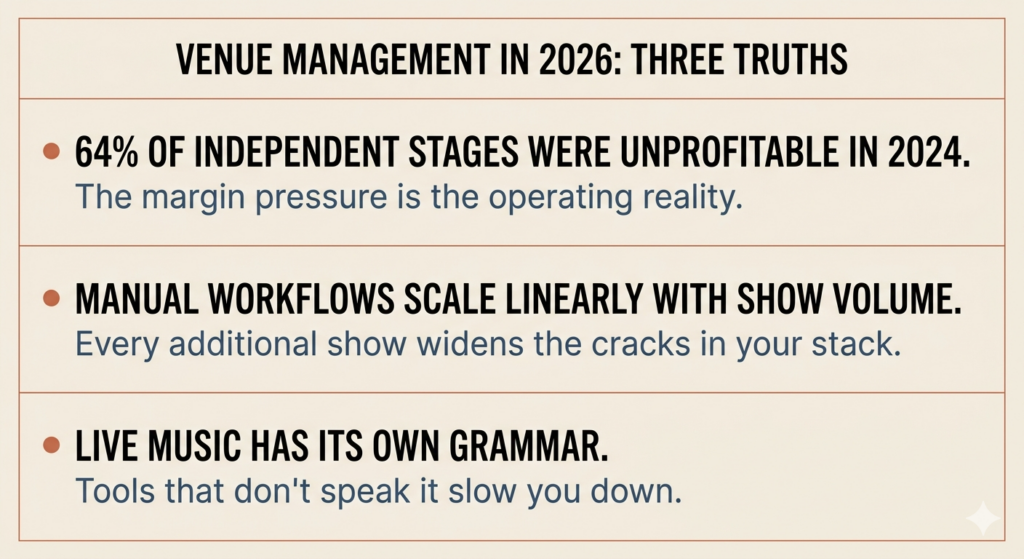
Venue management is operationally distinct from running a restaurant, wedding venue, or convention center, and most general-purpose software treats it like all three. Live music has its own vocabulary: holds versus confirms, versus deals, radius clauses, internal versus external deal terms, advancing, run of show, settlement, and co-promotion splits. None of that fits cleanly into a hotel sales pipeline or a banquet event order.
The U.S. live music market is projected to grow from $18.51 billion in 2025 to $26.93 billion by 2031, according to Mordor Intelligence’s market analysis. More demand means more shows, contacts, contracts, and financial reconciliation. If your operation is still held together by Google Sheets and a shared inbox, every additional show makes the cracks wider.
The result is a workday that gets eaten alive by coordination. Talent buyers chasing avails. GMs reconciling expense receipts. Marketing teams hunting for accurate ticket counts. Box office staff rebuilding settlement spreadsheets from scratch. None of this is revenue work. It’s overhead, and it scales linearly with show volume.
Where Does Your Day Actually Go?
If you’ve never audited where your time goes inside a typical week, do it once. Most operators are shocked. Here’s where the hours typically pile up and where a unified venue management system reclaims them.
How Much Time Does Booking Coordination Eat?
Booking is the front door of your business, and it’s where the worst friction lives. Agents send avail requests by email. You check calendars in one tool, ticket scaling in another, and financials in a third. Then you build an offer in Word, save it as a PDF, and email it back. That cycle can take 30 to 90 minutes per offer. Multiply it across a 200-show year, and you’ve burned multiple full work weeks just generating paper.
A live music venue management system condenses that. Holds, confirms, and offer generation happen on a shared calendar with templates, real-time financial modeling, and instant PDF output. Pabst Theater Group runs over 800 live performances a year across six Milwaukee venues, and their COO Matt Beringer has talked openly about how moving off spreadsheets reshaped their entire workflow. The tools you used to need (Dropbox, Air Table, a Frankenstein offer sheet) become dead weight.
What Does Marketing Coordination Cost You?
Marketing a show now means coordinating across email, social, programmatic ads, partnerships, presales, and your ticketing platform. The hard part isn’t the channels. It’s the data. If your ticket sales live in one place and your marketing spend lives in another, you’re guessing at ROAS instead of measuring it.
Venue operations software that integrates with your ticketing partner pulls scan data and revenue into one view. You see how a show is pacing without exporting four CSVs. You see which campaigns moved tickets without manually tagging URLs in a shared doc. MOKB Presents operates with real-time ticket data flowing into their financial workspace, which their team uses to reallocate spend mid-campaign instead of after the show is over.
Why Does Financial Reconciliation Take So Long?
Settlement is where operators lose the most time and where the cost of bad data is highest. A miskeyed cell at settlement is a miskeyed check to an artist. If you’re settling shows by hand at 1 a.m. after load-out, you’re working with stale information, and you’re tired. That combination is how mistakes happen.
A proper venue management system updates financials as tickets sell. Costs are entered against the show as they’re incurred. Estimated and actual values sit side by side. When you walk into settlement, the math is already done. You’re verifying, not building. The Auditorium Theatre’s Matt Rucins, a 26-year industry veteran, has described how a music-first platform saved him hours on a once convoluted, error-prone settlement process that previously lived in spreadsheets.
What About Communication and Advancing?
Advancing a show used to be a thread of 40 emails between you, the tour manager, production, your in-house team, and the local crew. Half of those emails are about details that already live somewhere in the system. The other half are clarifying questions because the details are scattered across three platforms.
Modern event operations platforms put advancing in one place. The artist’s hospitality rider, the production schedule, the day-of-show contacts, the load-in window, and the parking notes all live on the event record, shared with whoever needs it. Permissioning means your accountant doesn’t see the artist’s home address, and the tour manager doesn’t see your bar costs. Everyone gets what they need and nothing they don’t.
What Should Live Music Venue Operations Software Actually Do?
The category is crowded with tools that look similar on a feature checklist. Most aren’t built for music. Here’s what a real live music venue management system has to deliver:
- A unified hold and confirm calendar across all your rooms, with multi-user editing, hold levels, and conflict warnings.
- Offer generation with live financial modeling, including break-even calculations, deal scenarios (flat, versus, doors deals), and templated terms you can deploy in seconds.
- Ticketing integration that updates financials in real time as tickets sell, with support for major ticketing platforms.
- Settlement built for live music, including support for co-promotion splits, per-ticket bonuses, talent costs, and adjustments that aren’t part of generic event templates.
- Advancing, run of show, and document storage that lives on the event record, not in a separate folder system.
- Reporting and analytics that show you year-over-year venue performance, artist trends, deal-type profitability, and pacing against projections.
- Mobile access so you’re not chained to a desk to approve a hold or check a settlement number.
Software that only does some of this leaves you back where you started: stitching tools together with spreadsheets.
How Much Time Can Venue Management Software Save?
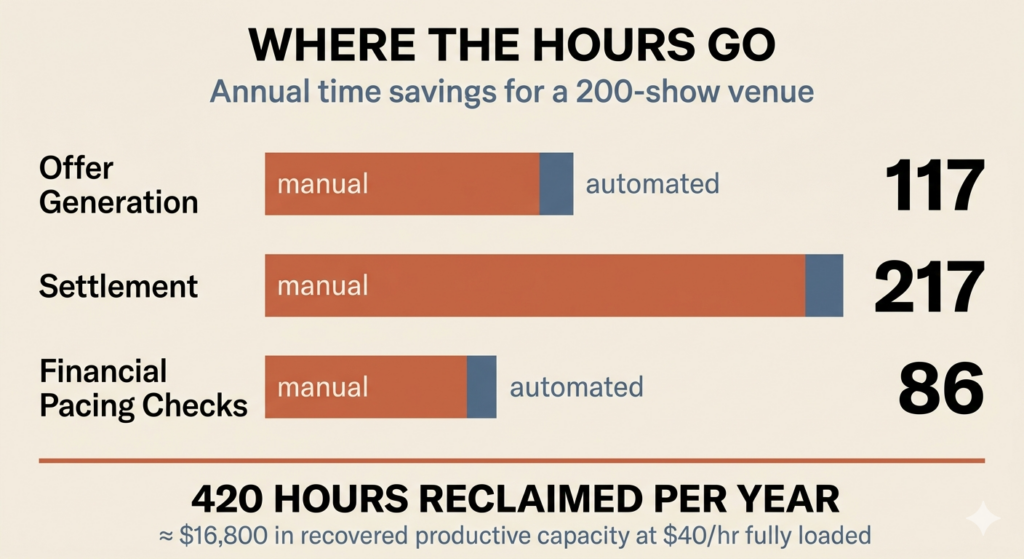
Let’s do the math instead of asserting the outcome. Take a venue running 200 shows a year with a small team. Estimate the time per task before and after.
Offer generation: 45 minutes per offer manually vs 10 minutes with templates and live financials. Savings: 35 minutes × 200 shows = 117 hours per year.
Settlement: 90 minutes per show building the sheet from scratch vs 25 minutes verifying a pre-built sheet. Savings: 65 minutes × 200 shows = 217 hours per year.
Financial pacing checks: 15 minutes per show pulled together from multiple sources vs 2 minutes inside a unified dashboard. Savings: 13 minutes × 200 shows (checked twice per show on average) = 86 hours per year.
That’s roughly 420 hours per year reclaimed across just three tasks. At a fully loaded labor cost of $40 per hour, that’s $16,800 in recovered productive capacity. RisingSun’s Senior Talent Buyer Graham Noel reports that with a music-specific platform, his team of four is doing the work of eight, and that booking is at least twice as efficient as before.
Why Do Generic Event Tools Fail Live Music Venues?
The event management software market is projected to reach $17.33 billion by 2030, growing at 13.2% CAGR according to Grand View Research’s industry report. Most of that growth comes from generic tools serving weddings, corporate events, conferences, and hotels. Those tools are well-built. They’re just not for you.
Generic event operations platforms typically miss:
- Holds versus confirms: A wedding venue books or it doesn’t. Music venues live in hold-level limbo for weeks.
- Co-promotion: Split revenue and expenses with a partner promoter, possibly with a flat per-ticket bonus and selective revenue-stream inclusion. No hospitality tool handles this natively.
- Versus deals: 85/15 splits against expenses, walk points, settlement adjustments. These aren’t standard event math.
- Radius clauses and tour relationships: Generic tools don’t track which artists can play within X miles of your venue within Y days.
Live music has its own grammar. Tools that don’t speak it slow you down.
How Do You Know You’ve Outgrown Spreadsheets?
Here are a few honest signals that you’re past the point where manual venue management is working:
- You’ve sent a settlement to an artist that had a math error
- You’ve double-booked a hold or a confirm
- Your team can’t agree on which version of the offer sheet is current
- You can’t answer “how are we pacing against last year” without opening four files
- Your finance team is reconstructing show financials weeks after the show
- Your talent buyer is making decisions without access to historical performance data on the artist
Any one of those signals is expensive. Two of them, repeating, is a margin problem.
What Are Your Options for a Venue Management System?
The market broadly splits into three camps. Generic event management tools handle private events, hotels, and restaurants well. They’re not built for live music. Stadium and convention-center platforms handle massive enterprise venues with arena-scale complexity, but they’re overkill and overpriced for clubs, theaters, and PACs. Live-music-specific platforms are the third category, and the one most relevant for promoters, talent buyers, performing arts centers, clubs, theaters, amphitheaters, and arenas that program live music as their core business.
When you’re evaluating, ask the vendor to walk you through a co-promotion settlement, a versus deal at break-even, and a tour deal across multiple rooms. If they can’t, they’re not built for your workflow.
FAQ
What is venue management software for live music? Venue management software for live music is a specialized platform that consolidates booking calendars, holds and confirms, offer generation, financial tracking, ticketing integration, advancing, and settlement into one system. Unlike generic event tools, it’s built around industry-specific workflows like versus deals, co-promotion splits, and radius clauses.
How is a venue management system different from event management software? A venue management system is built for ongoing programming at a specific venue or venue group, with a recurring calendar, financial reporting across shows, and historical artist performance data. Generic event management software is built around one-off events (weddings, conferences, corporate functions) and lacks live-music-specific deal structures.
Can venue management software integrate with my existing ticketing platform? Purpose-built live music platforms typically integrate with major ticketing providers and sync ticket sales data in real time. This eliminates manual data entry and gives you accurate financial pacing throughout the on-sale cycle.
How much time can a venue management system save? Operators report saving hundreds of hours per year on offer generation, settlement, and financial pacing. For a 200-show venue, conservative time savings across just three core workflows can exceed 400 hours annually.
Is venue management software worth it for smaller independent venues? The smaller your team, the more leverage you need from your tools. Independent operators running 50 to 200 shows annually often see the strongest ROI because every hour reclaimed goes directly back into revenue-generating work like booking and marketing.
Take Back Your Week
The operators thriving in this market have turned venue management from a daily grind into a system that runs in the background. The hours you reclaim from offer generation, settlement, and financial reconciliation go back into the work that grows your business: building artist relationships, programming smarter, marketing harder, and treating your audience like they matter.Prism was built by live music professionals for promoters, talent buyers, agencies, performing arts centers, clubs, theaters, amphitheaters, and arenas. Schedule a demo to see how it handles your specific workflow.

Matt Ford is the founder and CEO of Prism.fm, a platform built to help the live music industry operate with more clarity and confidence. After 15+ years running venues, producing festivals, and promoting shows, Matt saw firsthand how much of the business relied on fragmented tools and guesswork. He founded Prism in 2018 to change that.
Today, Prism powers more than 3,000 venues and 330 organizations nationwide, serving as an all-in-one platform designed to streamline operations by replacing cumbersome spreadsheets with integrated tools for booking, financial tracking, and contract management. Matt has also led the development of Insights, Prism’s demand prediction platform, which uses real, verified ticketing data to help teams better understand artist performance and make smarter decisions before committing to a show.
Related Post

Best Performing Arts Management Software for PACs: 2026 Buyer’s Guide
Most performing arts management software only runs half your building, and the half it skips is where your margin lives. Before you sign anything in 2026, buy for the workflow you actually run: book, confirm,…
Theatre Management Software vs. Performing Arts Center Software: What PACs Actually Need
The label on the software matters far less than whether the tool models how a performing arts center actually runs a week. Shop by whether the software can run your Tuesday: a school matinee, a…
Performing Arts Center Software: How PACs Manage Complex Events & Reporting
A performing arts center runs more event types through the same rooms than any other venue in live entertainment, and generic scheduling tools collapse under that complexity. If your calendar, deals, and financials live in…