

How Event Contract and Payment Software Simplifies Live Music
Unified event contract and payment software eliminates the chaos of managing live events across disconnected tools.
- Spreadsheet-based workflows cost promoters and venues thousands in errors, delays, and missed opportunities annually.
- Centralized platforms reduce settlement time from hours to minutes while improving accuracy.
- Real-time financial visibility enables smarter booking decisions and faster artist payments.
The venues still juggling email threads, PDFs, and manual spreadsheets are already losing ground to competitors using integrated systems.
The live music industry is projected to be part of a global events market reaching $2.5 trillion by 2035. Yet most venues and promoters still handle contracts and payments through a patchwork of spreadsheets, email chains, and disconnected software. When you’re managing dozens of shows per month, every manual touchpoint becomes a liability. Missed deposits, disputed settlements, and unsigned contracts are revenue killers that strain relationships with artists, agents, and co-promoters.
Event contract and payment software brings every financial and contractual element into a single, music-specific platform. From the initial offer through final settlement, the right system keeps your deals organized, your payments on track, and your relationships intact.
Why Has Event Contract and Payment Software Become Essential?
As live events have rebounded with a vengeance (the number of events grew by 52% in 2024), the operational demands on venues and promoters have intensified. More shows mean more contracts to negotiate, more deposits to track, and more settlements to reconcile. The margin for error has shrunk to nearly zero.
Consider what happens when your contract management lives in one system, your payment tracking in another, and your calendar in a third. Information gets siloed. Someone updates a deal term in the contract but forgets to adjust the payment schedule. The artist’s agent sends back a signed PDF that sits in an inbox for three days. Settlement night arrives, and nobody can locate the original offer terms.
Live event contract management platforms eliminate these gaps by creating a continuous data flow from booking through settlement. When an offer gets accepted, the contract auto-populates with the agreed terms. When tickets sell, that revenue appears in your settlement calculations in real time. When a deposit comes due, the system alerts everyone who needs to know. No copy-pasting between spreadsheets. No hunting through email threads. No 3 AM reconciliation sessions after the show.
The Hidden Costs of Disconnected Systems
The real expense isn’t the time you waste on manual processes; it’s the opportunities that slip through the cracks. When 67.4% of event planners say they’ve changed or plan to change their event software, that signals widespread dissatisfaction with tools that don’t deliver. Venues and promoters are discovering that generic event management platforms weren’t built for the unique complexity of live music operations.
Artist deals aren’t like corporate event contracts. They involve guarantees versus door splits, backend bonuses, rider requirements, deposit schedules, and settlement calculations that depend on actual ticket sales. A platform built for conference planning will never handle a promoter profit deal correctly. And when your systems can’t accommodate the industry-specific details, you end up building workarounds that create more problems than they solve.
What’s the Real Cost of Disconnected Contract and Payment Systems?
Every promoter has a settlement horror story. The numbers don’t match. The agent disputes an expense. Someone forgot to account for the facility fee. These situations damage relationships and reputation, but they’re completely preventable with the right infrastructure.
Manual contract workflows introduce friction at every stage. Creating offers takes longer because you’re starting from scratch each time. Tracking contract status requires checking multiple platforms. Following up on unsigned agreements means digging through email history. And when show day arrives, you’re scrambling to assemble settlement data from five different sources while exhausted artists wait to get paid.
Settlements can be a pain after a show when you’re counting tickets, calculating splits, and tracking what people are owed. Fatigue leads to errors. Errors lead to disputes. Disputes damage the relationships you’ve worked hard to build. The solution is to automate the pieces that software can handle better than humans ever could.
Artist payments software that integrates with your contracts and ticketing eliminates the late-night math sessions. When your system knows the deal terms, tracks ticket sales in real time, and automatically calculates settlements, you spend settlement night reviewing numbers instead of generating them.

7 Must-Have Features in Event Contract and Payment Software
When evaluating event contract and payment software for your live music operation, prioritize these capabilities:
- Automated offer generation with templates that match your deal types and venue configurations, enabling you to send professional offers in minutes rather than hours
- Electronic contract management that populates terms from accepted offers, tracks signature status, and stores executed agreements in a searchable archive
- Integrated payment tracking that monitors deposits, final payments, and co-promoter splits with automated reminders and status updates
- Real-time settlement calculations that pull ticket sales directly from your ticketing platform and apply deal terms automatically
- Mobile accessibility so you can review settlements, approve payments, and access contracts from anywhere, including backstage after the show
- Customizable permissions that let you share relevant information with agents, co-promoters, and team members without exposing sensitive financial data
- Reporting and analytics that help you understand which deals perform best, which artists deliver ROI, and where your money goes
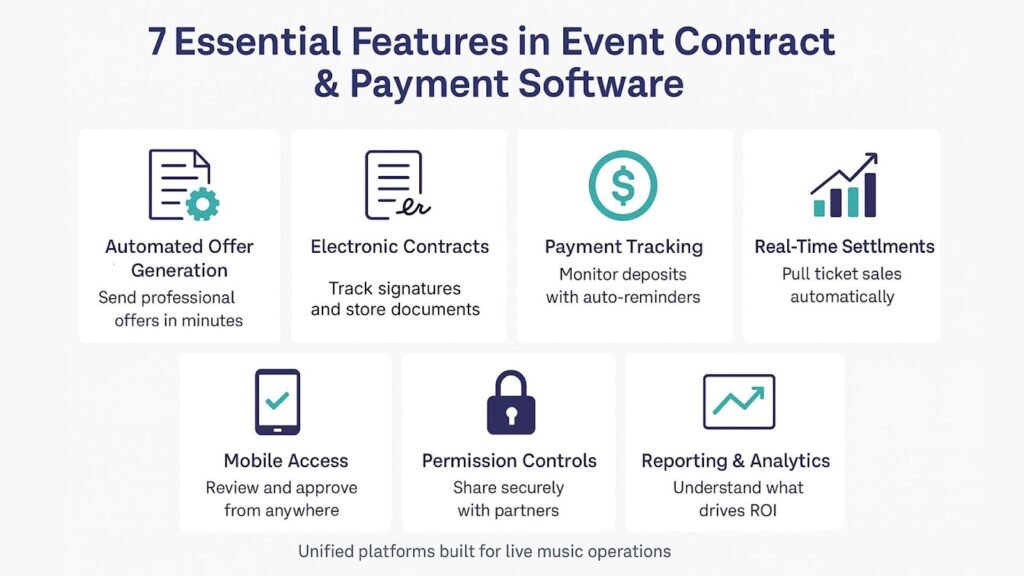
The platforms that deliver on these capabilities share a common trait: they were built specifically for live music. Generic event software treats a concert like a corporate conference, and the differences matter enormously when you’re trying to settle a backend deal at 2 AM.
How Can Live Event Contract Management Transform Your Workflow?
The traditional workflow looks something like this: receive inquiry, check calendar, draft offer, negotiate terms, send contract, chase signature, track deposit, remind about balance, settle show, reconcile numbers, issue payment. Each step involves different tools, different documents, and different communication channels. Dropping the ball at any stage creates downstream problems.
Modern talent buying software collapses this workflow into a unified process where each step flows naturally into the next. The calendar feeds the offer. The offer feeds the contract. The contract feeds the payment schedule. The payment schedule feeds the settlement. Nothing falls through the cracks because there are no cracks.
From Offer to Settlement in One Workflow
Using the right software looks like this: you see an opening on your calendar and want to make an offer. You select the date, choose a deal template, input the artist-specific terms, and send. The offer tracks automatically, and when the agent accepts, a contract is generated with all terms pre-populated. The artist signs electronically, and the deposit schedule automatically starts tracking.
As tickets sell, your system updates estimated settlements in real time. You can see at any moment whether a show is moving toward profit or loss. When show day arrives, you finalize the ticket count, the system calculates the settlement based on the original deal terms, and you generate a professional settlement sheet with one click.
This scenario is how the most efficient venues and promoters operate today, and it’s why they can manage more shows with smaller teams while maintaining accuracy and preserving relationships.
How Can Artist Payments Software Eliminate Settlement Chaos?
Settlement night separates the professionals from the amateurs. When the house lights come up and it’s time to pay the artist, you want confidence that your numbers are right. Disputes after the fact sour relationships and create unnecessary friction with agents you need to work with repeatedly.
Artist payments software built for live music handles the complexity that generic tools can’t touch. Different deal structures (guarantees, door deals, versus deals, promoter profit deals with backends) require different calculations. Tax withholding varies by state and artist residency. Co-promoter splits add another layer of math. Production charges, ticket facility fees, and credit card processing costs all factor into the final settlement.
Music performance contracts become much more manageable when your software understands them natively. Instead of manually calculating whether the backend kicked in, your system instantly does the math based on actual ticket sales pulled from your ticketing integration. Instead of debating expense allocations, you reference the terms that both parties agreed to in the original contract.
Eliminating Settlement Night Chaos
The software automates the process and ties in online ticket sales in real time because it’s integrated into your ticketing platform. Account for walk-ups by inputting the door count, and your settlement updates immediately. Generate customized, branded settlement sheets that show exactly how you arrived at every number.
Separate internal and external settlements keep your private financials private while giving artists and agents the transparency they need. When everyone can see the math and trace it back to agreed-upon terms, disputes become rare.

Building a Promoter CRM That Scales With Your Business
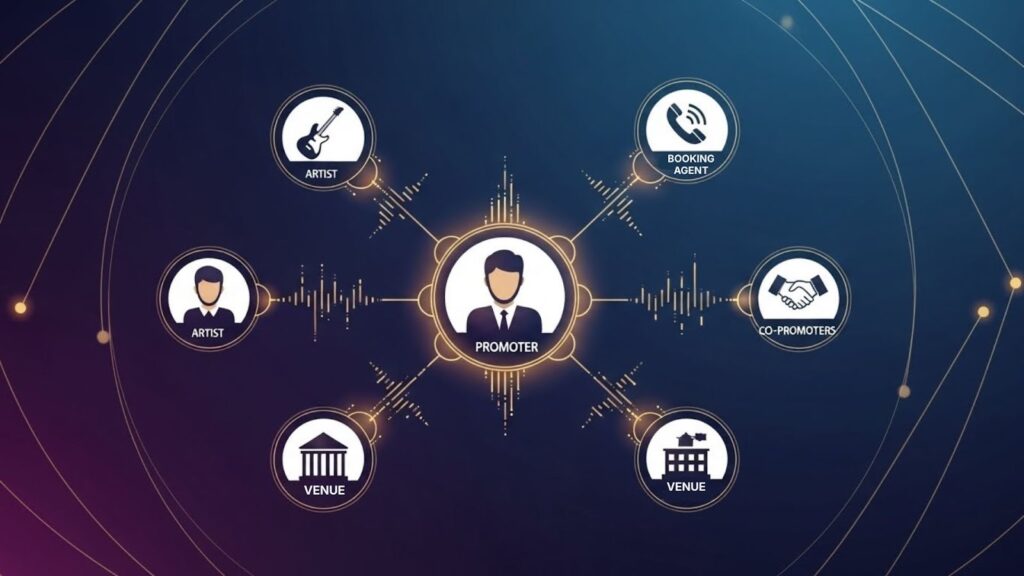
Contacts and relationships drive this industry. The agents you’ve built trust with, the artists who draw your crowd, the co-promoters you partner with on bigger productions. Managing these relationships through scattered email contacts and mental notes works until it doesn’t, usually right around the time you start handling enough volume that details slip.
A purpose-built promoter CRM stores the context that matters: past deals with an artist, communication history with an agent, and payment track record with a co-promoter. When you’re considering a booking, you can instantly see how previous shows performed, what deal structure worked, and whether there were any issues worth remembering.
This context becomes valuable as your operation grows. New team members can get up to speed on relationship history without lengthy briefings. Seasonal staff can handle tasks without requiring supervision on every decision. The knowledge that usually lives in one person’s head becomes accessible to everyone who needs it.
The best event contract and payment software includes CRM functionality because contacts, contracts, and payments are inherently connected. The agent you’re negotiating with today is the same person you settled with last month and will be working with next quarter. Keeping that relationship data alongside your deals and financial information creates a complete picture of your operation.
Why Are Event Professionals Now Use Dedicated Platforms?
The shift away from spreadsheets and generic tools has accelerated. Event professionals have realized that the time savings and error reduction from purpose-built software pays for itself many times over. The question is which platform matches your specific needs.
For live music venues and promoters, the answer involves finding software that speaks your language. Deal tracker features that understand holds, confirms, and cancellations. Settlement tools that handle the nuances of ticket-based calculations. Payment tracking that accommodates the deposit schedules and backend triggers that make this industry unique.
Venue management software has been replacing spreadsheets across the industry because the complexity has outgrown manual processes. Multi-room venues, co-promotion agreements, rental events, and bought shows each carry different financial structures. Keeping all of that straight in spreadsheets requires either superhuman attention to detail or a willingness to accept errors as inevitable.
FAQs
What’s the difference between event contract software and general contract management tools? General contract management tools handle document signing and storage but don’t understand live music deal structures. Event contract software designed for the industry includes features specific to guarantee versus deals, backend calculations, rider attachments, and settlement generation that generic platforms simply can’t accommodate.
How does artist payments software integrate with ticketing platforms? Purpose-built platforms connect directly to major ticketing providers, automatically pulling real-time sales data into settlement calculations. This eliminates manual data entry, reduces errors, and ensures settlements reflect actual ticket counts without requiring separate exports and imports between systems.
Can event contract and payment software handle co-promotion deals? Advanced platforms include co-promoter management features that track partnership terms, split revenue and expenses according to agreed percentages, and generate separate settlement reports for each party.
What ROI should venues expect from switching to unified contract and payment software? Most venues report time savings in offer generation, contract management, and settlement preparation. The accuracy improvements also reduce costly disputes and payment delays that impact cash flow and relationships.
Your Operations Deserve Better Than Workarounds: Get Started with Event Contract and Payment Software
The venues and promoters thriving share a common approach: they’ve stopped trying to make generic tools work for specialized needs. They’ve invested in platforms designed specifically for live music operations, and they’re reaping the benefits in efficiency, accuracy, and relationship quality.
Prism delivers exactly this kind of unified platform for venues, promoters, and agencies. With integrated offer generation, contract management, payment tracking, and settlements in one music-specific system, teams spend less time on administration and more time booking great shows. Get started with Prism and leave the spreadsheet chaos behind.

Matt Ford is the founder and CEO of Prism.fm, a platform built to help the live music industry operate with more clarity and confidence. After 15+ years running venues, producing festivals, and promoting shows, Matt saw firsthand how much of the business relied on fragmented tools and guesswork. He founded Prism in 2018 to change that.
Today, Prism powers more than 3,000 venues and 330 organizations nationwide, serving as an all-in-one platform designed to streamline operations by replacing cumbersome spreadsheets with integrated tools for booking, financial tracking, and contract management. Matt has also led the development of Insights, Prism’s demand prediction platform, which uses real, verified ticketing data to help teams better understand artist performance and make smarter decisions before committing to a show.
Related Post

What Is Speculative Ticketing? How It Works and Why the Live Music Industry Is Fighting It
Buying a concert ticket should be fairly straightforward: a ticket exists, someone sells it, and a fan buys it. But in the secondary ticket market, that isn’t always what happens. In some cases, resellers advertise…
Live Music Management Software: How to Replace Spreadsheets for Booking & Scheduling
Getting off spreadsheets isn’t a decision problem anymore. It’s an execution problem, and many teams botch the execution. Pick your cutover date before you pick your platform, and work backward from it. Your calendar lives…

Best Performing Arts Management Software for PACs: 2026 Buyer’s Guide
Most performing arts management software only runs half your building, and the half it skips is where your margin lives. Before you sign anything in 2026, buy for the workflow you actually run: book, confirm,…