
How Venues Can Streamline Operations with Management Software
The days of spreadsheets, sticky notes, and chaotic email chains are over for serious venue operators.
- Live music venues managing multiple shows weekly waste hours on manual processes that modern software handles in minutes.
- Integrated platforms eliminate double-bookings, automate ticket tracking, and centralize financial data for faster settlements.
- Multi-venue operations benefit most from consolidated calendars and shared access features that keep every team member aligned.
If your venue still runs on disconnected systems, you’re leaving money and efficiency on the table.
The global music industry will almost double from $105 billion in 2024 to nearly $200 billion by 2035, with live music as a core growth driver. Live revenues alone will climb from $34.6 billion to $67.1 billion over that period. The industry is thriving, but so is the complexity of running a venue. More shows, more artists, more financial arrangements, and more stakeholders demanding real-time information. For venue managers juggling booking requests, artist negotiations, and settlement paperwork, the operational load has never been heavier.
That’s where venue management software enters the picture. Purpose-built platforms designed for live entertainment are replacing the patchwork systems that venue teams have tolerated for decades. The shift is about reclaiming hours lost to administrative chaos and redirecting that energy toward booking better shows and creating memorable experiences.
Why Does Venue Management Software Matter?
Venue management software is a centralized platform that handles the core functions of running a live entertainment space. Think booking calendars, offer generation, artist contacts, financial tracking, settlement documents, and team communication in one system instead of scattered across email inboxes, Google Sheets, and filing cabinets.
The software matters because live music operations have unique demands that generic event management tools don’t address. A wedding venue books months in advance with predictable timelines. A concert venue might confirm a show two weeks out, place holds for three different artists on the same date, manage percentage-based deals, and settle finances with agents within days of the performance. These workflows require specialized tools.
For venues and promoters managing multiple rooms or properties, the complexity multiplies. Coordinating across different teams, tracking which spaces are available, and ensuring everyone has accurate information becomes nearly impossible without software built for these exact scenarios. The best platforms understand the live music business and deliver features that match how venues actually operate.
What Daily Challenges Do Venues Face Without Proper Software?
Venues operating without dedicated event operations platforms typically experience a predictable set of pain points that drain time and money.

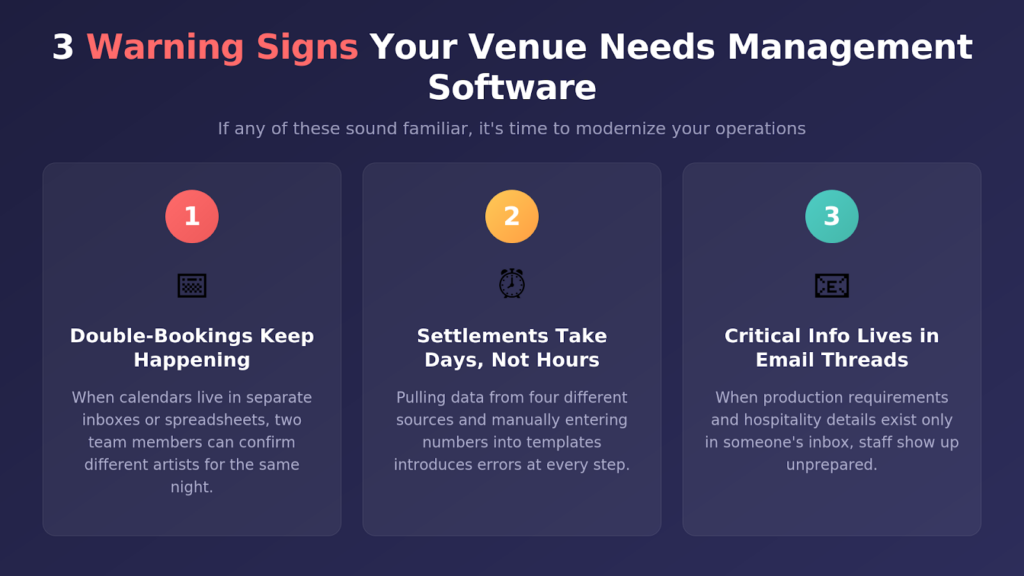
Double-bookings remain one of the most embarrassing and costly mistakes a venue can make. When calendars live in personal email accounts or shared spreadsheets without real-time updates, two team members can easily confirm different artists for the same night. The fallout damages relationships with agents, artists, and fans.
Financial tracking becomes a nightmare when ticket sales, bar revenue, merchandise splits, and artist guarantees live in separate systems. Settling a show shouldn’t require pulling data from four different sources and manually entering numbers into a settlement template. Yet that’s exactly how many venues still operate, introducing errors at every step.
Communication gaps create friction with artists and their teams. When production requirements, load-in times, and hospitality details exist only in someone’s inbox, the information doesn’t flow to everyone who needs it. Staff show up unprepared, artists get frustrated, and the venue’s reputation takes hits.
The cumulative effect is venue teams spending more time on administrative tasks than on the work that actually grows the business: booking compelling artists, marketing shows, and building relationships with fans and industry partners.
How Does Venue Management Software Transform Daily Operations?
Modern venue software attacks these problems by consolidating workflows and automating repetitive tasks. The transformation happens across several interconnected areas.
Unified Calendars for Show Scheduling
A shared calendar visible to every team member eliminates the confusion around what’s booked, what’s on hold, and what’s available. The best platforms distinguish between holds and confirms, allowing talent buyers to place multiple holds on a date without creating false conflicts. As negotiations progress, holds convert to confirmed shows with complete event details attached.
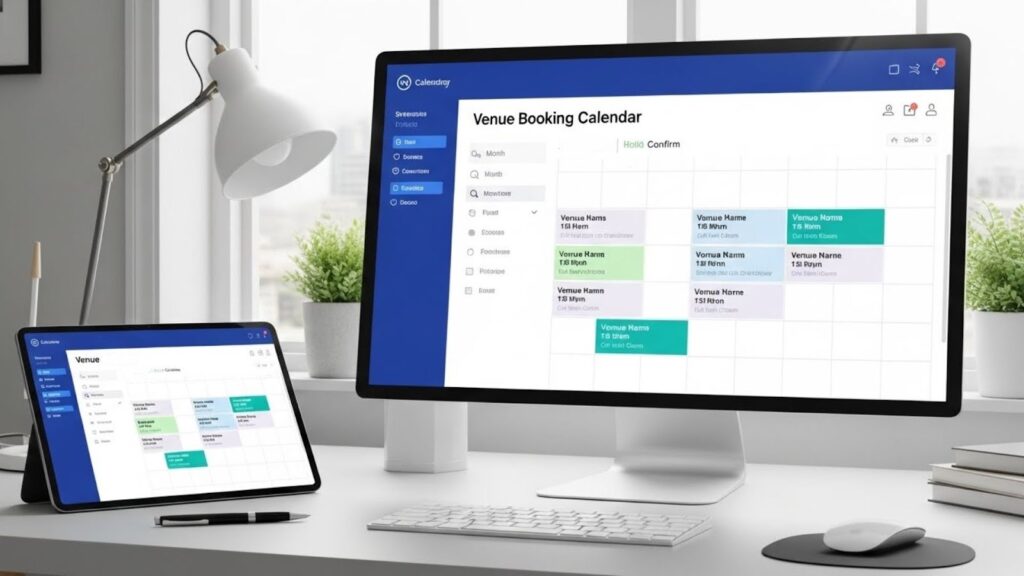
This approach to show scheduling prevents the back-and-forth of checking with colleagues before responding to booking inquiries. Team members see availability instantly, respond to agents faster, and capture opportunities that would otherwise go to more responsive competitors.
Automated Financial Tracking
When venue software integrates with ticketing platforms, real-time sales data flows directly into financial dashboards. No more waiting for end-of-night reports or manually entering ticket counts. As tickets sell, the numbers automatically update, giving you visibility into how a show is tracking before the doors even open.
This integration extends to settlements. Instead of building settlement documents from scratch for every show, the software pulls the relevant financial data into pre-built templates. Calculate artist payouts, account for expenses, and generate professional settlement documents in minutes rather than hours.
Streamlined Communication Channels
Rather than hunting through email threads for that one production rider attachment, venue software stores all event-related documents and conversations in one place. Production managers, talent buyers, marketing teams, and operations staff access the same information, eliminating the “I never got that email” problem.
Some platforms extend this connectivity beyond internal teams. Features that allow promoters or agents to view limited calendar information or place holds directly speed up the booking process and reduce friction with trusted partners.
Centralized Contact and Deal Management
Successful venues maintain relationships with hundreds of agents, artists, and promoters. Keeping track of past deals, preferred terms, and contact details requires more than a Rolodex. Venue software acts as a CRM specifically tailored to live entertainment, storing relationship history alongside contact information.
When an agent reaches out about a routing opportunity, you can instantly review past shows with their artists, see how those events performed financially, and make informed decisions about future offers. This historical context strengthens negotiations and helps avoid repeating mistakes.
5 Key Features That Define Effective Venue Software
When evaluating options, prioritize these capabilities that separate basic calendar tools from comprehensive venue solutions.
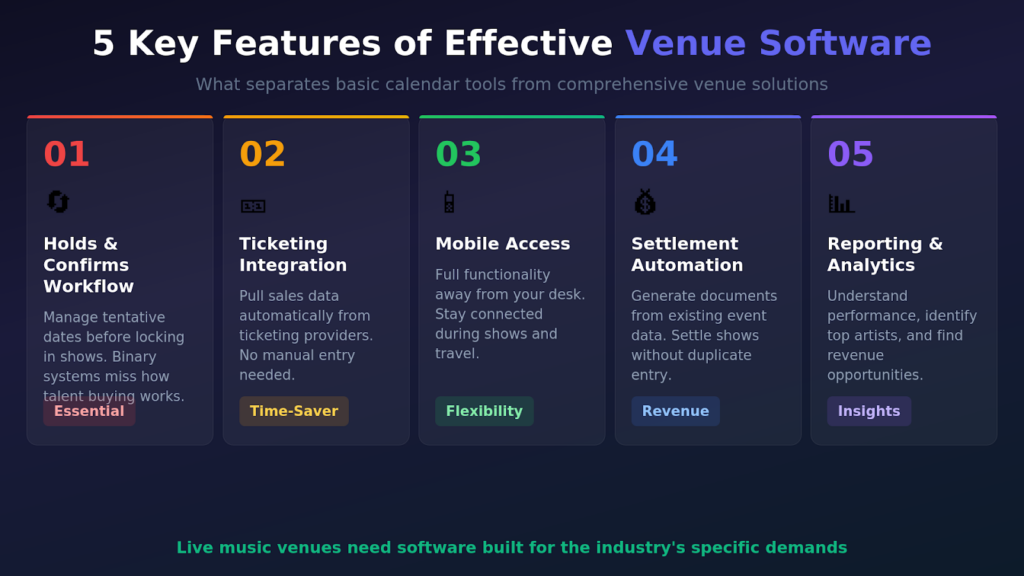
- Holds and Confirms Workflow: Live music bookings require managing multiple tentative dates before locking in shows. Software that treats every calendar entry as a binary “booked or not” misses the nuance of how talent buying actually works.
- Ticketing Integration: Manual ticket count collection wastes hours weekly. The right event operations platform automatically pulls sales data from major ticketing providers, updating your financials without manual intervention.
- Mobile Access: Venue managers spend considerable time away from desks, whether on the floor during shows, at conferences, or traveling between properties. Full mobile functionality ensures you’re never out of touch with your venue’s status.
- Settlement Automation: Settling shows quickly keeps artist relationships strong and cash flow predictable. Look for software that generates settlement documents from existing event data rather than requiring duplicate entry.
- Reporting and Analytics: Understanding which shows perform well, which artists draw repeat buyers, and where money gets lost requires data. The best platforms surface insights that help you book smarter shows over time.
Generic event management tools may offer some of these features, but they’re typically designed for corporate meetings or private events. Live music venues need software built by people who understand the industry’s specific demands.
Real-World Results: What Happens When Venues Modernize?
Consider a multi-venue operation managing dozens of rooms across various properties. Before adopting dedicated venue software, coordinating across teams meant constant phone calls, email check-ins, and the persistent anxiety that something was falling through the cracks.
After implementing a purpose-built platform, the transformation was dramatic. Booking that previously required back-and-forth across multiple people now happens through a shared system where everyone sees the same information. The talent buying team places holds without creating confusion. Finance tracks ticket sales in real time. Settlements that once took days now close within hours of the show.

One organization managing historic venues with complex programming described the shift as moving from a calendar tool to a comprehensive operational hub. They started with basic scheduling, then expanded to offers, settlements, and financial reporting. The platform grew with their needs rather than forcing them into a rigid structure.
The integration piece particularly transformed operations. Having ticketing data flow directly into the system meant eliminating manual errors and reducing the hours spent reconciling numbers after every show. Staff could finally focus on the work that matters instead of data entry.
These outcomes aren’t unique to large operations. Independent venues managing single rooms see similar efficiency gains. The scale differs, but the principle holds: time saved on administration is time available for the activities that actually grow revenue.
Frequently Asked Questions
What’s the difference between venue management software and generic event planning tools? Venue management software designed for live entertainment includes features specific to concert operations, like managing holds versus confirms, percentage-based artist deals, ticketing platform integrations, and settlement automation. Generic tools built for weddings or corporate events lack these specialized workflows, forcing venues to create workarounds or maintain separate systems.
How long does it typically take to implement new venue software? Implementation timelines vary based on operation size and complexity, but most venues begin seeing value within weeks rather than months. The key factor is data migration, specifically moving historical show information, contacts, and financial records into the new system. Platforms that offer guided onboarding and dedicated support accelerate the transition.
Can venue management software integrate with our existing ticketing provider? Leading platforms integrate with major ticketing providers used in live entertainment. These integrations pull real-time sales data directly into your financial tracking, eliminating manual ticket count collection. Before selecting software, confirm that your specific ticketing partner is supported or can be added to the integration roadmap.
Is venue management software cost-effective for smaller independent venues? The return typically comes through time savings rather than direct cost reduction. A single-room venue that saves five hours weekly on administrative tasks gains over 250 hours annually to invest in booking, marketing, and operations. For most venues, the efficiency gains exceed the software investment within the first year.
Take Control of Your Venue Operations
The live music industry shows no signs of slowing down. Research suggests a concert took place every 137 seconds across the UK in 2024, with consumer spending on live events jumping nearly 10% year-over-year. Venues positioned to capture this demand need operational systems that keep pace.
Spreadsheets and email served their purpose in a simpler era. Today’s venue operations demand tools designed for how live entertainment actually works. From managing complex hold patterns to automating settlements to integrating with ticketing partners, the right venue software becomes the backbone of a well-run operation.
Prism was built by live music professionals who experienced these challenges firsthand. The platform brings booking, scheduling, financial tracking, and team collaboration into one system designed specifically for venues and promoters. If your operation is ready to move beyond patchwork solutions, schedule a demo to see how the right software transforms daily operations.

Matt Ford is the founder and CEO of Prism.fm, an Austin-based software company revolutionizing live music event management. With a background in entrepreneurship and a degree from the University of Wisconsin-Madison School of Business, Ford combined his self-taught coding skills with firsthand experience as a concert promoter to address the inefficiencies he observed in the industry. In 2018, he launched Prism.fm, an all-in-one platform designed to streamline operations for venues, promoters, and agencies by replacing cumbersome spreadsheets with integrated tools for booking, financial tracking, and contract management. Under his leadership, Prism.fm has grown significantly, achieving $3 million in annual recurring revenue post-COVID and securing over $15 million in funding . Ford’s commitment to building user-centric solutions has positioned Prism.fm as a trusted partner for over 1,500 venues and promoters worldwide.
Related Post

How Event Talent Buying Works: Venues, Promoters, and Agencies
Event talent buying is the engine that keeps live music venues full and artists paid. If your team is still managing this process through scattered emails and spreadsheets, it’s time to modernize with purpose-built software.…

How Talent Buying Software Solves Promoter Pain Points
The right talent buying software turns booking chaos into streamlined operations, letting promoters focus on putting on great shows. Stop treating software as an expense; start treating it as the operational backbone that lets you…
Venue Management Software: The Key to Booking More Shows?
The live music industry is booming, but venues still running on spreadsheets and scattered emails are getting left behind. If your booking process still involves handwritten notes and hope, it’s time to level up or…