

What to Look for In Music Promoter Tools
The best music promoter tools are built around how promoters actually work, not how generic event software thinks they should.
- Most platforms marketed for “music promotion” are aimed at artists and fan marketing, not the operations side that promoters live in every day.
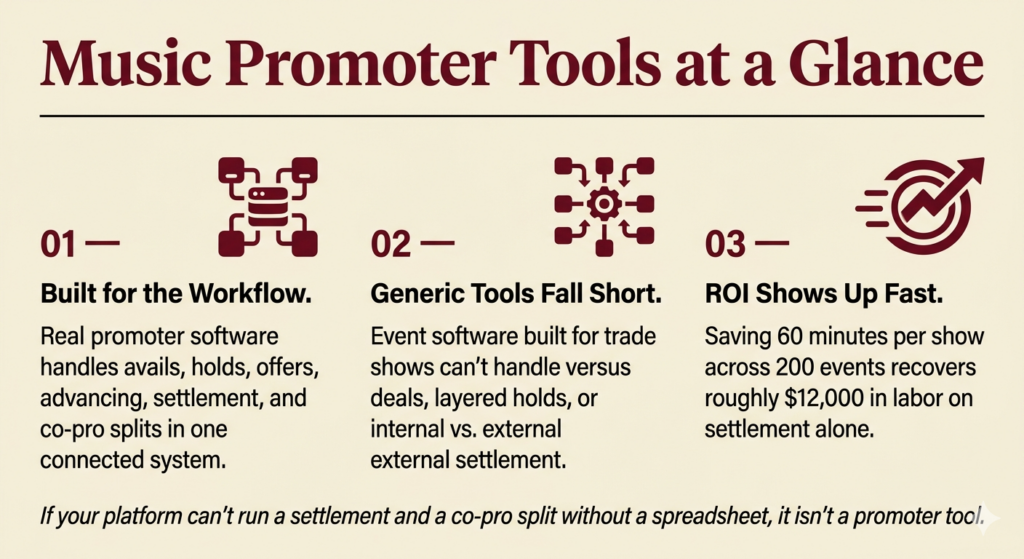
- Real promoter software handles the full workflow: avails, holds, offers, confirms, advancing, settlement, co-promotion splits, and reporting in one connected system.
- Generic event promotion software misses the pieces that matter most: versus deals, radius clauses, hold positions, internal vs. external settlement, and co-pro math.
If your platform can’t run a settlement and a co-pro split without a spreadsheet, it’s not a promoter tool. It’s a calendar with extra steps.
If you searched “music promoter tools” expecting a list of TikTok schedulers and email marketing apps, you’re in the wrong tab. We’re talking about the operations stack that real talent buyers, venue programmers, and concert promoters use to run their business. The kind of live music management software that turns avails, holds, offers, and settlements into one connected workflow instead of a spreadsheet graveyard.
According to Mordor Intelligence, the U.S. live music market reached $18.51 billion in 2025 and is projected to hit $26.93 billion by 2031. That growth comes with more shows, more partners, more deals, and exponentially more operational complexity.
This guide breaks down what real promoter platforms do, what to look for, and how to tell the difference between software that was built for live music and tools that just slapped “for venues” on the homepage.
What Are Music Promoter Tools?
Music promoter tools are software platforms that handle the business side of putting on live shows. They cover the work that happens between booking an artist and cutting the final check, including calendar and avails, holds and offers, contracts and advancing, settlements, financials, and reporting.
“Music promotion” usually points to artist-facing marketing tools like streaming pitches, social schedulers, email blasts, and playlist services. Those tools matter for releases, but they don’t run a show.
The promoter side is operational. You’re managing dozens or hundreds of moving deals at once, from holds and offers to contracts, advancements, settlements, and payouts. Every one of those steps used to live in its own spreadsheet. Modern platforms for music promoters collapse them into a single connected workflow.
How Are Promoter Platforms Different From Event Promotion Software?
Generic event software handles registrations, ticketing, and basic check-in for conferences, weddings, and corporate gatherings. It’s built around a one-time event with a flat attendee list. That model breaks the second you try to run a music venue through it.
Live music has its own grammar. You hold dates before you confirm them. You stack first, second, and third holds on the same date. You write versus deals where the artist gets the better of a guarantee or a percentage. You build internal and external settlements that look different on purpose. You split P&L with co-promoters on shared revenue and shared costs. You track radius clauses, NBOR vs. GBOR, split points, and walkout potentials. None of that exists in event management software built for trade shows.
Why Do Promoters Need Specialized Software In the First Place?
Promoters operate in a margin-thin, high-velocity industry where one missed hold can cost a routing date and one bad settlement can cost a relationship. Money moves through workflows that the average tech platform was never designed to handle.
The most common pain points sound the same across every venue, agency, and PAC out there:
- Lost time switching between calendar apps, email, accounting software, document storage, and ticketing dashboards
- Settlement errors caused by manual data entry between ticketing reports and internal P&L
- Holds and avails miscommunicated across team members, leading to double-booked dates or lost offers
- Co-promoter disputes because the numbers lived in someone’s personal spreadsheet
- Zero historical context when negotiating new deals because past show data is buried in old emails
The Pabst Theater Group’s case study is a clean example. Across six venues and thousands of events, the team consolidated booking, advancing, and settlement into one platform and pulled hours back into the week that used to disappear into spreadsheet reconciliation. The ROI of dedicated promoter software is that the operational drag goes away.
What Workflows Should Promoter Software Handle?
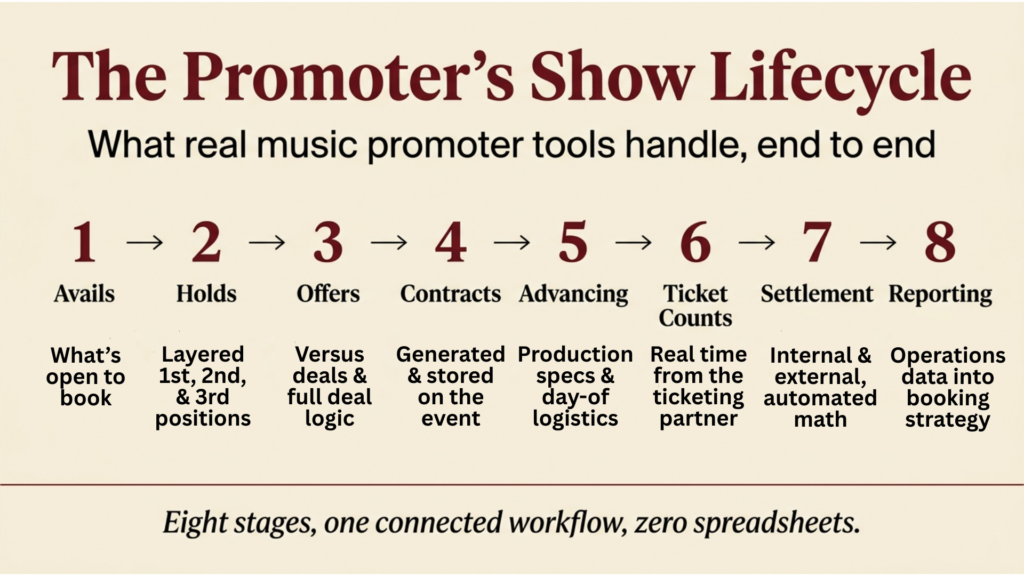
The fastest way to evaluate any platform calling itself a promoter solution is to walk it through the show lifecycle and see where it breaks. A real platform handles all of it. A pretender handles two or three of these and waves at the rest.

Calendar and Avails Management
Your calendar is the spine of the operation. It has to show every venue, hold position, confirmed show, rental, and internal block in one view. Multiple users have to be able to act on it simultaneously without overwriting each other. Filters need to let you pull “all third holds in November” or “all confirmed shows above $50K guarantee” in two clicks.
If your tool can’t show you exactly what’s happening across your rooms in a single screen, it’s not carrying its weight.
Holds and Offers
The hold-and-offer flow is where most generic platforms fail. Live music runs on layered holds, where multiple agents can sit on the same date in different positions, and the booker needs the ability to challenge, release, or confirm those holds with a clear audit trail. Offers need to flow directly out of the hold record so that deal terms, financial assumptions, and approval status are tied to the date from day one.
You should be able to build an offer with full deal logic (guarantee, versus percentage, walkout, bonuses, ticket scaling, fees, taxes) in one screen and send it out from the same record where the hold lives. Anything less is a workflow break.
Contracts and Document Management
Once an offer is accepted, contracts move fast. The platform should generate, store, and version contracts on the event record so that the artist’s deal, rider, and confirmation history are one click away. Document chaos is one of the most expensive forms of operational drag, and it’s the first thing real concert promotion tools eliminate.
Advancing
Advancing is the final stretch of preparation before a show, involving confirming load-in, hospitality, production specs, settlement terms, and day-of logistics. It usually happens through a flurry of emails between the venue, the artist’s tour manager, and the production crew. A good platform centralizes advancing into structured forms attached to the event, so nothing gets missed and last-minute changes are visible to the whole team.
Real-Time Ticket Counts
Ticket sales should automatically flow into your platform from your ticketing partner, so you’re never refreshing a separate dashboard. Real-time counts feed your forecasts, day-of-show projections, and settlement calculations without any manual entry.
Settlement (Internal and External)
Settlement is the moment of truth. The right platform handles internal settlement (your venue’s actual P&L on the show) and external settlement (the version you walk through with the artist or tour manager) as separate but linked outputs from the same data. Adjustments, comp tickets, taxes, fees, marketing co-op, and bonuses all calculate automatically.
Co-Promotion Splits
If you partner on shows, your platform has to handle co-pro deals natively. That means percentage splits on profit and loss, per-ticket bonuses, partner-specific revenue inclusions, and a clean settlement output that shows what each party earned and what they owe. The Auditorium Theater’s co-promotion case study is an example of this in practice. The team runs co-pro shows through the same workflow as their internal events and settles partners without rebuilding the math from scratch.
Reporting and Analytics
Promoters should be tracking year-over-year revenue, profitability by genre, talent buyer performance, venue utilization, which agents bring the best margin, and which artists they’ve lost money on twice and shouldn’t book a third time. Reporting turns operations data into a booking strategy.
What Features Should You Look for in Music Promoter Tools?
The full feature checklist gets long. Here are the eight that actually move the needle, in order of impact.
- Industry-native deal logic. Versus deals, walkouts, NBOR/GBOR, split points, radius clauses, and co-pro splits. If the platform doesn’t speak this language out of the box, you’re going to bend the software to fit and lose half the value.
- Integrated financials. Real-time ticket sales feeding actuals, automated tax and fee calculations, internal vs. external settlement views, and clean exports for accounting. The financial layer can’t be an afterthought.
- Hold positioning and conflict detection. First, second, and third holds on the same date with automatic conflict alerts and a clean challenge/release flow.
- Mobile parity. You’re advancing from the green room, holding dates from a cab, and confirming offers from an airport. The mobile experience needs to be a first-class version of the desktop one.
- Permissions and team collaboration. Granular access controls so external partners, accounting, marketing, and production each see what they need without seeing everything.
- Ticketing integrations. Direct, automated integrations with the ticketing platforms you actually use with real two-way data flow.
- Document and contract management on the event record. Every artifact is tied to the show it belongs to.
- Reporting that you’ll actually open. Dashboards with the answers you need on Monday morning, not a 40-tab export that nobody touches.
What Should You Watch Out For?
Some red flags that a platform was not built for promoters, even when the marketing copy says it was:
- The settlement requires a CSV export to Excel to finish the math
- “Co-promotion” is mentioned in marketing but doesn’t have a dedicated workflow
- The calendar can’t display multiple hold positions on the same date
- You can’t generate a clean external settlement document in a single click
- The platform charges per ticket sold or takes a cut of revenue (it should be a flat subscription)
How Does the Software Pay For Itself?
Take a mid-sized promoter running 200 shows a year. Conservatively, manual settlement and reconciliation across spreadsheets, ticketing reports, and accounting takes about 90 minutes per show. That’s 300 hours a year just on settlement, before you count the time spent chasing avails, advancing through email, and rebuilding co-pro calculations from scratch every month.
Move that workflow into a connected platform that automatically ingests ticket sales and runs settlement off live data, and you can compress those 90 minutes down to 20 to 30 per show. Call it a conservative 60 minutes saved per event. At 200 shows, that’s 200 hours back in the year per booker or operations lead. At a fully loaded labor cost of $60 per hour, that’s $12,000 in recovered time on settlement alone, before you account for fewer errors, faster offer turnarounds, and better booking decisions from cleaner historical data.
ROI shows up fast for any promoter doing serious volume. Rising Sun’s success story reports a 4x efficiency gain after consolidating their workflow, which lines up with the predictions of eliminating spreadsheet handoffs.
What Does Data-Driven Booking Look Like?
The other half of the value is on the booking side. Once your tools are running, they generate the historical data that lets you negotiate and route smarter. Past show grosses by venue, genre, and day of week. Walkout history with specific agents. Average draw for an artist in your market. Margin trends across your room.
The next layer up is shared box office data. Industry data-sharing platforms pool real, opt-in box office reports across hundreds of venues so you can see how artists performed in comparable markets, not just what their agent claims they grossed. That leverage turns guesswork into negotiation.
According to Music Business Worldwide, Live Nation reported $25.2 billion in revenue and 159 million attendees in 2025. The companies operating at that scale are winning on data infrastructure. Independent operators who adopt the same kind of infrastructure compete on much better footing.
How Do You Choose the Right Platform for Your Operation?
Three filters separate platforms that will actually work for you from ones that will frustrate you in six months.
Does It Speak Live Music?
Open the demo and ask the rep to walk you through holding a date with three positions, building an offer with a versus deal, advancing the show, and settling it with a co-promoter. If they have to apologize for any step in that flow, the platform isn’t built for you.
Can Your Whole Team Live In It?
Booking, marketing, production, finance, and external partners all need different views of the same show. The platform should support that without exposing sensitive deal info to people who shouldn’t see it. If your team is going to keep a shadow spreadsheet for the parts the software can’t handle, you haven’t actually solved anything.
Is It Built On Real Industry Relationships?
The strongest concert promotion tools come from teams that have either run venues themselves or built the platform alongside live music operators. That expertise shows up in product decisions. You can feel it within ten minutes of a demo. Generic platforms, even the polished kind, never quite get there.
McMenamins’ case study is a useful reference point. They consolidated dozens of properties onto one booking and operations system specifically because the platform understood multi-venue programming the way they actually run it.
What Trends Are Reshaping These Tools?
Three things are happening right now that anyone evaluating these platforms should keep in mind.
First, the broader event management software market is on a steep curve. Grand View Research pegs it at $8.4 billion in 2024 and projects $17.33 billion by 2030, with cloud-based platforms accounting for 63% of deployments. That growth pulls a lot of generic options into the conversation, and most of them aren’t built for music. Buyer beware.
Second, mobile and cloud parity is the new minimum. Promoters work from the road, the venue, and home. Any platform that treats mobile as a stripped-down version of the desktop experience is a non-starter.
Third, integrations and data sharing are becoming a competitive moat. The platforms that connect natively to ticketing systems, accounting tools, and shared box office data networks are the ones that pull ahead.
Ready to Run On Software That Actually Speaks the Industry?
If you’re tired of duct-taping spreadsheets to your calendar, advancing through email, and rebuilding co-pro math every Monday morning, the answer is purpose-built software, not another generic event tool. Prism is the live music industry’s all-in-one platform for promoters, talent buyers, agencies, and venues, powering hundreds of thousands of events at over 10,000 venues worldwide. From holds and offers to settlements and co-promotion, it’s built around the workflow you actually run. Get started with a demo and see what your operation looks like when every show lives on one record.
Frequently Asked Questions
What’s the difference between music promoter tools and music promotion tools?
Music promoter tools handle the business and operations side of putting on shows: calendar, holds, offers, contracts, advancing, settlement, and reporting. Music promotion tools usually refer to artist-facing marketing software like social schedulers, streaming pitch services, and email platforms. Promoters often use both, but the operations stack is what runs the business.
Can I use generic event promotion software to run a music venue?
You can, but you’ll lose most of the value. Generic platforms lack the deal logic that live music runs on (holds, versus deals, walkouts, co-promotion splits, internal vs. external settlement). Most teams that try it end up keeping a shadow spreadsheet for the missing pieces, which defeats the purpose of having a platform at all.
Are these tools worth it for an independent venue?
Yes, especially for independents. Smaller teams have less margin for error and less administrative bandwidth, which means manual workflows hurt more. The right platform pays for itself quickly through time savings on settlement, fewer ticketing reconciliation errors, and better booking decisions driven by real data.
How long does it take to onboard onto a new platform?
A typical onboarding runs four to eight weeks, depending on team size and how much historical data you want to migrate. Most teams start running new shows on the platform within the first two weeks, with historical data and reporting layered in after that.
What integrations should I expect from quality promoter software?
At a minimum, real-time ticketing integration with the major platforms you use, accounting integrations for syncing financials, and document storage integrations for contracts. Anything less than that means you’re stuck on manual data entry, which is exactly the problem the software is supposed to solve.

Matt Ford is the founder and CEO of Prism.fm, a platform built to help the live music industry operate with more clarity and confidence. After 15+ years running venues, producing festivals, and promoting shows, Matt saw firsthand how much of the business relied on fragmented tools and guesswork. He founded Prism in 2018 to change that.
Today, Prism powers more than 3,000 venues and 330 organizations nationwide, serving as an all-in-one platform designed to streamline operations by replacing cumbersome spreadsheets with integrated tools for booking, financial tracking, and contract management. Matt has also led the development of Insights, Prism’s demand prediction platform, which uses real, verified ticketing data to help teams better understand artist performance and make smarter decisions before committing to a show.
Related Post
Concert Budget Template: How to Plan Profitable Events in 2026
A concert budget template only works when it connects planning, ticketing, and settlement into one live picture of the show. If your budget template can’t model a versus deal and a co-promotion split in real…

What Is Venue Management Software? Features, Benefits & Best Tools
Generic management software wasn’t built for live music. The platforms that win are built specifically for how concerts, theaters, and clubs actually operate. If you operate a music venue, theater, club, amphitheater, or PAC, pick…
How Venue Management Software Can Automate Scheduling & Reporting
Venue management software eliminates the chaos of spreadsheets and manual processes that drain live music operators of time and money. The venues pulling ahead are treating technology as an operational advantage rather than an afterthought.…