
Real-Time Scheduling Software for Venues Explained
Venue owners are picking up real-time scheduling software to solve chronic operational headaches.
- Traditional scheduling methods create operational inefficiencies and costly communication failures.
- Real-time systems eliminate booking conflicts while reducing administrative overhead.
- Automated schedule coordination prevents last-minute surprises that damage your venue’s reputation.
Smart venue owners gain competitive advantages through integrated live venue software platforms.
The live music industry moves at breakneck speed, but most venue operators are still managing their calendars like it’s 2010. While artists tour globally with million-dollar production schedules, venues juggle multiple spreadsheets, email chains, and phone calls just to confirm a Tuesday night show.
This disconnect between industry sophistication and venue management reality is driving a massive shift toward real-time scheduling software for venues.
The event management software market is projected to expand from $15.5 billion in 2024 to $34.7 billion by 2029, with a 17.4% annual growth rate. The industry is recognizing that traditional scheduling methods can’t handle modern venue demands.
What Are the Hidden Costs of Manual Scheduling?
Traditional venue scheduling creates a perfect storm of operational inefficiencies that most venue owners underestimate. Beyond the obvious time drain, manual processes generate cascading problems that ripple through every aspect of venue operations.
Manual scheduling systems create costly bottlenecks. Venue operators spend an average of 34% of their workday on scheduling tasks that automation could handle instantly. These minor inconveniences are revenue killers disguised as routine operations.
Double-bookings can force venues to relocate shows with minimal notice, creating financial damage beyond refunded tickets. Venues face potential artist penalties, damaged relationships with booking agents, and negative publicity that affects future bookings.
Manual communication chains compound these problems. A single scheduling change triggers dozens of phone calls, email threads, and text messages across multiple stakeholders. By the time everyone receives updated information, the original problem has often evolved into something completely different.

Consider the typical venue scheduling workflow: spreadsheet updates, manual calendar synchronization, individual notifications to team members, separate communications to artists and their management, vendor coordination calls, and finally, hoping nothing got lost in translation. Each step introduces potential failure points that can derail entire events.
Why Real-Time Scheduling Software for Venues Is No Longer Optional
The live music industry has reached a point where venue schedule automation is essential for survival. Modern touring schedules move at unprecedented speed, with artists making routing decisions based on real-time availability rather than traditional advance planning cycles.
Booking agents expect instant responses to holds and offers. When a venue can’t provide immediate calendar confirmation, agents simply move to the next option on their list. Real-time scheduling software for venues eliminates this disadvantage by providing instant, accurate availability.
Artist schedule syncing is vital as tours become more complex and compressed. Major acts often juggle multiple venue options across different markets while managing production logistics, travel schedules, and marketing timelines. Venues that can instantly confirm availability and automatically update all stakeholders gain a significant advantage in securing prime bookings.
The stakes continue rising as venue competition intensifies. Cities that once supported a handful of live music spaces now host dozens of venues, each fighting for the same pool of touring acts. Operational efficiency directly translates to booking wins and revenue growth.
Smart venue operators recognize that real-time capabilities extend beyond basic scheduling. Modern systems integrate with ticketing platforms, production companies, and marketing teams to create seamless workflows that adapt without manual intervention.
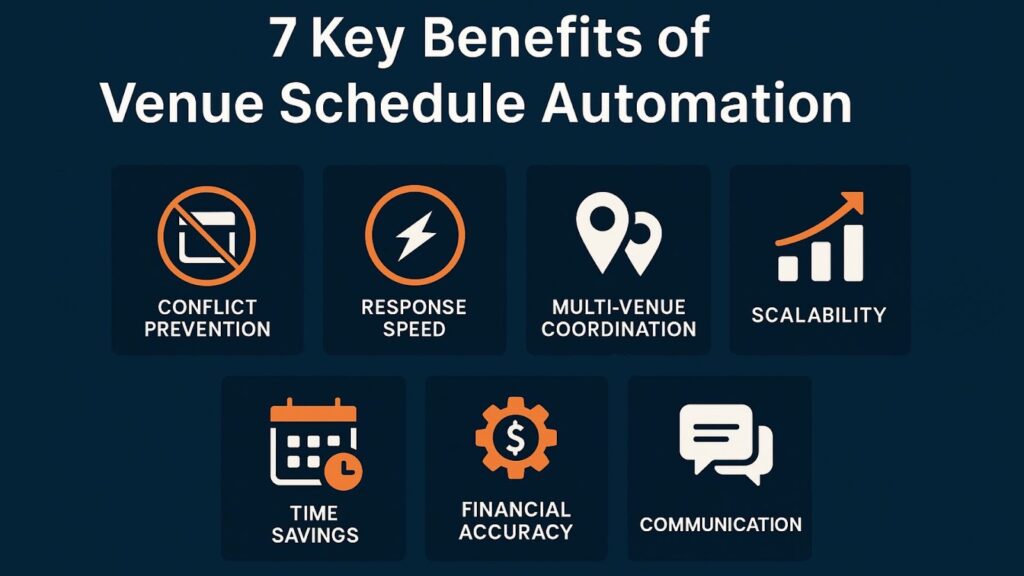
7 Game-Changing Benefits of Venue Schedule Automation
Venue schedule automation delivers measurable improvements across every aspect of live music operations. These benefits compound over time, creating competitive advantages that become impossible for manual competitors to match.
1. Eliminate Scheduling Conflicts Before They Happen
Automated systems prevent double-bookings through intelligent conflict detection that operates 24/7. When booking agents submit holds or confirm shows, the system instantly identifies potential conflicts and suggests alternative solutions. This proactive approach helps venues reduce scheduling conflicts while maintaining stronger relationships with industry pros.
2. Accelerate Response Times to Critical Opportunities
Live venue software enables instant responses to booking inquiries, turning potential missed opportunities into confirmed revenue. Instead of waiting hours or days for manual schedule verification, venues can provide immediate answers that keep them competitive.
3. Streamline Multi-Venue Coordination
Operators managing multiple spaces benefit enormously from centralized scheduling systems that simultaneously provide a bird’s-eye view of all properties. This visibility enables strategic decisions about show placement, resource allocation, and revenue optimization across entire venue portfolios.
4. Reduce Administrative Overhead
Automation eliminates repetitive tasks that consume valuable staff time. Venue managers report saving hours weekly when automation handles routine scheduling, deadline tracking, and stakeholder notifications.
5. Improve Financial Accuracy and Tracking
Real-time financial integration ensures that scheduling decisions are immediately reflected in revenue projections and expense tracking. This transparency enables better business decisions and reduces the accounting errors that plague manual systems.
6. Enhance Communication Across All Stakeholders
Automated notification systems keep everyone informed without overwhelming team members with unnecessary updates. Relevant parties receive targeted communications based on their roles and responsibilities, creating a cleaner information flow.
7. Scale Operations Without Proportional Staff Increases
Venues can handle more bookings with existing staff when automation manages routine tasks. This scalability is vital as venues grow or during peak booking seasons when manual systems typically break down.

User Access Controls: The Overlooked Game-Changer
One of the most undervalued aspects of modern scheduling systems is user access controls that enable secure collaboration without compromising sensitive information.
Effective access controls allow venues to grant calendar viewing permissions to trusted promoters while restricting financial data to internal team members. Booking agents can check availability and submit holds without accessing competitor information or confidential venue operations data.
Granular permission systems enable venue managers to create custom access levels for different team roles. Production managers might see technical requirements and load-in schedules while box office staff access ticket sales data and capacity information. Marketing teams can view promotional deadlines without accessing artist financial terms.
Access controls create audit trails that track who made specific changes and when those modifications occurred. This transparency proves invaluable when investigating scheduling discrepancies or resolving disputes about booking terms.
Modern systems also support temporary access grants for freelance staff, guest users, or project-specific collaborators. These time-limited permissions ensure that external parties can contribute to specific events without gaining ongoing access to venue operations.
Industry Momentum Behind Real-Time Adoption
The live music industry’s migration toward real-time scheduling reflects broader technological maturation that’s reshaping how venues operate.
Touring economics have become complex, with artists facing higher costs and shorter profit windows. Efficient venues that can quickly adapt to routing changes become preferred partners for artists and agents managing tight logistics.
The rise of festival culture has created new scheduling challenges that manual systems can’t handle. Multi-day events with multiple stages require complicated coordination. Real-time systems tackle the scheduling orchestration that modern festivals demand.
Artist schedule syncing has become particularly important as musicians increasingly manage their own booking alongside traditional representation. Artists expect direct access to scheduling information and the ability to track their tour logistics in real time.
Social media amplification means that scheduling mistakes become public relations disasters much faster than in previous decades. Venues can’t afford the reputational damage that comes from preventable booking conflicts or communication failures.
Automation tools have delivered ROI improvements between 30% and 300% across multiple industries, with companies reporting productivity gains and cost reductions. Implementation is just a matter of smart planning.
How to Successfully Make the Switch
Start by auditing current scheduling processes to identify the biggest pain points and inefficiencies. Document existing workflows, communication patterns, and data sources to understand what needs to be replicated or improved in the new system. This baseline assessment helps prioritize features and identify integration requirements.
Choose systems that integrate with existing tools rather than requiring complete operational overhauls. The best venue management platforms connect with current ticketing systems, accounting software, and communication tools to create unified workflows.
Plan for gradual rollouts that allow staff to adapt to new processes without overwhelming them. Begin with basic scheduling functions before adding advanced features like automated reporting or financial integration. This way progressively builds confidence and competency.
Establish clear protocols for data migration, backup procedures, and system maintenance. Venues can’t afford scheduling downtime, so robust technical support and redundancy planning are essential.
Train key team members thoroughly before full implementation, focusing on technical skills and process changes. Create documentation that supports ongoing training for new staff members and reference during complex scenarios.
Frequently Asked Questions
What’s the difference between real-time scheduling software for venues and basic calendar systems?
Real-time scheduling software provides instant updates across all users and integrates with other business systems, while basic calendars require manual updates and operate in isolation. Real-time systems also include automated conflict detection, stakeholder notifications, and business intelligence features that basic calendars lack.
How quickly can venues typically implement real-time scheduling systems?
Most venues complete implementation within weeks, including data migration, staff training, and system testing. The timeline depends on existing system complexity and integration requirements, but modern platforms are designed for rapid deployment with minimal operational disruption.
Do real-time systems work for venues with unique booking requirements?
Yes, modern real-time scheduling platforms offer extensive customization options that accommodate different venue types, booking processes, and business models. The best systems adapt to existing workflows rather than forcing venues to change their operational approaches.
What happens if the scheduling system experiences downtime?
Professional-grade systems include redundancy, backup procedures, and offline capabilities that maintain operations during technical issues. Most platforms guarantee 99.9% uptime and provide immediate technical support for critical situations.
Transform Your Venue Operations Today
Manual scheduling is over. Owners who embrace real-time scheduling software for venues position themselves for sustainable growth while their competitors struggle with outdated processes that limit their potential.
The benefits are clear: eliminate administrative overhead, prevent costly scheduling conflicts, accelerate booking responses, and improve stakeholder communication. These advantages compound monthly, creating advantages that become impossible to match.Prism’s venue software was built specifically for the live music industry by professionals who understand the unique challenges venue operators face daily. Our real-time scheduling platform integrates seamlessly with existing operations while providing the automation and efficiency tools that modern venues require to thrive. Get started today with a free demo.

Matt Ford is the founder and CEO of Prism.fm, an Austin-based software company revolutionizing live music event management. With a background in entrepreneurship and a degree from the University of Wisconsin-Madison School of Business, Ford combined his self-taught coding skills with firsthand experience as a concert promoter to address the inefficiencies he observed in the industry. In 2018, he launched Prism.fm, an all-in-one platform designed to streamline operations for venues, promoters, and agencies by replacing cumbersome spreadsheets with integrated tools for booking, financial tracking, and contract management. Under his leadership, Prism.fm has grown significantly, achieving $3 million in annual recurring revenue post-COVID and securing over $15 million in funding . Ford’s commitment to building user-centric solutions has positioned Prism.fm as a trusted partner for over 1,500 venues and promoters worldwide.
Related Post

Why Venue Management Software Is Replacing Spreadsheets
The spreadsheet era is over for serious venue operators. The shift from manual processes to automated platforms is essential for achieving a competitive advantage. The live music industry is experiencing a massive resurgence. With global…

How to Choose the Right Music Venue Booking Software
Modern music venues need sophisticated booking systems to compete in the industry. Choose specialized music venue software over enterprise solutions for better ROI and user experience. How is your music venue currently handling the booking…
Top 10 Features Every Music Venue Management Software Should Have
The live music industry is experiencing unprecedented growth, with global revenues reaching over $33 billion in 2023, marking a 25% increase from the previous year. This surge in live events has created both opportunities and…